Showing posts with label Charles Dickens House. Show all posts

Friday, June 9, 2017

A Week of Dickens: Resources on His Life, Works, Walks, and London


Charles Dickens was enormously popular around the world during his lifetime, and it’s no surprise that a veritable wealth of information exists on his life and writings.

I’d suggest starting with at least some of his books. Every one of his novels and collections of his articles are still in print, testifying to the man’s enduring literary legacy. I first started reading Dickens in high school for class assignments, and of course we read paperback editions. You can find them at the local bookstore or on Amazon, Barnes & Noble and Book Depository (which, based in the UK, has free shipping worldwide). If you have an Amazon Kindle, you can buy the entire collection of his works for $1.99, via Doma Publishing House.

I’ve been reading Dickens’s novels using the Oxford Illustrated Dickens edition. It was first published more than 20 years ago, and my copies still look brand new.

Biographies

Hundreds of biographies of Dickens have been written, beginning shortly after his death/ His friend John Forster, who received a considerable amount of Dickens’s private papers, published one of the first, The Life of Charles Dickens. It’s still available in both print and digital formats. It was this biography that first disclosed that Dickens had worked as a child in a London blacking factory, pasting labels on bottles of shoe publish. Dickens used that experience for David Copperfield, and it was one that he was deeply ashamed of and humiliated by.

One of the best biographers of Dickens was G.K. Chesterton, whose Charles Dickens: The Last of the Great Men was first published in 1903 and reprinted many times. For a publication of Dickens’s works in 1911, Chesterton also wrote the introductions for each of the volumes, and these were later collected and published separately as Appreciations and Criticisms of the Works of Charles Dickens.

Another notable biography is Dickens (1991) by Peter Ackroyd. It’s mammoth – almost 1,200 pages, including more than 100 pages of notes and index. Ackroyd also wrote Dickens: Public Life and Private Passions (2002). Michael Slater has also written a fine biography, Charles Dickens (2009), in addition to several other books on the author. More recently Claire Tomalin published Charles Dickens: A Life (2011).

Online Resources

The Dickens Fellowship maintains an online site, and it also publishes The Dickensian.

The Charles Dickens Museum in Bloomsbury
If you travel London, you should visit the Charles Dickens Museum at 48 Doughty Street in Bloomsbury. I’ve been three times, and if we return to London, there will be a fourth visit. (See below for a video about the museum). I posted about the museum on this blog in 2013.

The University of Buckingham maintains the Dickens Journals Online project, which includes the various journals Dickens edited and wrote for.

BBC Radio has a relatively short broadcast (about six minutes) on “Charles Dickens: Campaigning Reporter.” And BBC maintains a biographical entry for Dickens, as does Biography.

I’ve reviewed several books here about Dickens and various aspects of his life and writings, including Becoming Dickens by Robert-Douglas-Fairhurst; Charles Dickens by Simon Callow; God and Charles Dickens by Gary Colledge; and reviews of A Christmas Carol, The Chimes, and The Cricket on the Hearth. I also reviewed David Copperfield and Oliver Twist at Tweetspeak Poetry.

Dickens Walks in London

Writers have been writing about Dickens and London for a long time. I have a 1908 edition of Dickens’ London by Francis Miltoun, that provides some idea of what Dickens knew that still existed at the turn of the 20th century. Times (and London) have changed, however.

If you go to London, several books are available that explain how to “walk the London of Charles Dickens.” Two published in 2012 and still in date are Walking Dickens’ London by Lee Jackson and A Guide to Dickens’ London by Daniel Tyler. A collection of Dickens’s own descriptions of walking London at night can be found in Night Walks, published by Penguin.

The City of London and the Charles Dickens Museum have collaborated on a brochure guide entitled “Chickens’ ‘Magic Lantern,’” a walk-it-yourself tour of the key areas in the city associated with Dickens. The brochure is available at the Tourist Information Office on Cannon Street across from St. Paul’s Cathedral.

There are also several guided Dickens walks and tours available:  one with Richard Johnson, author of Walking Dickensian London; Walks of London; and one hosted by the Charles Dickens Museum.

The Charles Dickens Museum in London


Top photograph: a studio portrait of Charles Dickens.

Monday, June 5, 2017

A Week of Dickens: “Charles Dickens” by Lucinda Dickens Hawksley


When we were planning our visit to London in 2012, one of the sites I was looking forward to seeing was the Charles Dickens Museum in Bloomsbury. The year 2012 marked the 200th anniversary of his birth, and I knew the museum must have been planning a number of events and special exhibits.

Except it wasn’t. The museum was closed in 2012 for remodeling. Bad timing.

I did see it in 2013 (and 2014 and 12015 as well). Located at 48 Doughty Street, it is a townhouse where Dickens lived with his family from 1837 to 1841, and the only Dickens residence in London still standing. There are five floors, including the basement, so you’re climbing a lot of stairs (an elevator is available for several floors). The gift shop is small but packed with all things Dickens. In 2013, I noticed a scrapbook-like book that celebrated what the British call the bicentenary of Dickens’s birth. It was a bit expensive and so I passed.

I saw it again (with fewer available) in 2014 and (fewer still) 2015. A few months ago, I found it on sale for a very reasonable price (and free shipping from England).

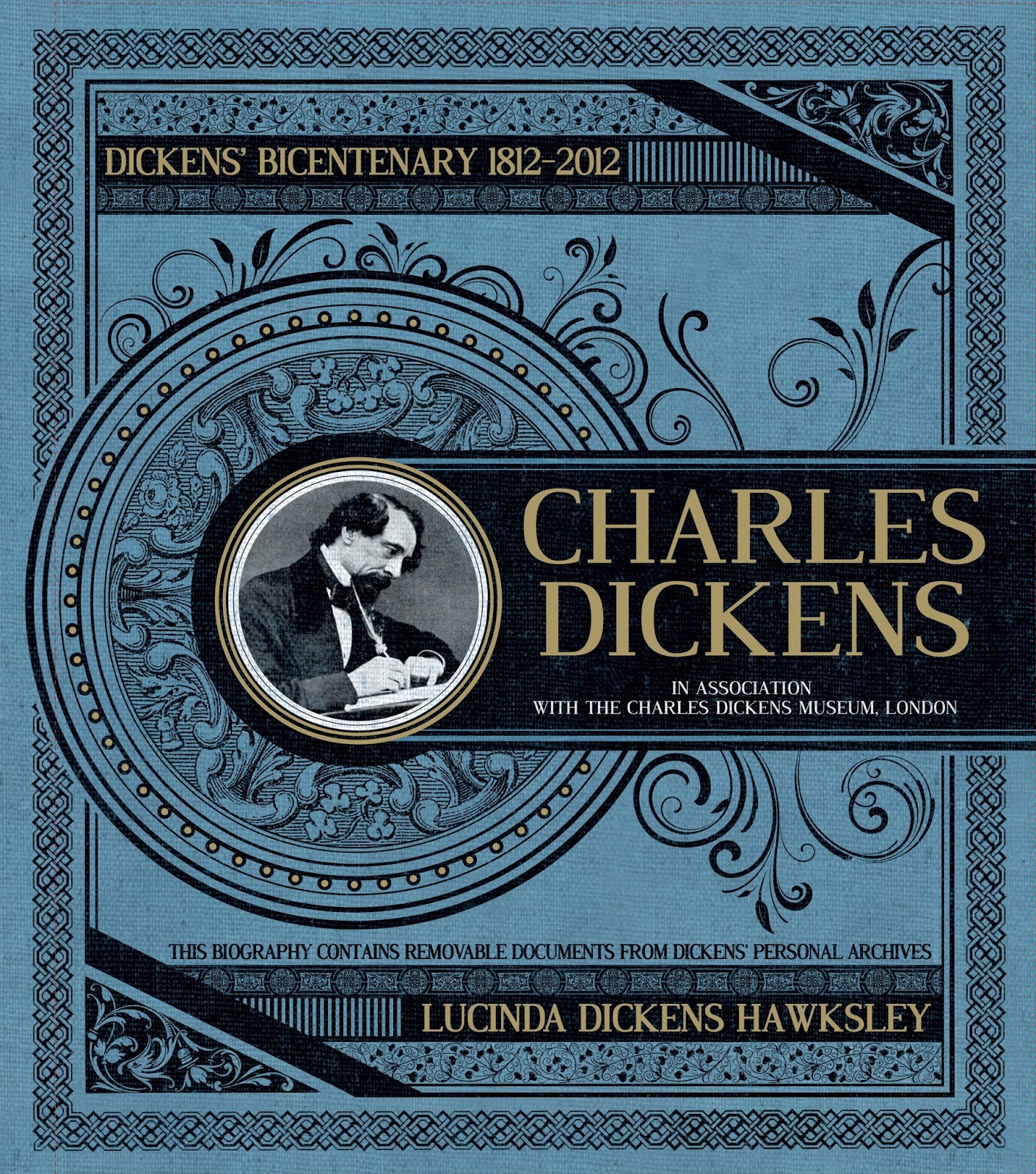
Charles Dickens: The Dickens Bicentenary 1812-2012 is written by a descendant of the writer, Lucinda Dickens Hawksley. It is not an exhaustive, detailed biography. Instead, roughly the size of a scrapbook, it is a volume of 39 short chapters about Dickens’s life, works, family, friends, social issues he was involved in, and legacy. In addition, the work includes four “envelope pages,” containing facsimiles of letters, photographs, calling cards, theater playbills, excerpts of the magazines that carried his serialized stories, a front page of the newspaper he published, portions of manuscripts, and even his will.

Yes, they are reproductions and facsimiles, but there’s something fascinating about holding a copy of the first serialized number of Bleak House (priced at one shilling), including the illustrations and advertisements, that gives a Dickens fan a minor thrill. You’re seeing the first two chapters of the novel just as the original readers did when they were published in March of 1852. The ads, by the way, are for waterproof overcoats from Edmiston & Son on the Strand and bedsteads by Heal & Son on Tottenham Court Road.
Lucinda Dickens Hawksley

And the Dickens calling cards, which no gentleman or lady went without when visiting friends and acquaintances, each include a different photograph.


Charles Dickens has numerous photographs and illustrations, in addition to the envelope facsimiles. With the concise chapter texts, it is a very visual and tactile way to experience the life and times of Dickens.


A Week of Dickens: For no ostensible reason other than I like the man’s writings and novels, each post this week will be about Dickens or his writings. Featured tomorrow is a review of Oliver Twist, published at Tweetspeak Poetry.


Top photograph: Charles Dickens in his late 40s.

Friday, December 6, 2013

Finding “The Genius of Dickens” at the Charles Dickens House


When we visited London in 2012, I was looking forward to seeing the Charles Dickens House on Doughty Street, where the writer lived with his family for about three years in the late 1830s. This was the 200th anniversary of his birth; Simon Callow was playing him in the one-man play “The Mystery of Charles Dickens” (written for Callow by the noted writer and Dickens biographer Peter Ackroyd); and I knew a lot more about Dickens and the London of Dickens’ era than when we first visited in 1983.

The only problem was the Charles Dickens House was closed for reconstruction. On his bicentennial birth year. Go figure.

So when we went back this year, I was determined to see it. I had checked and knew it was open. Since my wife was less interested in seeing it, she chose to have a leisurely morning, and off I went, via three tube lines. Surfacing at the Russell Square station (same one you use for the British Museum),  I walked the six blocks or so to Doughty Street, found the house, paid my admission fee, and stepped back in time 170 years.

It’s a narrow structure, four floors and a basement, with narrow stairs. The self-guided tour is well done, and I could stare in wonder at the parlor when the Dickens family entertained, the study, the bedrooms, even the bathroom. The kitchen is in the basement.  The house had been furnished with period furniture, including some furniture from the final home of Dickens, at Gad’s Hill in Kent.

And the house included a small shop; the English are good at small but outstanding. I could have spent hours looking over the books, biographies, book markers, and busts of the writer. As it was, I had to watch the clock; we had plans for later in the morning.

One of books in the shop was a small volume, The Genius of Dickens by Michael Slater. Slater is a well-regarded biographer of Dickens, having not only written an official biography but also several smaller studies, including one on Dickens’ love affair with actress Ellen Ternan.

In The Genius of Dickens, Slater considers the themes that dominate the novels and other writings: fancy (something akin to what we call imagination), innocence, responsibility and earnestness, progress, home, and faith. He uses all of the novels as primary research material, but has also drawn upon articles, letters, writings of contemporaries, and news and magazine reports.

Noting the author’s continuing appeal to readers today, Slater says, however, that “we should always bear in mind that in the first place he was a man of his own age.” Dickens was a Victorian at the age’s high-water mark, sting at the “top of the literary tree in the English-speaking world” (as Slater says) for thirty-five years – no small achievement. It is almost as if Dickens were the right writer for the right time, achieving notice and then fame as literacy was surging, the middle class was growing, and the Industrial Revolution was creating great (if unevenly distributed) wealth and leisure time. In many ways in his writings, Dickens became the conscience of his era

It’s a small volume, yes, but sitting behind it is an exhaustive amount of research. Originally published in 1999 as The Intelligent Person’s Guide to Dickens, it’s full of insight about the man and his work.

I purchased my copy, along with a small, easily packable bust, a bookmark, and a book of walking tours of Dickens’ London. Back outside, I walked in the overcast morning back to the tube station.


Illustration: Dickens Receiving His Characters by William Holbrook Beard (1824-1900), via Wikipedia.