Showing posts with label Rome. Show all posts

Tuesday, September 16, 2025

“Horace: Poet on a Volcano” by Peter Stothard


My introduction to the Roman poet Horace happened in Latin II class in high school. As a foreign language elective, Latin was down to two classes – introductory Latin I and Latin II. As I recall, the class did a group translation in class, which likely meant the Latin teacher did most of the heavy lifting. And then in college, in a class on Western civilization, we read a few of his odes.  

Other than that, I’ll confess to a general ignorance of the poet’s body of work.


Quintus Horatius Flaccus (65-8 B.C.), better known to us as Horace, lived through one of the most tumultuous periods of Western history. The son of an ex-slave, he came of age during the rapid decline of the Roman Republic, the assassination of Julius Caesar, the civil wars that followed as competing factions battled (literally) for power, and the final triumph by Octavian, soon called Augustus Caesar. 


When death from warfare, suicide, forced suicide, and murder was all too common, Horace was able to thread his way through the politics of power in Roman society. And he did something that few of peers accomplished – he died in his bed from natural causes. That by itself was an achievement, given the deadly nature of Roman politics, especially in the upper tier of society.


British journalist and author Peter Stothard tells Horace’s story in Horace: Poet on a Volcano. But he does do in an intriguing way – he uses Horace’s famed odes as the biographical reference. 

Some Tuesday Readings


A Video Reading of the Poem ‘The Loons of Colby Lake’ – Michael Pietrack at Society of Classical Poets.


Found in Translation: Gently May It Sing – L.L. Barkat at Twetspeak Poetry.


“Leda and the Swan,” poem by William Butler Yeats – Joseph Bottum at Poems Ancient and Modern.

Friday, May 21, 2021

In a cell, daily


After Ephesians 1:15-23

What is it to sit in a cell,
day after day, waiting
for some movement,
some progress, some
anything on your case,
but hearing only 
the silence of the night,
the scurrying of the rats,
the groaning and nearby
whimpering, punctuated
only by occasional 
shouts of guards and
slamming of doors?
It is endless waiting,
an existence of gray, 
until news is heard,
news from a thousand
miles away, news that
serves to remind that
a work once done
bears fruit and returns
as many more works
still being done, that
a visit years ago has
left growth and
flourishing behind it,
tangible expressions
of faith and love,
and you’re sitting
in that cell, desolation
crowding your soul,
and you hear of that
good thing, that life,
and you know that
your life is not in vain,
that this waiting, too, 
has its purpose and is
itself another good work.

Photograph by Michael Jasmund via Unsplash. Used with permission.

Sunday, May 16, 2021

Logical progression


After Ephesians 1:15-22

He was nothing if not
logical, speaking and
arguing with that razor
sharp mind of his, and
the logic continues,
even though it’s not
an argument or
discussion, but a report,
some welcome news,
so he gives thanks,
he prays for them,
he prays very generally
and very specifically,
for them to receive
a spirit of wisdom 
and revelation, so that
hearts are enlightened,
hearts know the hope,
the hope that is calling,
the riches of inheritance,
the power extended,
the power of a death and
resurrection extending
above all other power
and authority for all time,
and all that in one breathless
this-follows-that sentence.

Photograph by Jeff Frenette via Unsplash. Used with permission.

Friday, May 14, 2021

The plan


After Ephesians 1:1-14

It was a plan,
it is a plan
for the fullness
of time. Envisioned
and created before
time, it had an aim,
a purpose, a means
and an end: unity,
oneness, union
of all things,
things in heaven,
things on earth.
It’s all rather
stunning, when
you consider it:
a plan for all time,
created before time
began, a plan 
to unify all things.

Photograph by Eleventh Wave via Unsplash. Used with permission.

Sunday, May 9, 2021

Inheritance


After Ephesians 1:1-14

The will and testament
is written and read,
the inheritance obtained,
executed exactly as
he planned.
The first to hope
become the praise.
The ones who hear
and believe the word
are sealed for eternity.
And an eternal warranty
is given, a guarantee
of permanence, a promise
of forever.

Photograph by Alvaro Serrano via Unsplash. Used with permission.

Friday, May 7, 2021

From a cell


After Ephesians 1:1-14

From a cell he writes
his letter to the faithful
in the city of Artemis,
twelve hundred miles 
of separation but still
together as one. He 
writes of being chosen
together, predestined
together, sharing 
an adoption,
a redemption, sharing
forgiveness. Distance
is of no consequence
because of what they 
share in common,
their sharing surpassing
the wealth of their cities,
the culture of their societies,
the strength of their empire.
And he calls them saints.
And he calls them faithful.

Photograph by Michael Jasmund via Unsplash. Used with permission.

Friday, February 21, 2020

At the center


After Romans 1:1-17

A group, likely small,
but noticeable, because
of how they behaved,
sitting at the center
of the world, the center
of empire, ruling
with iron and fist and
law created on the banks
of the Tiber, a group
whose faith is proclaimed. 
Small, yes, but visible,
attracting interest and
curiosity, perhaps suspicion,
and they are prayed for,
always.

Photograph by Verne Ho via Unsplash. Used with permission.

Monday, March 6, 2017

“Pax Romana” by Adrian Goldsworthy


The Pax Romana, or “Roman Peace,” was the period in Roman history from approximately 14 B.C., when Caesar Augustus consolidated power and became the first emperor, to 180 A.D, with the accession of Commodus, the son of Marcus Aurelius. It’s the period traditionally viewed as almost two centuries of peace, highlighted by expansion of empire, the building of the great roads, Roman law extended to a considerable portion of the known world, and the expansion of Christianity.

But was it really two centuries of peace?

Academic historians in Europe and North America have been actively rewriting all kinds of history (and some would say substituting political beliefs for history). Ancient historian Adrian Goldsworthy is no revisionist historian; instead, he is a very thorough and informed historian who writes engagingly. In Pax Romana: War, Peace, and Conquest in the Roman World, Goldsworthy has produced a comprehensive history of the period and provided a fascinating look at how the Roman Empire grew and consolidated, how it was ruled, and what daily life was like.

To understand the Pax Romana, Goldsworthy starts at the right beginning – the era of the Roman Republic. The republic provides the context for what came after. So Goldsworthy looks at the rise of the republic, how it waged war, how it made alliances, how its merchants could be found alongside its soldiers (or arrive shortly after), and how the Senate administered the republic’s growing territories.

From there he looks at the Pax Romana, including the role of the emperors, how the Romans dealt with rebellion and banditry, how the imperial governors administered the provinces, the Roman army, and what life was like under Roman rule. What emerges is a picture very different from what we understand from movies and popular culture.

Of special note is Goldsworthy’s reliance on original records. He draws heavily from Julius Caesar, Cicero, Trajan, Pliny, still existing records, Tacitus, and other writers of the time. He lets them speak in their own words, communicating how they understood the events and themes of the times they lived in.

Adrian Goldsworthy
Goldsworthy is a graduate of St. John’s College, Oxford. He was a junior research fellow at Cardiff University, and taught at both King’s College, London, and the London extension program of the University of Notre Dame. He eventually gave up teaching to write full-time.

He’s the author of Caesar: Life of a Colossus (2006); How Rome Fell: Death of a Superpower (2009); Antony and Cleopatra (2010); The Fall of Carthage: The Punic Wars 265-146 BC (2012); Caesar’s Civil War 49-44 BC (2013); Augustus: First Emperor of Rome (2014); and In the Name of Rome: The Men Who Won the Roman Empire (2016). He’s also written six novels about the British soldiers who fight in the Napoleonic Wars. He lives in South Wales.

Pax Romana is an excellent history, full of insight, nuances, and deep understanding of the Romans and how they ruled the ancient world.


Top photograph: Status of Augustus Caesar.

Sunday, January 10, 2016

A simplicity


After Acts 28:11-31

Beatings, yes, threats
of death, persecutions,
stoning, imprisonments,
ridicule, shipwreck,
these I endured with
his grace and provision.
But when I saw them
at the Forum of Appius, by
the Three Taverns, when
I saw these come from Rome,
arms opened, my heart
overflowed, my tears
overwhelmed my eyes, and
I thanked him for this,
a simplicity of courage,
a simplicity of encouragement.


Photograph: Forum of Appius today, Via Appia, near Rome.

Sunday, January 3, 2016

What I do


After Acts 28

To walk in this city, even
between guards, soldiers
escorting their prisoner,
even so to walk here is
the feel the throb of empire,
a bustle of commerce,
a convulsion, an excitement,
orators in the streets, shouts,
and noise, constant noise
abating only at late night, yet
this place pulsates,
the sheer excitement of what
men call the center
of the world, the center
of the universe.

Yet I see a weed between
paving stones, a weed flowering
as its grows. I do what I know
to do, from the beginning:
to speak, perhaps to preach,
even with my soldier guards
on each side.


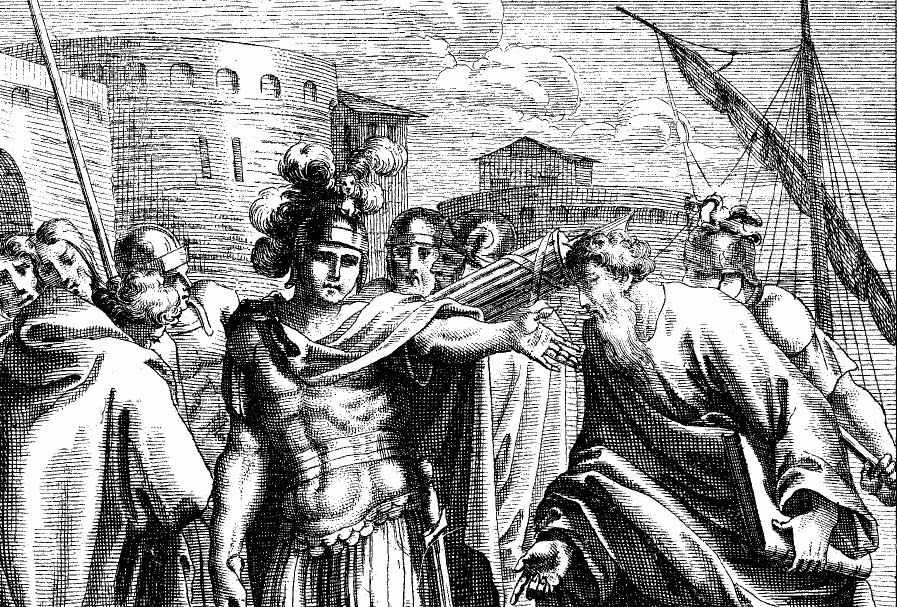
Illustration: Paul in Rome by Christoph Weigel (German engraver, 1654-1725).

Tuesday, August 19, 2014

Sitting in the caves


We sit huddled
the city’s caves offering
a respite
a single candle burns
dim light
our faces and thoughts
shadowed

cries echo above us
we sit, hiding,
not stirring
an occasional glance
offered the passageway
an occasional glance, uneasy
offered the graves

running feet above
what follows:
boots thudding above
cries anguished
then silence

we sit in caves
a spared remnant


Illustration: Crypt of Saint Caecilla in the catacomb of Callistus in Rome. Image adapted from Walter Lowrie, Monuments of the Early Church (New York:The Macmillan Company, 1901).