Showing posts with label redemption. Show all posts

Wednesday, March 16, 2022

“Redemption: The Church in Ancient Times” by Luke Herron Davis


My knowledge of church history was spotty – at best – for a very long time. My grade school and undergraduate education was almost entirely secular. I took two years of catechism (Lutheran version), and in my 20s took several extension courses about the Old and New Testaments. But if you asked me what I knew about the history of the early church before my mid-30s, I would have given you a timeline that leaped from the book of Acts to St. Augustine, and from St. Augustine to the Reformation.  

That state of affairs changed, dramatically, when I pursued a liberal arts master’s degree in my mid-30s. I took course like “Athens or Jerusalem,” “History of the Early Christian Church,” and “The Image of Rome.” I read the early church fathers, like Origen, Athanasius, Clement of Alexandria, and Tertullian. I read Peter Brown’s marvelous biography of Augustine. I read the Didache. And the Desert Fathers (and a few Desert Mothers). I read Kenneth Scott Latourette’s A History of Christianity (two fat volumes) and The Rise of Christianity by W.H.C. Frend. And a whole lot more. 


And I learned that the Christian church had an unbelievably rich, complex, and often profound history. And I realized how much of that history had been erased from so many of my history courses in high school and college. And I’ve often wondered how one could introduce that history to children and young people.


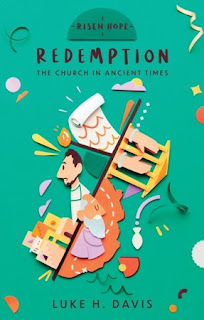
Luke Herron Davis has an answer – a series on church history written especially for younger readers. The first volume in that series is Redemption: The Church in Ancient Times. And far from being a weighty tome that could be a weapon if thrown at someone, it’s short, readable, interesting, and tells engaging stories taken straight from the Gospels and the Book of Acts as well as other sources of early church history.


Davis tells the story of the church by telling the stories of some of its leading historical figures from the first through the sixth centuries A.D. Each entry is 10 to 12 pages, written in story format – enough to impart important information about each figure and whet the appetite for more.


The people included are Peter, Paul, Ignatius, Polycarp, Cyprian, Constantine, Athanasius, Ambrose, John Chrysostom, Jerome, Augustine, and Patrick. Many others are mentioned in side notes (including one of my favorite figures, Tertullian). Each chapter is written like a story, bringing a freshness and a contemporary feel. The reader feels an integral part of what’s happening. 


It's an easy, interesting read, and I suspect that even adults would enjoy it (and learn a few things).

 

Luke Herron Davis

Davis teaches at 
Westminster Christian Academy in St. Louis and chairs the Bible Department there. He’s also taught at schools in Louisiana, Florida, and Virginia. He describes himself as “Presbyterian body, Lutheran heart, Anglican blood, Orthodox spirit,” all of which have served him well in writing the Cameron Ballack mysteries. He has published three Ballack mysteries, Litany of Secrets (2013), The Broken Cross (2015), and A Shattered Peace (2017), and the first book of a new series, Joel: The Merivalkan Chronicles Book 1 (2017). He blogs at For Grace and Kingdom.


Redemption is not written to be a complete, encyclopedic overview of church history. What it does is, aiming at young readers, provide an introduction to some of the leading figures of early church history, the people who evangelized, taught, encouraged, and admonished, and who often had the specter of martyrdom hanging over them (like Polycarp, bishop of Smyrna, who was himself discipled by the Apostle John). These are the people who faithfully transmitted the faith to future generations, and Davis is providing a real service in introducing them in such an engaging way to contemporary readers.


Next weekReign: The Church in the Middle Ages.


Related:


Reading a Novel that Stars Your Hometown.


My review of Litany of Secrets.


My review of The Broken Cross.


My review of A Shattered Peace.


My review of Tough Issues, True Hope by Luke Davis.


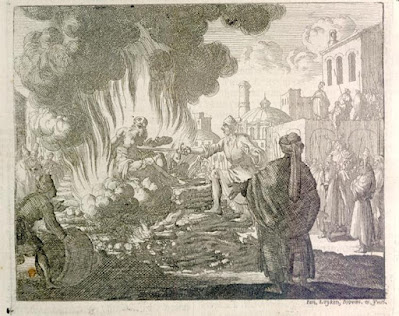
Top illustration: a representation of the burning of Polycarp of Smyrna (168 A.D.), drawn by Jan Luyken in 1685.

Friday, May 14, 2021

The plan


After Ephesians 1:1-14

It was a plan,
it is a plan
for the fullness
of time. Envisioned
and created before
time, it had an aim,
a purpose, a means
and an end: unity,
oneness, union
of all things,
things in heaven,
things on earth.
It’s all rather
stunning, when
you consider it:
a plan for all time,
created before time
began, a plan 
to unify all things.

Photograph by Eleventh Wave via Unsplash. Used with permission.

Sunday, September 20, 2020

Nothing separates


After Romans 8:31-39

Hearing the call, and
responding to the call,
they gathered together.
And once gathered,
nothing could separate
them from the caller.
A whole litany of foes –
disease, war, famine,
poverty, upheaval – 
stood silent, mute,
unable to divide
and conquer. Nothing
separates the called,
nothing separates
the gathered, from
the Caller. From
the Gatherer. 
Nothing prevails
against them,
because of who
the Caller is.

Photograph by Hannah Valentine via Unsplash. Used with permission.

Friday, September 18, 2020

It's over and done


After Romans 8:31-39

It’s over and done,
this battle, this war,
it’s over and done
before it even begins.
The forces are arrayed 
so unequally:
on one side, God;
on the other,
it doesn’t matter.
And his people 
as well, those he
called and those
he gathered, so, too,
do they stand
undefeated and
unaccused, because
the accusations
and the charges
and the crimes 
have been paid for,
atoned.

Photograph by Nghia Le via Unsplash. Used with permission.

Friday, September 11, 2020

There's a process


After Romans 8:26-30

There’s a process involved,
even if we think it’s all
spontaneity. It begins
with weakness, ours;
weakness so profound
that we’re at a loss
to know even what
to pray for.

But then, and next, 
the groaning,
the groaning too deep
for words, the sign
of intercession,
of help, the sound
of wind and fire
searching, seeking,
ferreting out
the hearts of weakness.

And so: our prayers are made.
And so: our prayers are heard.

Photograph by Suzanne Williams via Unsplash. Used with permission.

Sunday, September 6, 2020

We groan


After Romans 8:12-25

We groan within,
a racking of the soul, 
a piercing of the heart,
a stifled scream, for
what we know is
coming, the changes
promised, a new heaven
and a new earth,
a new father and
a new body,
a realization of hope
for the unseen, a hope
promised and anticipated,
a hope enshrouded
with patience. That is
what we groan for.

Photograph by Camila Quintero Franco via Unsplash. Used with permission.

Friday, September 4, 2020

What is to come


After Romans 8:12-25

What we have now
cannot be compared
to what is to come.
From its deepest soul,
creation groans
in anticipation
of what will be.
Creation aches 
to be set free
from its bondage
to the darkness,
to the corruption
to enslavement.
The groans are those
of childbirth, intense,
increasing in power
and frequency, a wave
heralding what
is to come.

Photograph by Kyle Cottrell via Unsplash. Used with permission.

Sunday, August 30, 2020

A child


After Romans 8:12-25

A child, abandoned,
alone, is found and
touched, claimed,
adopted to become
a son, a son
who cries father
with assurance,
knowing he belongs
now, and because
of this, he’s an heir,
guaranteed a place
with fellow heirs,
able to claim
what is promised,
an inheritance of life,
an inheritance of suffering,
an inheritance of glory.

Photograph by Max Goncharov via Unsplash. Used with permission.

Sunday, August 23, 2020

Set free


After Romans 8:1-11

We’re set free
from the law,
the law of death,
to embrace
the law of life,
the spirit of life,
We’re set free from
the law of death,
the law of sin
and death.
A substitution
was made, 
a sacrifice
acceptable,
fulfilling what
the law required,
and liberating from
the penalty required.
It’s that simple.
It’s that monumental.

Photograph by Junior Moran via Unsplash. Used with permission.

Friday, August 21, 2020

The resistance


After Romans 7:7-25

A war rages.
On one side:
what it is
we’re supposed
to do, to believe.
On the other:
what our hearts,
our minds, our souls,
want to do instead.
There’s a sense, 
inborn, of what 
is right. There’s
a sense, inborn,
of what we want
to do instead.
It’s a war
we cannot win
without help.
It’s the war
Of already
not yet.
We cannot win
on our own,
no matter
how great
the desire.

Photograph by British Library via Unsplash, Used with permission.

Sunday, July 19, 2020

What was isn't now


After Romans 6:1-14

The old is gone, not
merely cast aside,
but taken,
a violent act, and
nailed to a tree
of all things, and
there to die
in the only way
it could, With
it gone now, 
the new remains,
a sprouting seed,
set free to grow,
set free from the old,
the old left lifeless,
powerless, forgotten,
absolved.

Photograph by Dietmar Becker via Unsplash, Used with permission.

Sunday, May 24, 2020

We were works


After Genesis 3:17-15 and I John 3:1-10

We were works of before,
changed, in a moment,
into works of now.

We were fields of before,
fallow, then sown, the seed
now sprouting within us.

We were wind of before,
blowing aimlessly, now
with purpose and direction.

We were water of before,
polluted, until freshened,
cleansed, and purified.

We were works of darkness,
transformed, into works
of light, unshaded.

Photograph by Kyle Glenn via Unsplash. Used with permission.

Sunday, May 17, 2020

A symmetry


After Romans 5:12-21

There’s a kind
of symmetry
to it all, that sin
was transmitted
through one man,
one act bringing
condemnation
and death,
and
redemption was
achieved through
one man,
one act,
bringing
justification and
life.

Photograph by Greg Jeanneau via Unsplash. Used with permission.

Friday, May 15, 2020

Genetic inheritance


After Romans 5:12-21

Genetics are, or can be,
destiny, giving us height
and hair color, eye color,
skin color, ear size,
foot size, and, often,
health or aspects of it.
Strings of DNA twist
down generations, twist
down time, certain
combinations never
letting go, never
disappearing, tagging
along generation after
generation, replicating
and never weakening,
never disappearing, more
than a parasite, part of 
the genetic core.
Genetics is destiny, 
the guilt of birth broken
only by the gene-changer
nailed to a tree.

Photograph by Hal Gatewood via Unsplash. Used with permission.

Sunday, December 29, 2019

Sounds in the well


After Romans 8:26-28

A well of darkness,
cold, the only company
a shaking, shivering.
The voice rises through
the stones, winds echoing
off each other before
vanishing in the darkness
above.

The walls tremble, not
in anticipation but 
in the sounds reverberating,
an intercession unexpected
and undeserved, a groaning
so deep that it pounds
the ears, the hearing
realizing the meaning,

realizing that the intercession
is a gift, a provision of grace,
a provision planned and saved.

Photograph by Maria Krasnova via Unsplash. Used with permission.

Wednesday, June 19, 2019

"When Winter Breaks Softly" by Jim Burnett


Jim Burnett has written a considerable number of novels set in the Old West, and now he’s published a collection of short stories, also set in the Old West and with a strong theme of faith. When Winter Breaks Softy includes five stories that are simple and straightforward tales of good, evil, and redemption.

In “Blind Love,” a young couple have struggled for years to have a family. When a baby finally does come, their joy is cut short when they learn their little boy is blind. Not helping at all is the young woman’s mother, who’s constantly criticizing and belittling her daughter.

“Fiona’s Redemption” is a kind of Hatfield-McCoy or Romeo and Juliet kind of story. Two families have hated each other for a long time, and one family in particular has more than its fair share of bad men and bullies. Fiona Darcy finds herself attacked and raped by Clay Miller, an attack that leads to the birth of a child. It will be another Miller, however, who will fall in love with Fiona.

Jim Burnett
In “Fit to be Tied,” the Jackson family has four boys until the birth of their daughter Annabelle. They live on a big ranch in Wyoming, and as Annabelle grows up, she takes special delight in aggravating Danny Elder, the son of the ranch foreman. They always seem at odds, until an abandoned calf changes their lives.

“Maria’s Stubborn Love” is set in Texas. Maria Sanchez and her mother work at the Lazy D Ranch, where they are both the occasional object of ridicule by the ranch hands because of their Mexican heritage. But the son of the ranch owner will discover a very different kind of relationship with the beautiful girl.

“The Man Behind the Hammer” is Jess Slade, who once had been a farmer but had turned to blacksmithing after the accidental deaths of his wife and young son in a wagon crash. He’s never gotten over their deaths, and he seems to take his anger and guilt out on the iron and meatal he’s pounding in the shop. But Sarah Jane Nickels, the daughter of a cattle buyer and entrepreneur, has set her sights on the blacksmith. 

The stories of When Winter Breaks Softly seem a bit old-fashioned, but that’s what gives them their charm. Good and evil are clearly drawn, and broken people find redemption and love.

Wednesday, September 26, 2018

“Something Better” by Dustin Renz


Tom Schneider’s life is a mess. His wife Julie has left him, taking their 4-year-old daughter Kayla and moved in with her mother. He’s sinking deeper into depression. And he’s still trying to escape the years of physical abuse he and his mother endured at the ends of his father.

Tom is one big mess of anger, hurt, and depression. He’s got a single lifeline – the desire to be reunited with his family. But that looks increasingly impossible. Then a letter from his father arrives, asking to see him. Instead, Tom flies from Michigan to his boyhood home near Atlanta, and a slow process of forgiveness and reconciliation begins. But will it last?

Something Better by Dustin Renz is the story of Tom Schneider, but it could be the story of many of us. It’s about the damage that happens in families continuing down through the generations. It’s about the struggle to hold a failing marriage together. It’s about learning to forgive and learning to be forgiven. And it’s a story about how a young man comes to faith, and how his faith changes him before it begins to change his life and the people around him.

Dustin Renz
It’s also the story of any of us caught in a web of the past and our own mistakes, problems, and sins.

Renz is the Associate and Outreach Pastor at the Kettering Assembly of God in Kettering, Ohio, the founder of Make Way Ministries, and a contributing writer and speaker for Pure Life Ministries in Dry Ridge, Kentucky. He is also the author of Pile of Masks: Exposing Christian Hypocrisy (2016). Renz received a B.S. degree in church ministries from Southeastern University in Lakeland, Florida. He and his family live in Dayton, Ohio. 

Using an alternating series of flashbacks and contemporary scenes, Something Better points toward how each of us can, well, find something better in faith.

Top photograph by Eric Ward via Unsplash. Used with permission.