Wednesday, July 20, 2022

When You Find Yourself in Someone Else's Memoir


I started reading the memoir Ghost of the Hardy Boys because I loved the Hardy Boys mystery books as a kid and because I knew a little of the story of how they came to be. Leslie McFarlane (1902-1977) didn’t write all of the 60 books in the series published under the name of Franklin W. Dixon, but he wrote the first third of them. McFarlane was responsible for the 22 books between The Tower Treasure in 1927 and The Phantom Freighter in 1947.  

I read all 22, roughly between 1960 and 1963. I loved them. They even inspired me to write, or start to write, my own mystery. The handwritten manuscript, forever lost, was about 25 pages of a group of kids finding a secret passage from a grandfather down into a cave. I was 10 years old. Yeah, I could see the books had some old-fashioned words, like roadster and coupe for types of automobiles. But I didn’t care, even though I looked up the words in the dictionary. (If you’re interested, a coupe was a two-door car, the name borrowed from a type of horse-drawn carriage. A roadster is what we would call a convertible today.)


To continue reading, please see my post today at Dancing Priest.


Photograph: University of Iowa School of Journalism office in the 1920s

Tuesday, July 19, 2022

"Connections" by Mihai Brinas


Nine short stories comprise the collection Connections by writer and poet Mihai Brinas. Yet to call them stories is to do them a disservice; they are also poems, or include poems, that make up an integral part of each tale.  

The stories seem simple, but deceptively so. “Path to Anywhere,” for example, is about watching trains that pass without stopping, until the day when one with only a single passenger car halts at the platform. And a journey begins.


“The Drawing” concerns a woman condemned to life imprisonment for being a witch, until another prisoner devises an extraordinary means of escape. In “The Crystal Ball,’ the fortune teller places a towel over her head, and disappears, with her client left wondering where he is. “Paintings” might be better titled as “the fishing settlement at the end of the world.”


Mihai Brinas

“Connections,” the title story, is about a patient discharged from what seems to have been a mental hospital. But the state of his clothes and shoes suggests that the former patient might not have been officially discharged. In “The Bait,” a couple on a fishing vacation at a lake are the victims of a crime – and how justice gets ultimately served. “Introspection” concerns a writer who tries to help a neighbor deal with the abduction of her daughter, who had been trying to buy a specific brand of oil paint. And then the story becomes circular – and a story about a story. 


“Werewolves” is about a man who keeps finding his garden disturbed and damaged by a large animal, and he hears the stories about werewolves on the prowl. And “The Nightmare” tells a dark tale of a police officer on his way home who hits a barn owl – and how his life changes. 


Brinas’ poetry collections are Alignment of ThoughtsCrossroads, Thoughts That Bring Us Closer, and Invitation to Poetry. Born and raised in Romania, he lives in the city of Arad in the western part of the country, not far from the Hungarian border.


These stories are all jarring, slightly offbeat, and sometimes disturbing. They invite you to reconsider the reality you know while they rather poetically ask, “What if?”


Related:


Invitation to Poetry by Mihai Brinas.

Monday, July 18, 2022

"Ghost of the Hardy Boys" by Leslie McFarlane


Leslie McFarlane was a young newspaperman, working on the Springfield Republican in Massachusetts. A Canadian by birth, he’d grown up in the mining country of northern Ontario. One day, he saw an ad from an outfit called the Stratemeyer Syndicate that was seeking writers. His salary was something of a pittance, so he sent a letter of application. 

He received a package of two books and an explanation of how the syndicate worked. For each of the books published in a series, he would be paid $100. He would be provided a full outline. The books would not be published under his name but instead use a pseudonym. He could also never disclose he was the real author.


Given what his salary was, he accepted. A trial run was undertaken with the Dave Fearless series, several books of which had already been published. He passed the test of writing two chapters. He was hired as a freelancer, and he continued his newspaper job. After turning in several manuscripts, and being paid $100 for each, he was given a new project, one involving two brothers living in the fictional town of Bayport and who were amateur detectives. Frank and Joe Hardy were being born.


The Stratemeyer Syndicate was the genius of Edward Stratemeyer, who had picked up the legacy of the Horatio Alger stories. Stratemeyer has a number of popular series in publication, with The Bobbsey Twins being the most popular and Nancy Drew and The Hardy Boys almost as popular. These books, often sneered at by literary types, were likely the most popular children’s books of the 20th century, until the arrival of the Harry Potter stories. And they still sell.
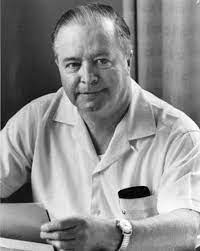
 

Leslie McFarlane

McFarlane published his memoir of how he came to be “Franklin W. Dixon, author of The Hardy Boys,” in 1975 as Ghost of the Hardy Boys. The publisher Godine has reissued the book, smartly designing it to look like one of the famous Hardy Boys book covers. 


And while it describes just about everything you want to know about the books and the author, it’s also McFarlane’s story. It describes his upbringing in northern Ontario, how he became a newspaperman, the people (and characters) he worked with in various newsrooms, and how he came to write the famous series, and how he ended it. 


McFarlane is a born storyteller, including how his son discovered he was the author of what the boy knew, if his father didn’t, as the most famous boys’ book anywhere. He’s also funny, ironic, tongue-in-cheek, and high entertaining. Reading Ghost of the Hardy Boys is almost like reading one of the Hardy Boys mysteries; it uses that same light fast-paced, and cliffhanging style.


It’s a real treat to read how my favorite mystery series from childhood came to be. 

Sunday, July 17, 2022

Rules for life


After Matthew 6:9-15
 

It is the best-known,

best-remembered,

most-often-spoken-aloud

instruction in the lengthy

rules for life explained

on that hillside

on that day.

It is embedded

within a series

of rules: blessings

and salt and light

and anger and lust

and divorce and oaths

and revenge and

enemies (live them!)

and giving and fasting

and anxiety and

judging and needs

and serving. Almost

right in the middle,

there it is: the rule

for how to pray.


Photograph by Jack Sharp via Unsplash. Used with permission.

Saturday, July 16, 2022

Saturday Good Reads - July 16, 2022


It almost seems a contradictory thing, but when it comes to public education, it’s the progressives and those of a more liberal political persuasion who take the traditionalist, conservative stance and defend the status quo – even if the status quo is not working well. A recent study looked at one of the largest school systems in the United States, that of New York City, and concluded we need to rethink the whole concept of public education. Ray Domanico at the Manhattan Institute has the story. 

Another seeming contradiction: big corporations (like the one I retired from) embracing pretty what some call “woke politics.” Writer Paul Kingsnorth explains it: progressives were always part of the corporate elite.


Historically, the U.S. military draws its recruits from the more conservative regions of the country, like the South and Midwest. But something is happening across all service branches: no one wants to join the military anymore. And there are reasons, says Jeff Groom at The Spectator.


More Good Reads


Life and Culture


In Praise of Printed Journals, Newsletters, and Ephemera – Brian Miller at A South Roane 

Agrarian.


How Connectivity Made Us Miserable – Samuel D. James at Digital Liturgies.


Repairing the Rents of History – Jeffrey Bilbro at Front Porch Republic.


The American dream can be achieved if we spend more time building strong, stable families—Brad Wilcox & Chris Bullivant at USA Today.


The Abolition of Man (and Woman) – Paul Kingsnorth at The Abbey of Misrule.


British Stuff


The Alleys of Old London – Spitalfields Life.


Bull and Mouth Inn, Northumberland House, French Church and Aldersgate: City of London Blue Plaques – A London Inheritance.


After Disenchantment: C.S. Lewis, Sally Rooney, and the Perennial Hunger – Cornelia Powers at Image Journal.


American Stuff


Catherine the Great Takes Notice of the American Revolution – Eric Sterner at Emerging Revolutionary War Era.


The Story Behind One of the Most-Mocked Paintings in U.S. History – Samantha Basking at Smithsonian Magazine.


The Horrors of Slavery at the Constitutional Convention – Bradley Birzer at The Imaginative Conservative. 


Faith


We need to be more sparing about when we shout ‘fire’ – Stephen Kneale at Building Jerusalem.


Scrooge and the Economics of Abortion – Anna Reynolds at Crisis Magazine.


Poetry


For Then – Manuel Gutiérrez Nájera, translated by Cheryl Corey at Society of Classical Poets.


Christianity and Poetry – Dana Gioia at First Things Magazine.


Writing and Literature


Edmund Wilson’s Big Idea: A Series of Books Devoted to Classic American Writing. It Almost Didn’t Happen – David Skinner at National Endowment for the Humanities.


Black kids should study Larkin – Tomiwa Owolade at UnHerd. 


London and the Long, Dark Shadow of Charles Dickens – Simon Toyne at CrimeReads.


News Media


News engagement plummets as Americans tune out – Neal Rothschild and Sara Fischer at Axios.


May It Be (Enya / Lord of the Rings) – VOCES8


Painting: Man Smoking Pipe, oil on canvas (1872) by Claude Monet (1840-1926).

Friday, July 15, 2022

How to pray


After Matthew 6:5-8
 

It’s rather simple,

actually, this lesson

on how to pray. First,

go into your room,

your private room,

away from distractions

and audiences like

other people, Next,

shut the door, making

your private place

even more private.

Then, pray. 

Fourth is how you

Pray. Keep it simple;

don’t keep adding

words because you

think it sounds cool

or that more is better

or that you like

the sound of your own

voice. In this case,

more is not better, and

for a simple reason.

The one to whom you

pray already knows

what your needs are;

in fact, he knows them

better than you do.


Photograph by Aaron Burden via Unsplash. Used with permission.

Thursday, July 14, 2022

“Two-Way Murder” by E.C.R. Lorac


E.C.R. Lorac (1894-1958) is relatively unknown today, but she was one of the lights of the Golden Age of Mystery in Great Britain and a member of the Detection Club, which included such mystery writers as Agatha Christie, Dorothy Sayers, and G.K. Chesterton (Chesterton was the first president). Her real name was Edith Caroline Rivett (and thus the E.C.R.), and she was one prolific writer. She published some 49 mystery novels under the Lorac pen name (most of them Chief Inspector Macdonald mysteries) and 23 under the pen name of Carol Carnac. 

One of her last manuscripts, completed in the 1950s but never published for reasons unknown, was Two-Way Murder. That is, until now. The British Library’s British Crime Classics has published the work, and it’s the first time the series has issued a not-previously-published book.


It’s a dark, foggy night near coastal southern England. Two friends, Nicholas Brent and Ian Macbane, are motoring their way to the annual Hunt Ball in the town of Fordings. The dancing isn’t the only attraction; attending will be Dilys Maine, a local beauty whom half the county is in love with. Dilys has a very strict father, who happens to have traveled to London on business, so she’s able to sneak out and attend the ball.


E.C.R. Lorac

Brent gives Dilys a ride home; she needs to be home before her father returns early the next day. But about a mile before their reach the Maine manor home, they come across what looks like a large bag in the roadway. Except it’s not a bag, but a body. Nick sends Dilys to walk on foot the rest of the way; they’re trying to keep her father from finding out about the dance, as he certainly will if she’s called to give evidence at the presumed inquest. Nick walks back to the farm of Michael Reeves to use the phone. Michael, a potential suitor for Dilys, is apparently still at the dance. Nick gets inside through a window, calls the police, and then is interrupted in the dark and knocked unconscious.


The local police and C.I.D. are soon on the case, as is just about everyone else – the Maines’ housekeeper, Macbane, Reeves, and the rest of the local population. Everyone, it seems, has something to hide, including the identity of the victim and the disappearance 18 months previously of Michael Reeves’ sister. 


It’s a complex story, dependent upon multiple roadways running roughly parallel to each other. It’s packed in a tightly written narrative, and it requires close reading. Lorac leaves clues, but the solution will still come as something of a surprise. 


Related:


My review of Fire in the Thatch by E.C. R. Lorac.


My review of Bats in the Belfry by E.C.R. Lorac.