Showing posts with label Battle of Shiloh. Show all posts

Wednesday, April 15, 2026

“Brookhaven” and the Battle of Shiloh


For a very long time, no one in my father’s family – father, aunts, uncles, grandmother, or cousins – knew why the family Bible contained a death notice. The name was Jarvis Seale; the only thing the listing had was the date of his death. Who was this person? Why was he considered so important that my great-grandfather, who’d penned every entry in the records, had included him. My father guessed Jarvis might have been a distant cousin, or a close friend. 

It was only in the years I’d been doing reading and research for my historical novel Brookhaven that I discovered the answer, and then it was simply by happenstance. The key was the date of his death.


To continue reading, please see my post today at Dancing Priest.


Some Wednesday Readings


What Pullman gets wrong about Narnia – Caleb Woodbridge at The Critic Magazine.


The Liberalism of George Smiley – Jake Meador at Mere Orthodoxy.


Chesterton’s Radical Sanity – Rachel Lu at Law & Liberty.

Wednesday, November 22, 2023

"Shiloh" by Shelby Foote


Shelby Foote (1916-2005) was a journalist, writer, and historian best known for his three-volume The Civil War: A Narrative, published between 1958 and 1974. His writings about the war and the South generally tilted in the direction of the Lost Cause, which means he’s as far out of favor with historians today as he can be. And yet his scholarship and depth of research were impressive. 

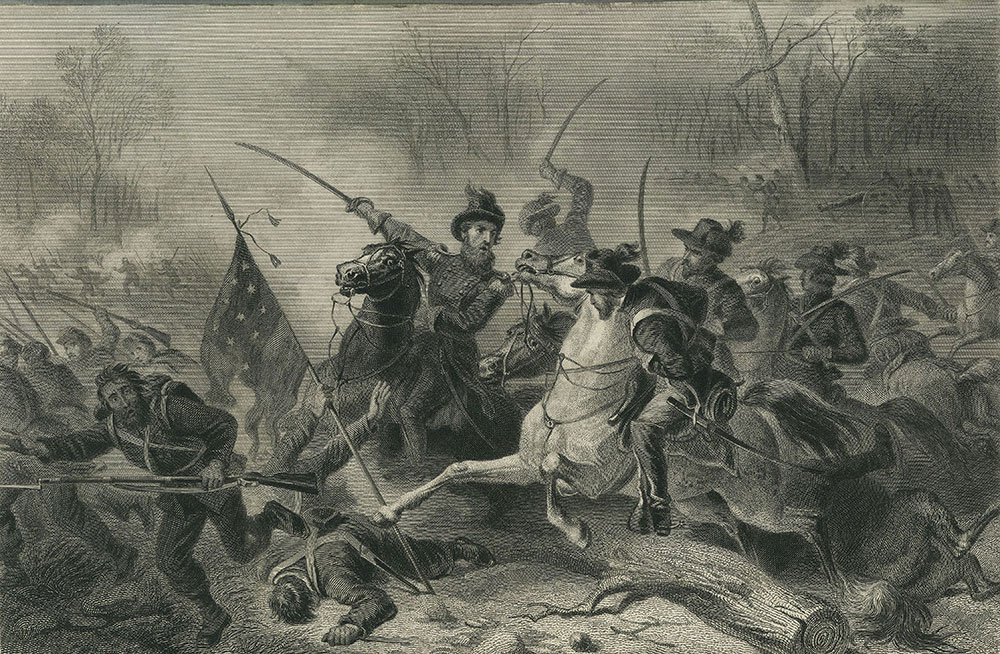
Foote also wrote six novels, one of which was entitled Shiloh, published in 1952. As the title indicates, it was about the Battle of Shiloh, fought April 6-7, 1862, in southern Tennessee very close to the Mississippi border. It was something of a seesaw battle, in that the Confederates under Albert Sidney Johnston and P.G.T. Beauregard clearly won the first day, only to see their victory turned into defeat the second day by the Union forces under Ulysses Grant and Don Carlos Buell. There were some 24,000 casualties, the total of both sides, and Shiloh has the dubious distinction of being one of the bloodiest battles of the war.


To continue reading, please see my post today at Dancing Priest.


Some Wednesday Readings


Final Resting Places: Reflections on the Meaning of Civil War Graves – book review by Tim Talbott at Emerging Civil War.


‘I am very uneasy to know if my husband is alive or dead’: Memorial highlights Irish in US civil war – Sen O’Riordan at Irish Examiner.


Don’t Burn Down the Ivory Towers – Joshua Katz at The Free Press.


The Return of the Progressive Atrocity – Susie Linfield at Quillette. 


MeToo unless you’re a Jew – Nicole Lampert at UnHerd. 


C.S. Lewis: A Sonnet -- Malcolm Guite.

Wednesday, June 15, 2022

The Mystery Man in the Family Bible


It’s a two-line reference in the family Bible, first owned by my great-grandfather. The family records section in Bibles in the 19
th century was generally inserted between the Old and New Testaments, and that’s where our family recordings were. All of the entries were in the same hand, the early ones in the same ink, suggesting they were written down at the same time. A friend estimated the Bible to have been published in the 1870s. 

My great-grandfather Samuel Young was born in in 1845, 1846, or 1848 – the handwriting is not clear. Other records, like those found in online genealogy sites, have 1845 and 1846. The handwriting is clear for the birth date of his wife and my great-grandmother, Octavia Montgomery. That date is 1844. The same handwriting continues after her death in 1887, which tells me it was my great-grandfather making all the entries (and his death in 1920 is not recorded).


To continue reading, please see my post today at Dancing Priest.


Monday, June 13, 2022

“Attack at Daylight and Whip Them” by Gregory Mertz


At the time, April of 1862, Shiloh was the most devastating battle in American history. The combined tally of casualties for both sides was an estimated 23,746 – some 3,500 dead, 16,000 wounded, and almost 4,000 captured or missing. The two-day battle, despite Confederate success on the first day, was ultimately decided as a Union victory.  

Despite the Union victory, people were so horrified by the carnage that, in the north, newspapers called for the dismissal of the commanding generals. That didn’t happen, but Shiloh was an indication of the terrible battles to come. (The battle is sometimes referred to as Pittsburg Landing, the nearby spot on the Tennessee River where the Union unloaded supplies. Shiloh was the name of the church or meeting house around which the battle was fought; its name means "peace.")


In Attack Them at Midnight and Whip Them, National Park Service historian Gregory Mertz does two things. He tells the story of the Battle of Shiloh, while he provides an in-depth guide for driving the battlegrounds. (The Park Service also offers a suggested guide for an automobile tour, but Mertz includes little-known details, history, and context.)


The title of the book, a quotation by Gen. Ulysses S. Grant, who was the commanding Union general at Shiloh, is also an almost identical quotation by General Albert Sidney Johnston, the Confederate commanding general who was killed at Shiloh (Mertz raises the possibility that it might have been by friendly fire). Grant was attempting to reach Corinth, Mississippi, an important Confederate rail hub; Johnston had rushed his army to the Shiloh area to stop him.


Gregory Mertz

Over the course of April 6 and 7, 1862, the battle seesawed over fields, streams, roads, and forests. Almost too late, Gen. Sherman understood the Confederate threat before he finally acted. Gen. Grant was alerted to the battle when he heard the cannon booms. Gen. Buell was hurrying his Union troops to the scene, arriving barely in time. The first day went tothe Confederates; the second day and overall victory to the Union. But it was a costly victory.


Mertz carefully guides the reader (and presumably automobile driver) through the site. It’s a complex tour, and a complex story, as battle lines ebbed and flowed. He does an excellent job of matching the contemporary scene to action during the battle.


For 40 years, Mertz has worked with National Park Service, most recently as Supervising Historian at Fredericksburg and Spotsylvania National Military Park. A native of the St. Louis area, he received a bachelor’s degree in Park Administration from the University of Missouri and a master’s degree in Public Administration from Shippensburg University. Growing up in what is now Wildwood, Missouri, a St. Louis suburb, Mertz paid numerous visits to Shiloh National Military Park for Boy Scout field trips.


After the Battle of Shiloh, Union soldiers buried their own dead in individual graves. The Confederate dead were buried in nine mass graves, three of which have never been found. The year after the war ended, Southern women went to Shiloh and placed flowers on the Confederate grave sites. When they noticed the absence of flowers on the Union graves, they distributed the flowers to include them as well. A group of Northern women heard the story and did something similar. It was an act that eventually led to a national Memorial Day.