Showing posts with label relationships. Show all posts

Friday, January 13, 2023

Poets and Poems: Nancy Murphy and “The Space Carved by the Sharpness of Your Absence”


A marriage fails. A mother dies. An only child goes off to college. A father’s health is failing. No one ever said life was easy, and we all seem to spend considerable time making sense of our lives and especially our relationships with loved ones and friends. 

It’s what poet Nancy Murphy does in The Space Carved by the Sharpness of Your Absence, her first poetry collection. She describes loss, separation, grief, and pain; the measure of those emotions can be seen in the title, “the sharpness of your absence.” You might think loss dulls with time, but Murphy reminds us that many things can suddenly make the loss piercingly real all over again.  


To continue reading, please see my post today at Tweetspeak Poetry.

Sunday, September 5, 2021

Servants and masters


After Ephesians 6:1-9
 

He’s speaking to slaves 

and masters, but the ideas

apply to any relationship

involving service and

oversight, subordinate

and manager. The words

are underscored by 

understanding what slaves

and masters do when left 

to their own ideas:

people-pleasing hypocrisy

and threats of punishment.


Instead:


Serve with a sincere heart,

with a good will as to the Lord.

Manage and oversee the same,

remembering that in heaven

God is not partial

to earthly distinctions.


Photograph by Liane Metzler via Unsplash. Used with permission.

Friday, September 3, 2021

The one with a promise


After Ephesians 6:1-9


A history of covenants,

promises, with Adam,

with Noah, with Abraham,

promises made and

promises kept. And

a commandment, one

of ten, the first with

a promise attached,

not only do this,

be this, but do this

and here’s what happens.

Honor your father,

honor your mother

—and here it is—

a twofold promise—

that it may go well

with you

and you may live

long in the land.

It starts with 

the most basic 

of human conditions

and relationships –

child and parent –

with this addition,

a word of advice

to parents: 

don’t provoke

your children to anger,

but raise them in – not

yours – but the discipline

and instruction of the lord,

and that assumes that

parents themselves have

been taught what that is,

by their parents. 


Photograph by Sorasak via Unsplash. Used with permission.

Sunday, August 29, 2021

Circular relationships


After Ephesians 6:1-9
 

Read the words. Watch

the rounded movements, See

what he’s doing, pairing

theoretical opposites, 

turning our understanding

on its head.


Children and parents,

parents and children,

slaves and masters,

masters and slaves.


We think we know

what these are and

how they function,

but he says no,

responsibilities are

mutual, responsibilities

exist on both sides,

and they are transformed

by faith, shared.


Photograph by Yiranding via Unsplash. Used with permission

Tuesday, September 26, 2017

Poets and Poems: John Latham and “From Professor’s Murasaki’s Notebooks”


John Latham is a research scientist, specializing in cloud formation. He’s received several medals from the Royal Meteorological Society, founded the Atmospheric Physics Research Group at the University of Manchester, and has served as a senior research fellow at the National Center for Atmospheric Research in Colorado.

John Latham
He is also a poet and novelist. His latest poetry collection, From Professor Murasaki’s Notebooks on the Effects of Lightning on the Human Body, may win the prize for the most unusual poetry title. It’s a title with a scientific sense; it almost sounds like the title of a research paper published in Nature. And the first few poems in the collection suggest a scientific theme – poems with titles about lightning, the chemistry of fog, and the forms and qualities of ice.

But that’s not where Latham goes. Where he does go is to the familiar territory of relationships. But it’s a journey marked by a practiced eye, an intense gaze, and a sensitive understanding.


To continue reading, please see my post today at Tweetspeak Poetry.

Tuesday, May 17, 2016

Poetic Voices: Kelly Hansen Maher and Heather Derr-Smith


In new collections, poets Kelly Hansen Maher and Heather Derr-Smith write about lives as women, Hansen Maher speaking to the pain of repeated miscarriages and Derr-Smith exploring relationships and female sexuality. Oddly enough (for me, not the poets), as I read these collections, I found myself considering recurring images of end-times.

Perhaps this isn’t so odd: miscarriages are about endings, accompanied by heartbreak and pain; and what Derr-Smith describes suggests, in part, the pain land loss of endings that can be accompanied by violence. Of course, my images of end-times could be nothing more than reflections of my own anxieties about the presidential election.


To continue reading, please see my post today at Tweetspeak Poetry.

Friday, July 10, 2015

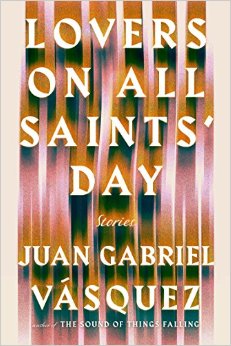
Juan Gabriel Vasquez’s “Lovers on All Saints’ Day”


Colombian writer Juan Gabriel Vasquez gained considerable critical notice (and a number of literary awards) in 2013 for his novel The Sound of Things Falling, which explores the impact of Colombia’s recent violent drug culture on people’s individual lives, even years after the old drug regime has been overthrown (a similar novel was written in 1975  by Peruvian and Nobel Prize winner Mario Vargas Llosa – Conversation in the Cathedral – about the impact of military dictatorship).

Later this month (July 21, to be precise), Gabriel Vasquez is publishing a collection of short stories, Lovers on All Saints’ Day, that were first written when he was living in Belgium and Barcelona. Describing them, he quotes the writer Tobias Wolff: “a book of stories should be like a novel in which the characters don’t know each other.”

And that is exactly how this collection of stories reads.

Six of the seven stories are set in Belgium, mostly in the Ardennes Forest region but also including Brussels and smaller towns (one story is in Paris). Each is about relationships, and mostly husband-wife relationships. Each is about deterioration of those relationships. And each is about time, and how the past is never really past but always a part of the present, and the future.

In “Hiding Places,” a freelance writer visits friends in Brussels, and walks into a family tragedy. In “The All Saints’ Day Lovers,” a marriage is evaporating; the husband spends the night with a café owner who lost her husband in a plane accident, and each relationship becomes a kind of metaphor for the other. “The Lodger” concerns what happens with a couple more than 20 years after the wife has an affair with the husband’s best friend.

Juan Gabriel Vasquez
In “The Return,” a woman paroled after spent 45 years in prison for killing her sister’s fiancé comes home, and past and present become intermingled. “At the Café de la Republique,” a couple recently separated meet so they can visit the husband’s dying father. In “The Solitude of the Magician,” a woman has an affair with a magician, ultimately leading to a family tragedy. And “Life on Grimsey Island” describes two people, she a veterinarian and he the reluctant owner of his father’s stables, both trying to escape their pasts.

These are somber stories, filled with loss and tragedy, with people trying to cope with intense personal loss with little to guide them. The writing is spare; nothing in these stories is gratuitous. The impression is always clouds, rain and cold. Each story has a sense of inevitability, as if the characters can’t really prevent what is going to happen. Or not happen.

Lovers on All Saints’ Day is a commentary on contemporary relationships. And little of what Gabriel Vasquez sees is good.

Photograph: Rue Goossens in Brussels, which plays a role in one of the stories in Lovers on All Saints’ Day. « Schaerbeek Rue Goossens 001 » par Varech — Travail personnel. Sous licence Domaine public via Wikimedia Commons.