Showing posts with label Edward Hopper. Show all posts

Friday, January 9, 2015

“Edward Hopper: Portraits of America”


I attended the School of Journalism at LSU from 1970 to 1973. It was a kind of twilight time for journalism; the upheavals of the 1960s hadn’t left LSU untouched but it was certainly less than elsewhere. And journalism was still framed by what was called objectivity – a philosophy developed by Walter Lippmann and others. According to the American Press Institute, “Objectivity called for journalists to develop a consistent method of testing information – a transparent approach to evidence – precisely so that personal and cultural biases would not undermine the accuracy of their work.”

Objectivity was the child of modernism, which had replaced realism. And it had quite a long run, as did modernism itself, which wasn’t limited to journalism but also affected literature, poetry, science, culture, architecture – and all of American and Western culture. In poetry, the “big three” modernists were T.S. Eliot, William Butler Yeats and Wallace Stevens.

It was modernism that framed education and understanding for my journalism teachers, and which in turn framed my own education and understanding. (Journalism would change dramatically with the Watergate scandal of 1973 and then yet again with the rise of post-modernism in the 1980s and 1990s.) But I believe the “modernist” influences on me is one reason why I’m so attracted to the paintings of Edward Hopper (1882-1967).

In Edward Hopper: Portraits of America (originally published in 1995 as Edward Hopper: Images of America), Wieland Schmied (1929-2014) borrows the phrase “transcendental objectivity” from the painter Max Beckmann and applies it to Hopper’s visual world. And he quotes Hopper himself as once describing his work as “the objectivity of inner visions.”

Part of objectivity is putting distance between one’s self and the object being studied (or painted). You can see and sense that distance in Hopper’s paintings; the artist is separate from the scenes and people he’s depicting with his brush. Even the more intimate paintings, Like the women in their bedrooms and the usherette in the theater, have an air of detachment about them, as if Hopper couldn’t get too close or he might lose himself. 

But these paintings are American paintings, or paintings of America, snapshots of almost six decades of scenes and people distinctly American. It says much about Schmied, who was an Austrian art critic, art historian and for a time the director of the National Gallery in Berlin, that he has captured the essence of Hopper so well.
The book is less a formal book and more a long, extended essay, surrounded by Hopper’s paintings, walking the reader through the decades of the artist’s working life, watching him as he grew artistically and developed into one of America’s foremost painters of the 20th century. We can see the stories the paintings tell but the artist’s objectivity doesn’t allow us to enter the stories. We watch, we observe, we understand, but we only imagine our own feelings.


Painting, top: Chop Suey by Edward Hopper, oil on canvas; 1929. Museum of Fine Arts, Boston.

Painting, bottom: Self-Portrait by Edward Hopper, oil on canvas, 1925-1930; Whitney Museum of American Art, New York.

Saturday, October 3, 2009

The Hopper Painting Poems

In the last week, I’ve posted three poems on paintings by the American artist Edward Hopper (1882-1967). Critics and art historians generally classify his work as “realism;” some consider him the iconic painter of America.

I’m not an art critic; I just like his paintings, and always have. I also like the fact that while he didn’t get established as a painter until his 40s, he resisted all of the trends and fads of the art scene and stuck to what he knew he should, the kind of paintings he was most comfortable with. Today you can see one of his paintings in a museum and know without checking the little card on the wall that it’s an Edward Hopper. His work looks like his own work.

Last year, my wife and I were in Chicago for a long Mother’s Day weekend. I had a speech to give at a conference on that Thursday, and she had learned that a British singing duo named Chad and Jeremy were doing three concerts in Chicago that weekend, including a house concert in Wilmette in the northern suburbs. My wife’s longstanding love affair with Chad and Jeremy’s music is another story, but suffice it to say that we splurged on tickets for the Friday night house concert, she got to talk with them face to face and the lady who organized the whole thing was able to squeeze us in to the concert for Sunday night in Evanston. I watched my wife become 12 years old again.

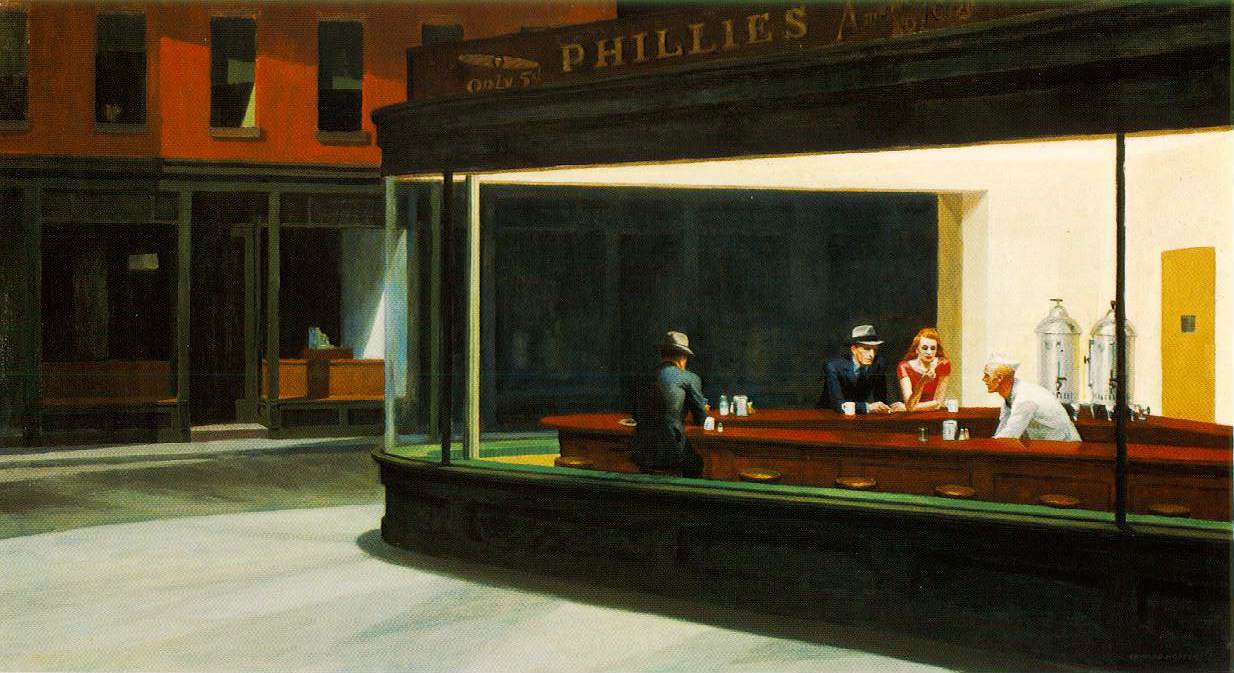
On Saturday, we caught the next-to-last day of a “mega-exhibit” at Chicago’s Art Institute. The exhibit was a “two-fer” – a double show of the works of Winslow Homer and Edward Hopper. The Art Institute is the home of Hopper’s “Nighthawks,” painted in 1947 and one of the most famous paintings in modern American art. I liked the Homer part, but I loved the Hopper exhibit. I had seen some of his paintings before, but never so many in one place. The Art Institute and its cooperating museums had done a stunning job of curating the exhibit. I bought the exhibit catalog and a mammoth biography of Hopper by Gail Levin.

While I wandered into the poetry closet this summer on this blog, I happened to start looking at the exhibit catalog, and for whatever reason, the painting “Room in New York” caught my eye. And I began to write some thoughts, and then more thoughts, and then I suddenly I was looking at the rough draft of a poem. That rough draft eventually became this.

In the case of the Hopper paintings, I’ve found that the poems are another way to look at the art, as one of the comments on the “Blackhead, Monhegan” poem pointed out – art plus text. I used a similar approach with the poem for “Early Sunday Morning.”
Hopper’s work is usually sorted into three categories – interiors, landscapes and streetscapes. I’ve now done a poem about a painting in each of the three. I’m thinking about doing others, but I may be content with what I’ve done so far. As I said, I love Hopper’s work. (I also like the look of his paintings against the black background of the blog.) But he painted a lot of stuff, and I’d be occupied for a long time to come if I tried to write a poem for each. And – don’t let anyone kid you – poetry is hard work. Lots of drafts. Lots of chewing on single words. Lots of paper tablet sheets. Over and over again, and you’re still never really finished.

For now, the poems for the three works stand as a tribute to the artist. And then I really like "New York Movie," and "Summer Evening." And there’s "Hotel Room," and "Gas," and "Sunday," and "Drug Store." And, of course, "Nighthawks."

Okay, we’ll see.

Related: Edward Hopper and his painting at Artsy.

Edward Hopper, Self-Portrait, oil on canvas, 1925-1930, Whitney Museum of American Art, New York.

Sunday, September 27, 2009

Edward Hopper’s Blackhead, Monhegan (1916-1919)

Late summer
Sun, declining,
Scatters rays
On hills rounded
And worn,
Suggesting
Another place,
The hot-cool
Blue-gold hues
Of Provence.
It is something
In the French style,
After all, yes?
Not quite
Post-impressionistic
Nor closeted cubist;
More like
Cezanne arguing
Mont Sainte-Victoire
On to canvas
Repeatedly, never
Quite succeeding.

The mountains
Slip Into golds
And oranges
Against a front
Drop of blue.

Dying colors wash
Across an ocean,
Thrusting against
An island broken
From mainland.
Fading blue held
Back at shore’s edge,
Cutting itself on
Jagged rock,
Bleeding white.
Fading orange
Paling into
Sunset yellows.
If only it had been
Before the war;
Colors were
Stronger then.
Now they disappear
Into the power
Of the western sun.

Dark shade divides;
Always a division.
The waves still
Pound
A beach of stones.

Blackhead, Monhegan (1916-1919), Edward Hopper, Whitney Museum of American Art, New York

Friday, September 25, 2009

Edward Hopper’s "Room in New York" (1932)


Evening deepening.
He’d slumped, exhausted,
Into the comfort
Of the stuffed chair.
Then leans forward
To pretend keen interest,
Devouring the p.m. newspaper,
Already a relic of time lost,
The flip of a nickel
To the corner newsboy.
Intently, he
Reads
The Babe’s latest
Or the little mayor’s
Brooklynesque speech
Or another
“Cannery Idles 300”
As he silently
Shudders
To a freeze-frame stop.
Anything to avoid
The emptiness
Of the closed door.

She, too,
Taking refuge in words
And notes,
Toys with ivoried
Sheets of music,
A Portuguese sonnet
In reverse.
Anticipating
A song, or movie,
Even an automat
Sandwich,
Anything to escape
The room of her day.
A half-turn away
Knows the half-expected,
The fully hoped for
Has dissipated
Into another
New York night.

In the museum,
We look through
The curtain-less
Window,
Marveling
At the separation
Of desires spoken
Yet unmet,
Understood, yet
Ignored.
And know
The title
Should have been
The Red Dress.
Room in New York (1932), Edward Hopper, Sheldon Memorial Art Gallery, Lincoln, Nebraska