Showing posts with label Mary Harwell Sayler. Show all posts

Monday, February 19, 2018

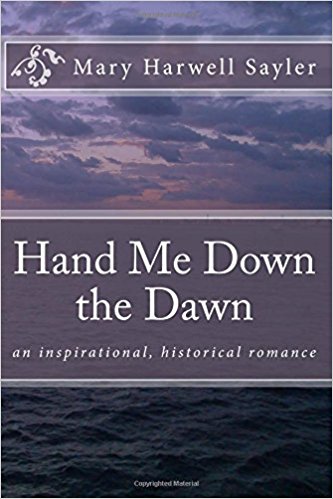
"Hand Me Down the Dawn" by Mary Harwell Sayler


It’s 1895. Catherine Caldwell, known as “Cat,” is 19 years old. She’s digging her father’s grave; her mother died some years before. She hasn’t had much education. The people of the town she lives near think of her as rather odd. With no other family, she decides to fulfill a kind of promise to her mother and heath south to Florida, specifically to Siloam Springs on the St. John’s River, a place she’s never visited but which holds the promise of a better life.
She disguises herself as a boy, wearing her father’s dungarees and boots. She hops a freight train headed south, and after she’s discovered and rather painfully thrown off the train, she meets Raff Jordan. Jordan is clearly a man of the gentleman class, and he is piloting his raft of goods to Siloam Springs with the help of a young local man named Wyatt Tate. For several weeks, the three make their way together on the St. John’s River from Jacksonville. Cat discovers that Jordan is a preservationist – someone deeply concerned by the destruction of Florida’s natural habitats by phosphate ore miners and others.

Cat discovers herself liking Jordan, a liking that grows stronger. But their relationship often seems like oil and water. Once they reach Siloam Springs and the big steamboat docked there, Jordan deposits Cat with the Tate family and takes off. Ma Tate isn’t fooled for a moment – she knows Cat is no young boy. And she helps her get a job working as kitchen help at the local hotel and establishing a double life – kitchen boy cleaning pots and pans and beautiful singer at the hotel.

Mary Harwell Sayler
Cat’s story is told in Hand Me Down the Dawn by Mary Harwell Sayler, first published in 1985 and now updated and republished. Sayler is a poet, editor, and writer whose published books include Living in the Nature Poem, Faces in a Crowd, Outside Eden, Beach Songs & Wood Chimes: Poems for Children, Christian Writer’s Guide, Praise: Poems, and What the Bible Says About Love, among many others. She lives in Florida.

Hand Me Down the Dawn is a historical romance, and Sayler has done her historical and environmental homework in telling Cat’s story. And it is a sweet, winsome story, including enough twists and turns to keep the reader guessing if Cat will find the life and the love she’s looking for.

Related:


Top photograph: Lucas New Lines operated steamboats on the Ocklawaha and St. John’s rivers in Florida in the 1890s.

Monday, October 23, 2017

“Lost in Faith: and poetry” by Mary Harwell Sayler


Mary Harwell Sayler loves writing, and has published 30 books. She loves poetry. She loves encouraging other writers and poets. But if there’s one thing she loves more than all of those, it’s the God she believes in. Before she’s a writer, before she’s a poet, and before she’s an encourager, Sayler is a woman of faith.

In Lost in Faith: and poetry, her newest collection of 73 poems, Sayler combines all of these attributes. She writes. She writes poetry. She praises. She encourages.  And she questions and sings and hopes and struggles and she lives her life – a life of faith.

Her faith shines through the poems, no matter what the subject – nature, the heavens, the fall, Dante, adult coloring books, prayer, finding the bones of baby birds, a church picnic, politics, a storm, doubt, reading (and sometimes struggling to understand) Scripture, a cloud bank, and even an argument.

Flighting
 
Talking, we stayed up too late,
knowing full well that tiredness
would awaken our next day.
So where do we go from here?
Do we resolve to speak promptly
of upset, hurt, and anger, or never
to speak at all of the carelessness
that mars our better selves?

I, for one, am weary
of trying to arrange a perfect time,
a perfect place for us to face our needs
and longings, and yet I cannot bridge
the space between your view and mine –
stark cliffs from which to push
or plunge and not resolve one thing.

Oh, for wings
to fly across the summit of ourselves:
the peaks of our emotions, the depths
and heights of love.

Is this not our landscape, filled with
a wondrous view? Is this not a reason
to go on
in faith, headlong?

Oh, God, give us Your view.

Mary Harwell Sayler
Her published books include Living in the Nature Poem, Faces in a Crowd, Outside Eden, Beach Songs & Wood Chimes: Poems for Children, Christian Writer’s Guide, Praise: Poems, and What the Bible Says About Love, among many others. She lives in Florida.

In Lost in Faith: and poetry, Sayler’s faith inspires and pours through her poems, but it doesn’t overwhelm them. They express emotion, thinking, reflection, meditation, and joy – and occasionally exuberance. The poems put the reader in mind of the psalms, and especially the psalms of David – inviting, heartfelt, and simultaneously personal and universal. She is indeed lost in faith.


Related:


Top photograph by Priscilla Du Preez via Unsplash. Used with permission.

Wednesday, March 29, 2017

“Praise: Poems” by Mary Harwell Sayler


Up to a third or more of the Bible is written as poetry, mostly in the Old Testament and certain quoted passages in the New Testament. While the single largest “block” of poetry is the Book of Psalms, one can also find poetry in the prophets, Genesis, Exodus, Judges, the history books of Samuel, Kings, and Chronicles, and several others.

The Song of Solomon, one of the earliest love poems, notwithstanding, the poetry of the Bible generally focuses on praise. The reasons for praise are many and varied, but the poetry is largely poetry of praise. Consider the picture of ancient Hebrews reciting poems and singing songs of praise to their God, often in the midst of terrible trials and upheavals.

So it is with Mary Harwell Sayler’s new poetry collection, Praise. These poems are not all about thanksgiving, but have a broader reach and purpose. As Sayler says in the introduction, “Praise focuses in Who God is, more than what God does. Praise pours out our love to the Lord.”

The collection of 72 is divided into six parts – praise, prayers, Easter, creation, wonder, and Christmas. And they are indeed a pouring out love for who God is. These aren’t poems about deliverance from trials. The focus is more eternal than transient.

Praise Christ Our Body—

Who holds us together
in cell and membrane,
tissue and blood,
tendon and tears.

Praise Christ Whose Body
embraces
each part of us—
an ear, an eye, a knee,
a scalp, a head of hair
with each curl counted.

Praise Christ Who gave
His Body and
welcomes each one of us—

Into the Body of Christ,
the Church—

To work, to play
and pray together,
to love and forgive,
to worship as One Being
the Lord we adore.

Mary Harrell Sayler
As in this example, Sayler consciously incorporates the title into each poem, and that’s part of her purpose here – creating contemporary psalms. “Instead of titling them with sequential numbers, as later editors had done to identify the biblical Psalms, the first line of each poem became its title and an integral part of its reading,” she says.

Sayler has published more than 2,000 poems in a wide array of publications ranging from magazines and e-zines, anthologies, journals, and church publications. She has five poetry collections, including Living in the Nature Poem (2012); Outside Eden (2014); Beach Songs and Wood Chimes (2014); Faces in a Crowd (2016); and Praise. She’s written three books on writing, and maintains several blogs, including The Poetry Editor and Poetry.

Praise achieves what it sets out to do – its poems individually and collectively pour out love for who God is.

Related:


Top photograph by Andrew Small via Unsplash.