Showing posts with label Sherlock Holmes. Show all posts

Wednesday, June 8, 2022

"The Sign of the Tooth" by Craig Stephen Copland


A young woman of English and Ceylonese parentage arrives at the house of Sherlock Holmes on Baker Street in London. She is carrying several golden figures of Buddha. And she has a strange story to tell. Her father, her father’s best friend and historical research colleague, and the colleague’s son have all died in exactly the same way – unexpectedly, at home, and with full rigor mortis within an hour. 

It's no coincidence that the murders have happened just as an exhibit has gotten underway at the British Museum – a sacred relic of Buddha, as in, his tooth (a molar, to be precise). Eight Buddhist attendants rotate guard over the tooth, a loan from the monastery in Ceylon (now Sri Linka). 


The young woman, Mary Morstan, has also been receiving notes, warning her of imminent personal danger. The game’s afoot, as Holmes tells Dr John Watson, and soon the pair are investigating the deaths, the warnings, and (surprise) the theft of the tooth. With that theft, Sherlock’s brother Mycroft and the British government get involved; the loss of the tooth could lead to an uprising and war in the Indian subcontinent. 


Craig Stephen Copland

Then there’s a further complication: Dr. Watson finds himself totally smitten with Miss Morstan.


The Sign of the Tooth is the fifth in the ever-growing Sherlock Holmes series by Craig Stephen Copland, and it’s chock full of Irish terrorists, missing monks, high-stakes foreign relations, and a love story.


Copland is a longtime fan of Arthur Conan Doyle’s Sherlock Holmes. After he retired, he set himself a goal of writing a new Sherlock Holmes mystery related to and inspired by each of the 60 stories published by Conan Doyle. He’s also written monographs on Holmes and two non-Holmes mystery stories featuring a detective in the Old American West, the Reverend Ezekiel Black. He currently lives and writes in Toronto, Buenos Aires, New York, and the Okanagan Valley in British Columbia. 


The Sign of the Tooth is a bit tongue-in-cheek; how could any contemporary version of the famous Arthur Conan Doyle detective not be, at least to a small extent. It’s a fast-paced, fast-reading, and entertaining short novel. 


Related:


New Sherlock Holmes Stories by Craig Stephen Copland.


Five Mysteries: 2 Short Stories, 2 Novellas, and a Long Story


The Adventure of the Beryl Anarchists by Crain Stephen Copland.

Monday, November 9, 2020

"The Adventure of the Beryl Anarchists" by Craig Stephen Copland


It’s 1912, Dr. Watson in 59 and Sherlock Holmes is 57. And in pursuit of their next case, both men are going to utilize a newfangled machine called the motorcycle. 

In The Adventure of the Beryl Anarchists by Craig Stephen Copland, Holmes and Watson are consulted by a private banker. The man’s records have been stolen from the safe in his home, and they contain an account of all payments made by customers – including payments made to keep certain people quiet about everything from affairs to bribery. Some of the leading names in Britain could be threatened by blackmail.


And as expected, the first attempt to extort money goes to a lord and lady rather notorious for their dalliances. The titled pair laugh it off, believing the publicity will be fantastic for their upcoming tell-all book (it is). The second attempt includes a kidnapping, and it goes seriously wrong.


Craig Stephen Copland

The trail to the culprit, or culprits, will lead through the banker’s own family, to veterans of the Boer War, a motorcycle club, and even to a boy scout camp-out. It’s a thrilling tale with an exciting, cliffhanger-type of ending.


Copland is a longtime fan of Arthur Conan Doyle’s Sherlock Holmes. After he retired, he set himself a goal of writing a new Sherlock Holmes mystery related to and inspired by each of the 60 stories published by Conan Doyle. He’s also written monographs on Holmes and two non-Holmes mystery stories featuring a detective in the Old American West, the Reverend Ezekiel Black. He currently lives and writes in Toronto, Buenos Aires, New York, and the Okanagan Valley in British Columbia. 


The Adventure of the Beryl Anarchists is a tale of revenge, outrage, and outright evil, with Holmes and Watson receiving last-minute help from a completely unexpected source. The emphasis is less on Holmes’s thinking and detective skills and more on an action-packed story.


Related:


New Sherlock Holmes Stories by Craig Stephen Copland.


Five Mysteries: 2 Short Stories, 2 Novellas, and a Long Story

Thursday, June 20, 2019

New Sherlock Holmes Stories by Craig Stephen Copland


Craig Stephen Copland is a man with a mission –to write 60 new Sherlock Holmes stories. He’s well on his way. Two of them take Holmes and Dr. John Watson well away from England – to the United States and Japan. 

In The Hudson Valley Mystery, Holmes and Watson (ably assisted by Mrs. Watson) travel to New York to investigate what appears to be an open-and-shut case. Charles McCarthy, who had made a considerable fortune in the California Gold Rush, has been murdered, and his nineteen-year-old son James has confessed, pled insanity, and is now confined in a prison for the criminally insane. The widow (and mother) has retained Holmes, not believing that her son could have committed the deed.

Involved are the nearby neighbor and Gold Rush partner John Turner and his daughter, and Holmes and Watson soon learn that few of the people in both families are telling the truth. Something is being hidden, and Holmes is determined to discover what it is.

In The Yellow Farce, Holmes and Watson travel to Japan at the behest (actually, the demand) of Holmes’ brother Mycroft. It is 1905, Japan and Russia are at war, and the Russian fleet is sailing around the world to battle the Japanese fleet. The head of the British legation in Tokyo is married to an American who happens to be a former Russian, and it looks like the woman is up to no good in trying to tilt the British toward supporting the Russians. 

Craig Stephen Copland
It’s a vastly different culture from England or the United States, and the detective duo find themselves confronting gun smuggling, spies everywhere, and even what looks to be a planned assassination. The climax will come at the summit of Mount Fuji.

Copland is a longtime fan of Arthur Conan Doyle’s Sherlock Holmes. After he retired, he set himself a goal of writing a new Sherlock Holmes mystery related to and inspired by each of the 60 stories published by Conan Doyle. He’s also written monographs on Holmes and two non-Holmes mystery stories featuring a detective in the Old American West, the Reverend Ezekiel Black. He currently lives and writes in Toronto, Buenos Aires, New York, and the Okanagan Valley in British Columbia. 

The stories are great fun, but readers should not expect an exact reproduction of Holmes and Watson. Copland’s Holmes make mistakes, and he often has to directed on to a better path by Watson and his wife. That said, it makes for a more realistic detective, one that is still paying homage to the original stories.

Monday, February 22, 2016

The Museum of London’s “Sherlock Holmes”


For five months in 2014-2015, the Museum of London hosted an exhibition about that most famous of all fictional detectives, Sherlock Holmes. Since the first Sherlock Holmes story appeared in the Strand Magazine in the early 1890s, the literary creation of Sir Arthur Conan Doyle has been imitated, replicated, adored, borrowed wholesale by other authors, and filmed and recorded countless times in movies, radio, and television.

And his popularity endures. Consider Benedict Cumberbatch’s Sherlock, or the television series Elementary. The Museum of London’s exhibition, Sherlock Holmes under the Microscope, was an extraordinarily popular event.

For the exhibition, the Museum published a companion book, Sherlock Holmes: The Man Who Never Lived and Will Never Die, a collection of essays edited and compiled by Alex Werner, head of the museum’s History Collections. The museum wisely did not tie the book to the exhibition, and instead brought together six essays (and a considerable number of illustrations) that will stand the test of time and add to the literature about the famous detective.

The introductory essay, “A Case of [Mistaken?] Identity,” is by Sir David Cannadine, Dodge Professor of History at Princeton University. It is a fine contextual setting piece, placing Holmes in his historical context of late Victorian London and drawing a detailed picture of what London was like socially, politically, and culturally at the time, and how it influenced both Doyle and his detective.

John Stokes, Emeritus Professor of Modern British Literature at Kings College London, delves into “The ‘Bohemian Habits’ of Sherlock Holmes.” In 1980s London, “Bohemia” was both a specific place – embracing Covent Garden, the Strand, and Fleet Street – and a way of life.

In “Sherlock Holmes, Sidney Paget and the Strand Magazine,” the museum’s Werner introduces us to Sidney Paget, the illustrator who has as much to do with our picture of Sherlock Holmes as Doyle himself. It was Paget who gave Holmes many of his distinguishing features, including the famous deerstalker cap (which Doyle had never included). Werner also describes the Strand Magazine and the role it played, and how it achieved the popularity it did. (The book includes a complete reprint of an article published by the Strand in 1892, “A Day with Arthur Conan Doyle.”)

Pat Hardy, Curator of Paintings, Prints and Drawings at the Museum of London and the Sherlock Holmes exhibition’s curator, examines “The Art of Sherlock Holmes,” the art, photographs, drawings and prints of the period. He provides ample detail of those which included London’s famous fog (and includes some beautiful examples of photographs).

The Museum of London
Clare Pettet, Professor of Nineteenth Century Literature and Culture at Kings College London, looks at “Throwaway Holmes,” a discussion of communication methods in the 1890s and how new developments were fundamentally changing daily life (and how they were used in the Holmes stories).

The final essay, “Silent Sherlocks: Holmes and Early Cinema” by Nathalie Morris, Senior Curator of the British Film Institute’s National Archives Special Collections, consider the early forerunners to Benedict Cumberbatch (my words, not hers). American actor William Gillette essentially set the image of Holmes on screen for his own and future generations, and John Barrymore also played the detective in an early film.

The subtitle of the book, “The Man Who Never Lived and Will Never Die,” is a concise summary of the world’s fascination with Sherlock Holmes. It’s difficult to think of a fictional character who has had more of a pull on our imaginations than Sherlock Holmes. The Museum of London’s Sherlock Holmes goes a long way to explaining the “why” of that influence.

Note: The Sherlock Holmes exhibition ended in April of 2015, but the Museum of London is well worth a visit. Located in the Barbican Centre about three blocks north of St Paul’s Cathedral, the Museum has outstanding exhibits on pre-Roman and Roman London (including a view of a piece of the original Roman Wall still standing), Victorian London, and the Lord Mayor’s gilded coach, among many other exhibits.


Illustration: Dr. Watson and Sherlock Holmes in “Silver Blaze,” Strand Magazine, December 1892. Drawing by Sidney Paget.

Friday, July 3, 2015

Anthony Horowitz’s “The House of Silk”


A London art dealer comes to Sherlock Holmes and Dr. Watson, reporting that he’s being followed by the leader of an American criminal gang bent on revenge. Because of art (paintings by John Constable) caught up and destroyed during a train robbery, and the busting up of the gang involved (and the death of its co-leader), the art dealer fears for his life.

Holmes and Watson are on the case, except the case is not quite as straightforward as it seems. The criminal is found murdered in his hotel room, tracked down by a boy involved in Holmes’ “Baker Street Irregulars.” The boy disappears and is later founded brutally murdered.

More is afoot that a revenge killing over a train robbery gone bad. Much more.

And so we’re drawn, almost catapulted, into Anthony Horowitz’s The House of Silk: A Sherlock Holmes Novel.

This is the first of Horowitz’s Sherlock Holmes novels, the second being Moriarity (which I reviewed here in April). Such is Horowitz’s reputation that these two books and are the only Holmes novels authorized by the Arthur Conan Doyle estate. (Horowitz, among numerous other works, was the writer for both the popular BBC and PBS series Foyle’s War and the long running detective series Midsummer Murders.)

Anthony Horowitz
The House of Silk takes us across London and its suburbs (Wimbledon was a suburb in the early 1890s), from the houses of the middle class to the smells and squalor of the East End. In the process we learn about the plight of orphaned children in Victorian England in institutional settings as well as on their own in a society that could crush them without thinking.

The author is true to both the Sherlock Holmes style and story signature – we think we see what’s coming, and it indeed comes, but it includes what we did and didn’t expect. Like Dr. Watson, we are left amazed by Holmes’ knowledge and deductions. Horowitz plays that extremely well in his Holmes novels, and keeps a surprise or two up his sleeve – just like Conan Doyle did in the original stories. And there's even a cameo appearance by Professor Moriarity.


Here’s to more Sherlock Holmes novels by Anthony Horowitz.

Wednesday, May 13, 2015

Short Takes: “Jack’s Wager" and “The Three Monarchs”

Short Takes is a new feature here that reviews generally short works (“short” defined as able to be read in under an hour).

Jack’s Wager

Both Halloween and Samhain in Ireland happen at roughly the end of the harvest season. Both have pre-Christian roots. And both share an emblem – the jack o’lantern, a hollowed pumpkin with a light inside. Such decorations sit on American front porches on Oct. 31 each year (including my own). The decoration spread in the United States with the large Irish immigrations in the 19th century.

But where did the jack o’lantern come from? Writer Wirton Arvil has a creative suggestion, and describes it in detail in Jack’s Wagers. Using some of the legends and stories that have grown up around the jack o’lantern over the centuries, Arvil tells the story of Jack, a poor man for whom nothing ever seems to go right, but who manages to trick the devil not once but twice.

It’s a folk tale, written for contemporary readers, and it is great fun. One can image the story being told around a campfire on a moonlit Halloween night, the harvest finished, and the farmers and field hands fascinated with the a story of the devil being tricked.

The story is told in both English and Italian.

The Three Monarchs

Anthony Horowitz, writer for the popular British (and PBS) series Foyle’s War and the long running mystery series Midsomer Murders. In 2011, he wrote a Sherlock Holmes novel, The House of Silk, that was authorized by the Arthur Conan Doyle Estate. And last year, he published a second Holmes novel, Moriarty (reviewed here last month).

He’s also written a Holmes short story, The Three Monarchs, available as a single story. It is remarkably like the original Holmes stories, so good that it could have been written by Conan Doyle himself.

Dr. John Watson has been married for a year, living happily with his wife Mary not far from 221B Baker Street. But, rather naturally, he’s seen little of Holmes during that time, pursuing his medical career to provide for his new family. But he misses the excitement, and one say his wife suggests he visit Holmes.

He arrives as Holmes is talking with Inspector Athelney Jones of Scotland Yard (a major character in Moriarty) about a most puzzling case. A burglar has been shot dead by a homeowner. And, as it turns out, the burglar had also visited two neighboring homes, stealing the exact same thing from each – a figurine of Queen Victoria for her Golden Jubilee, of which millions were made and sold. In other words, the figurines are worth virtually nothing. So why would they be stolen?

Leave it to Holmes to find the larger meaning in what seems inconsequential. The Three Monarchs is a story solidly within the Sherlock Holmes tradition.


Top photograph of a jack o’lantern licensed under CC BY 4.0 via Wikimedia Commons.

Thursday, April 23, 2015

Anthony Horowitz’s “Moriarity”


In 1893, the British public was outraged. Arthur Conan Doyle had just done the unspeakable – in a titanic struggle at the Reichenbach Falls in Switzerland, Sherlock Holmes and his arch-enemy Professor Moriarty had struggled and fallen to the rocks below, presumably to their deaths. Sherlock Holmes would no longer grace his way in the minds of the reading public.

It would take eight years, and considerable sullen outrage, but Holmes would finally return, in Doyle’s 1901 novel The Hound of the Baskervilles.

We know what happened to Holmes, but what happened to Moriarty?

Numerous authors have tried answering that question in novel form since Doyle’s death in 1930. Now Anthony Horowitz has now taken a shot at it, with Moriarty.

In short, the novel is enthralling, convincing – and devilish.

Frederick Chase is a detective with the Pinkerton Detective Agency in America. He’s sent to Europe, and specifically to Switzerland, to find clues to the whereabouts of an arch-criminal in America, one Clarence Devereux. He is reportedly in Europe, to step into the place of Moriarity.

In Switzerland, Chase meets Scotland yard detective Athelney Jones, sent by the Yard to verify Moriarty’s death. There is a body; together Jones and Chase examine it. And they find a note, in code, addressed to Moriarty and likely from Devereux. Then it’s on to London; the game is indeed afoot.

With each page, the story becomes more than a mystery. It quickly centers on the growing friendship of the two detectives, one American and one British, one a private agent and the other representing the greatest investigating authority of the time. The developments begin to come one after another, quickening the pace toward what looks to be a horrific conclusion. (In fact, the story is almost as fast-paced as the television series Sherlock, starring Benedict Cumberbatch.)

Anthony Horowitz
Slowly the reader begins to be ask – was that Moriarty’s body they saw in Switzerland, or was it someone else? And if someone else, then where is Moriarty?

Horowitz has written numerous novels and one previous Sherlock Holmes story, The House of Silk in 2011. He is perhaps best known as the creator of two television programs popular in both Great Britain and the United States, Midsomer Murders and Foyle’s War.

What a story Moriarty is, full of twists and turns, keeping the reader on edge and guessing in every chapter. It is mystery writing at its historical best.


Illustration: Professor Moriarty and Sherlock Holmes in their struggle at Reichenbach Falls.

Saturday, February 8, 2014

I'm Sherlocked


Last Sunday night, some people watched the Super Bowl. Well, perhaps a few more than some. I didn’t. My wife and I watched Downton Abbey (and were glad to see Maggie Smith with some acidly wonderful lines again), and then we watched  Sherlock Holmes.

Sherlock Holmes. If you haven’t seen this version of Arthur Conan Doyle’s famous detective, then you have missed what is likely the best (and I can say that because I’ve seen them all).

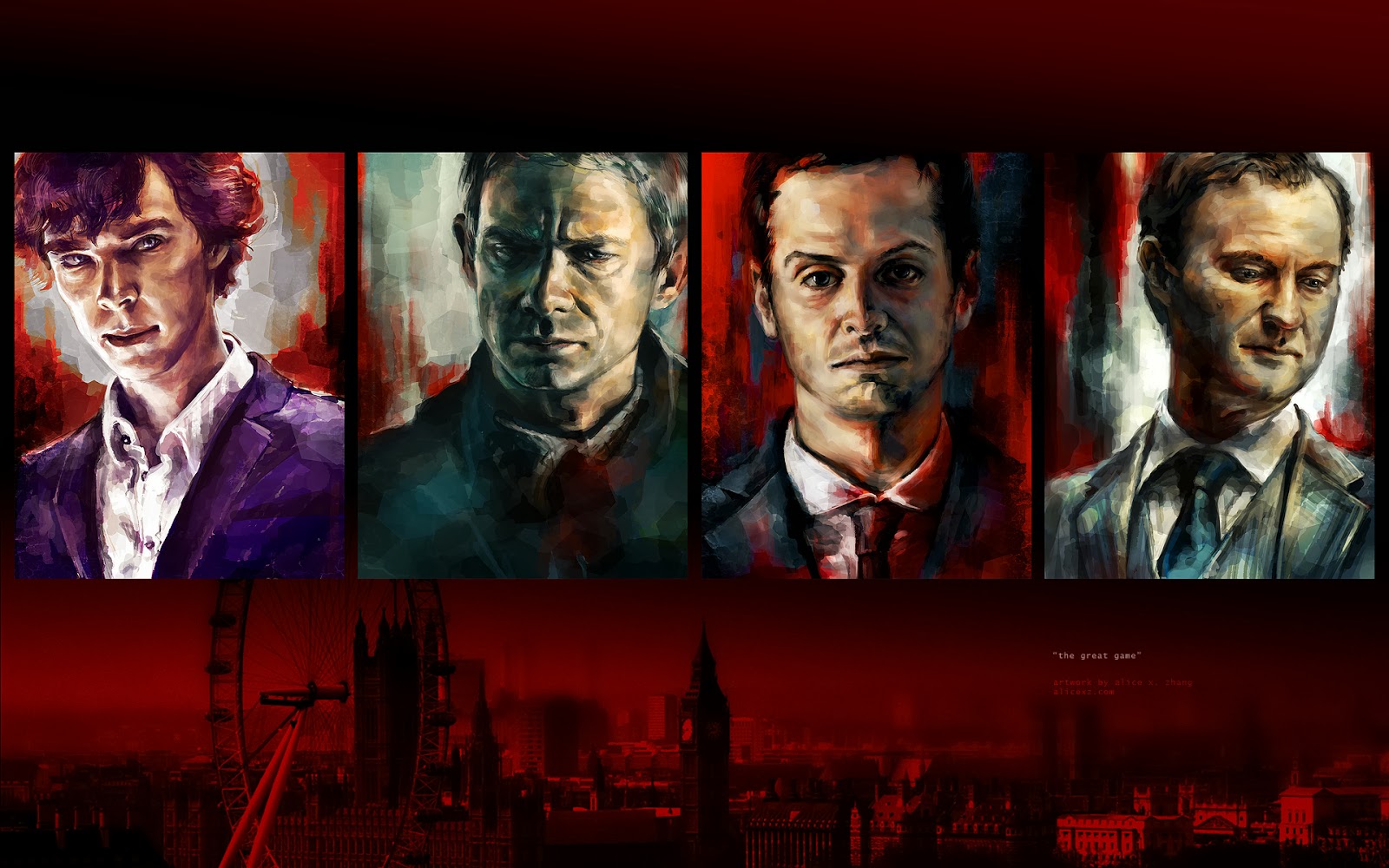
This Sherlock Holmes is the PBS series starring Benedict Cumberbatch and Martin Freeman (Bilbo in The Hobbit). Sunday night was the third (and last) episode of season three. (Only three episodes in a season! What can the British be thinking? Only three?)  I didn’t think the episode could equal the one from the week before – John Watson’s wedding, but it did (it even included a tongue-in-cheek reference to The Hobbit). It’s been a long time since I’ve been this blown away by a television program.

Episode 2 – the wedding – included what has to be one of the most extraordinary wedding toast by a best man (Sherlock) ever. It’s a long segment of the episode; in fact, the episode is largely built around the wedding toast.

As long as it’s available on YouTube, here are two parts of that wedding toast.