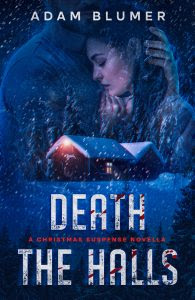
This is one Christmas that doesn’t go exactly as planned.
Lauren Henry is arriving at her family’s cabin, preparing to celebrate Christmas.
With her are her mother and grandmother; Lauren and her grandmother are barely on speaking terms after a spat. Soon to arrive are Lauren’s father and her boyfriend, veterinarian James Coleman, who’s meeting the family for the first time.
At the cabin, the three women discover intruders. Within minutes, Lauren’s mother and grandmother are lying on the kitchen floor, shot and presumably dead, while Lauren is speeding down the mountain on a snowmobile, a killer’s arms holding on to her waist. And the man claims to be her brother.
Adam Blumer
Death the Halls by Adam Blumer is a Christmas novella that you don’t want to start reading as you prepare to go to bed. You’ll want to find out what happens next, and so you keep reading.
And you just may get yourself wired enough to have a sleepless night.
Adam is the author of Fatal Illusions,The Tenth Plague, and Kill Order.A print journalism major in college, he works as a novelist and freelance writer and editorafter serving in editorial roles for publishers more than 20 years. He was the editor for my first two novels,Dancing PriestandA Light Shining. Adam lives in Michigan’s Upper Peninsula with his family.
Death the Halls has a bit of romance in it, but it is more a combined thrilled and mystery. It may not get you into the Christmas spirit, but it’s definitely an entertaining read.
Adam Blumer is the author of three Christian suspense novels: Fatal Illusions (Meaningful Suspense Press); its sequel, The Tenth Plague (Kirkdale Press); and Kill Order (Lighthouse Publishing of the Carolinas). A print journalism major in college, he works full-time from home as a book editor after serving in editorial roles for more than 20 years (Adam was the editor for my first two novels, Dancing Priest and A Light Shining). He lives in Michigan’s Upper Peninsula with his wife, Kim, and his daughters, Laura and Julia.
And he has a new book – Kill Order. Here’s the summary:
“When he sleeps, the forgotten terrors of the past come alive.
“Grammy-winning pianist Landon Jeffers’s brain cancer has given him only a few years to live. But when he sleeps, the forgotten terrors of his past torment him. When he wakes, shameful memories come rushing back. Desperate for answers, Jeffers discovers that a brain implant intended to treat his cancer is really a device to control him, forcing him to commit terrible crimes. Now he’s being manipulated by an evil crime syndicate and a crooked cop.
“What if free will isn’t? What if your every move is predestined? If you kill, are you guilty of murder?”
Here’s what Adam has to say about his writing journey, writing fiction, his faith, and Kill Order.
Tell me about your writing journey. How did you get started?
I’ve loved to write stories since I was a kid and studied novel writing in college. I completed five unpublished novels, mostly for youth, before I began Fatal Illusions, my first published novel, in the spring of 2002 in conjunction with a Writer's Digest correspondence course on novel writing. In January 2006, literary agent Steve Laube, a well-known and respected voice in Christian fiction, responded enthusiastically to my book proposal and asked to see the entire manuscript. Of course, I was on cloud nine. Though he ultimately declined to represent me, he kindly gave me eight suggestions on how to make the novel publishable.
Energized, I followed his advice and got to work, but I still couldn't find an agent or publisher. A year later, I contacted Kregel Publications, not about my novel but about opportunities to edit books from home. The managing editor noticed on my résuméthat I’d written several unpublished novels and asked to see my latest project. Kregel accepted it for publication in August 2007. God opened a door I never could have opened for myself.
What other novels have you written?
My first novel is Fatal Illusions (Meaningful Suspense Press). The sequel is The Tenth Plague (Kirkdale Press). Both are available as paperbacks and e-books.
What inspired you to write Kill Order?
My dad, Larry, passed away from brain cancer in 2011, and several aspects of his cancer journey kicked off the initial story idea. One key detail involved a medical procedure. The doctors agreed to remove as much of my dad’s brain tumor as possible and replace it with medicinal wafers intended to fight the existing cancer. My mind began playing the what-if game. What if the doctor implanted something else, something that could monitor or even control my dad’s life? The story’s premise grew from there.
When did you realize your calling to create words on paper to share with the world?
Adam Blumer
When I was a child, I began writing wildly imaginative pirate and fantasy stories. My first handwritten story was a fantastical tale about Captain Kidd’s spyglass. In high school, I also wrote and finished an unpublished novel called Down with the Ship. It’s such an Agatha Christie copycat that I laugh whenever I peruse it, but emulation is how a lot of authors get to be where they are today. Those were the early projects that inspired me to take novel writing seriously. When I won a high school award for creative writing, I wondered if God wanted to do more with my love for fiction. In college I won more writing awards, and though I studied journalism, I took as many creative writing courses as possible. God opened doors from there, and I’ve never lost my love for fiction writing.
Do you have a favorite Bible verse?
Isaiah 41:10 says, “Fear not, for I am with you; be not dismayed, for I am your God; I will strengthen you, I will help you, I will uphold you with my righteous right hand” (ESV). I’ve always loved this verse, and my wife and I included it in our wedding ceremony.
If you could, what advice would you give to your younger self?
Writing the story is only half of the project. The other half is finding out what readers like to read, crafting the story for them by following publishing standards, and writing the story to the best of your ability. Then remember that publishers can take a very long to decide whether they want your work. Don’t get discouraged. Just keep going and waiting.
What is the hardest part of the creative process of writing?
I rarely have difficulty coming up with story ideas and even an engaging premise, but getting from the beginning to the ending is a circuitous path that can sometimes come to dead ends. The hardest part of novel writing is choosing the right path that comes out at the right ending. There are so many moving pieces and critical decisions along the way that the writer can become paralyzed, overcome by too many choices. If you’re an indecisive person, you’ll never succeed as a novelist.
What do you read for fun?
Authors write what they like to read. When I was a kid, I devoured Hardy Boys books—yes, even my sister’s collection of Nancy Drew. While growing up, I read Agatha Christie, Arthur Conan Doyle, C. S. Lewis, J. R. R. Tolkien, Terry Brooks, Ray Bradbury, and Madeleine L’Engle. Eventually I gravitated to suspense fiction by authors like Frank Peretti, Terri Blackstock, and Mary Higgins Clark. I grew weary of whodunits and preferred suspense novels. I like novels that grab me around the throat, keep the pages turning, and never let go until the final period. Suspense novels filled with plenty of action and conflict captivate me like no other books I read, though I also have a fondness for good literature, fantasy, history, biography, true crime, and science fiction.
What was the hardest part about writing Kill Order? How long does it typically take you to write your novels?
The ending was tough to write. While I’m typically an organized plotter, I took off the training wheels on this one and let the story glide where it and the characters wanted to go. The journey became fun but scary. I had the premise and some plot developments in place, but how the story concluded took more work than I expected.
I typically take at least a couple of years of evenings and weekends for the actual writing of the book. But that doesn’t count the time needed to shop the novel around through my agent and then wait on a publisher before and after the contract; the publishing wheel turns much more slowly than most readers realize. I wish I could write more quickly than that, but that’s the reality for me, since this isn’t my full-time gig.
Your branding on your website is for “meaningful suspense.” What inspired you to write these kinds of thrillers and suspense novels? Also, what inspired your “clean fiction guarantee”?
I began reading Christian novels in junior high and soon gravitated to suspense. Back in the day, an inspirational thread was a staple in Christian fiction, and I believe a Christian novel can do more than simply entertain. These days many authors are leaning toward writing clean, moral stories but avoiding overt Christian content. I’m a believer that the inspirational content should stay (hence “meaningful suspense”). Books can encourage and even challenge readers’ thinking while taking them on a roller coaster of a ride. The “clean fiction guarantee” came about due to the rise of objectionable content in some Christian fiction. My fans were expressing disappointment to me due to content issues when they tried books by some Christian authors. I felt it was time to declare where I stood, and many readers have appreciated my guarantee.
Where is your favorite place to write?
I’ve been blessed with a wonderful home office. Though I often like to write in other locations, this is by far my favorite place. I can close the door, shut out life’s distractions, pray, and become immersed in my story. Now and then, if I need a break, I can glance out the window and delight in God’s creation.
What are you reading at the moment, and who are a few of your favorite authors?
I’m currently enjoying Mind Games by Nancy Mehl. I especially enjoy a good thriller, whether Christian or secular. Some of my favorite authors are Steven James, Terri Blackstock, Frank Peretti, Ted Dekker, and Brandilyn Collins. I like how they weave story threads together and craft their scenes in ways that keeps the plot moving forward. Their books are great examples of what works in suspense writing. I learn so much simply by reading their novels.
What is the best part of your author’s life?
I love hearing from readers who went to work tired because they stayed up too late finishing one of my novels. If I kept them immersed in my story and entertained, that’s a score in my book.
Do you have any new writing projects on the horizon?
I’m almost finished with the first draft of the sequel to Kill Order and hope to have something ready for my agent sometime this fall.
What’s one unusual fact about you?
When I was a kid, for a while I wanted to be a ventriloquist and had a “dummy” named Andy. But then I got braces and could no longer talk through my teeth like I used to. Andy sadly went into storage.
What are your three biggest frustrations about the writing business?
First, the amount of time each book requires from start to finish. Included in this is the long wait time from publishers. Second, the continually changing rules in writing and publishing. Just when you think you know what publishers are looking for, your agent tells you something else. Third, book marketing. One cannot guarantee sales. I wish a book release was like the movie Field of Dreams. “Build it, and they will come.” If only it were that easy. There is almost an equal amount of work in just promoting the book.
What excites you the most about the creative process?
I get most excited about the creative process when a plot development I never saw coming unexpectedly presents itself, taking the story in a new but stronger direction. This epiphany has happened to me several times.
Last week, we announced a giveaway for a copy of the new edition of Adam Blumer's The Tenth Plague. The comment period closed at noon today, and I put the names in a hat (well, it wasn't a hat; it was actually a box) and pulled out Mark's. Congratulations, and you're in for some suspenseful reading!
Today,
my friend (and editor) Adam Blumer
is re-publishing his latest suspense novel, The Tenth Plague.
If you think the novel might have some connection to the 10 plagues visited
upon Egypt in the Old Testament, you would be right. Here’s the summary: “Water
turns to blood. Flies and gnats attack the innocent. Marc and Gillian Thayer’s
vacation resort becomes a grisly murder scene, with a killer using the ten
plagues of Egypt as his playbook for revenge.”
Downton
Abbey it’s not.
Adam is
the author of Fatal Illusions(Kregel
Publications) and now The Tenth Plague (Kirkdale Press). (My review
of Fatal Illusions is here.)
A print journalism major in college, he works as a freelance writer and editor after serving
in editorial roles for more than 20 years. He was the editor for both of my
novels, Dancing Priest and A Light Shining. He lives in
Michigan’s Upper Peninsula with his wife, Kim, and his daughters, Laura and
Julia.
We
asked Adam about The Tenth Plague, and here’s what he had to say.
One
day I was reading the book of Revelation and came across 22:18–19. “I warn
everyone who hears the words of the prophecy of this book: if anyone adds to
them, God will add to him the plagues described in this book, and if anyone
takes away from the words of the book of this prophecy, God will take away his
share in the tree of life and in the holy city, which are described in this
book” (ESV). My mind began playing the “what if” game. Would God really bring a
biblical plague on someone who tampered with His Word? I chatted with a few
theologian friends, and the plot emerged from there.
How
does this novel compare with your first novel, Fatal Illusions?
Though
the plot, of course, is different, the two novels share a number of
similarities. Both are set in Michigan’s Upper Peninsula, where I live. I like
to write about average folks like Marc and Gillian Thayer, a pastor and his
wife who face unexpected, even threatening, events. Of course, there’s another
really bad killer who wants to do them harm, and their retired homicide
detective friend, Chuck Riley, once again comes out of retirement to help them.
I also like to weave in a historical event that somehow relates to the present
day. In Fatal Illusions,
it was the killer’s obsession with Houdini; in The Tenth Plague, an old
mine disaster plays an important role. The past always plays an important role
in the present—a running theme in my novels. Overall, I like to write about
redemption: how biblical truth offers the answers to the complicated issues of
life. Stories, like parables, present some of the best ways to illustrate
biblical truths.
What
was one of the most important lessons you learned during the writing of this
novel?
The
power of the collaborative process. I had a fairly strong first draft, but I
was stuck. A novel editor provided a creative springboard and helped me see
where my true story lay. Without her help, I doubt this story would have seen
the light of day.
Adam Blumer
What
part of writing this novel took the most work?
This
novel required a ton of research. From an old mining tragedy to autism, from
adoption law to anthrax, from pheromones to the Oklahoma City bombing, the
research for this one required much more than I ever expected. I’m so thankful
for technology and ease of access, thanks to the Internet. Without Google and
so many resources at my fingertips, I’d probably still be researching this
story.
So
far, what has been your favorite work experience in life?
During
one summer between years in high school, I worked at a library, a book lover’s
paradise. Granted, a lot of the work involved stocking shelves, but being
surrounded by so many fascinating books and interesting authors was pure
heaven. I was born a die-hard book lover, and I’ll probably die one too.
Consider
the qualities that make you unique. How do these qualities come out in your
writing?
I
love suspense fiction and history, so a blending of the two always seems to
come out in my writing. In high school, I won awards in calligraphy; Gillian
Thayer, my female lead, is into calligraphy in a big way (it’s her job). I’ve
always been intrigued with how one’s past impacts his or her present and future.
This is a recurring theme in my novels because it’s part of who I am. Now that
I think about it, what I write is inseparable to some degree from who I am.
Introduce
your plot summary and main characters. What is your favorite part of the story?
Water
turns to blood. Flies and gnats attack the innocent.Marc and Gillian
Thayer’s vacation resort becomes a grisly murder scene, with a killer using the
ten plagues of Egypt as his playbook for revenge.
When
their friend turns up dead, Marc and Gillian put their vacation on hold, enlist
the help of a retired homicide detective, and take a closer look at the bizarre
plagues as they escalate in intensity. Meanwhile, a stranger is after the
Thayers’ newly adopted baby. Will they uncover the truth behind the bitter
agenda before the tenth plague, the death of the firstborn son?
My
favorite part is when the firstborn son is revealed and the novel culminates in
the tenth plague. This is the most suspenseful and action-packed part of the
story, with several key characters in jeopardy. I had a blast writing it.
One
of the main themes of The Tenth Plague is confronting and dealing with
your past. What can readers take away from this theme, especially in a novel that
deals with religion and death?
Both
the villain and my heroine, Gillian Thayer, grapple with heartbreaking
real-life issues from their past. But how they respond shows two very different
paths. My hope is that readers will see the stark contrast in the context of
biblical truth presented in the story. The bottom line is that God is enough,
and He offers the solution to every problem of life. This is another repeated
theme in my stories. Thank you for the opportunity to talk about my latest
project.
(Some
content used by permission of Kirkdale Press.
This is a revised version of an interview that first appeared here in 2013)
And a giveaway!
To
help celebrate the publication of The
Tenth Plague, Adam is giving away a free copy of the paperback. Just leave
a comment in the comment section, and a name will be drawn at random. Entries
are limited to U.S. addresses. Entry deadline is Monday, April 11, at 12 p.m. Central Daylight Time.
Top illustration: The
plague of locusts was the eighth of 10 plagues visited upon Egypt, as described
in the Book of Exodus in the Bible.
Today, my friend (and editor) Adam Blumer
is publishing his latest suspense novel, The Tenth Plague. If you think the novel might have some connection to
the 10 plagues visited upon Egypt in the Old Testament, you would be right.
Here’s the summary: “Water turns to blood. Flies and gnats attack the innocent.
Marc and Gillian Thayer’s vacation resort becomes a grisly murder scene, with a
killer using the ten plagues of Egypt as his playbook for revenge.”
Downton Abbey it’s not.
Adam is
the author of Fatal
Illusions(Kregel Publications) and now The Tenth Plague (Kirkdale Press). (My
review of Fatal Illusions is here.)
A print journalism major in college, he works as a freelance
writer and editor after serving in
editorial roles for more than 20 years. He was the editor for both of my
novels, Dancing Priest and A Light Shining. He lives in Michigan’s
Upper Peninsula with his wife, Kim, and his daughters,
Laura and Julia.
We asked
Adam about The Tenth Plague, and here’s
what he had to say.
One day I was reading the book of Revelation and came across
22:18–19. “I warn everyone who hears the words of the prophecy of this book: if
anyone adds to them, God will add to him the plagues described in this book,
and if anyone takes away from the words of the book of this prophecy, God will
take away his share in the tree of life and in the holy city, which are
described in this book” (ESV). My mind began playing the “what if” game. Would
God really bring a biblical plague on someone who tampered with His Word? I
chatted with a few theologian friends, and the plot emerged from there.
How
does this novel compare with your first novel, Fatal
Illusions?
Though the plot, of course, is different, the two novels
share a number of similarities. Both are set in Michigan’s Upper Peninsula,
where I live. I like to write about average folks like Marc and Gillian Thayer,
a pastor and his wife who face unexpected, even threatening, events. Of course,
there’s another really bad killer who wants to do them harm, and their retired
homicide detective friend, Chuck Riley, once again comes out of retirement to
help them. I also like to weave in a historical event that somehow relates to
the present day. In Fatal Illusions,
it was the killer’s obsession with Houdini; in The Tenth Plague, an old mine disaster plays an important role. The
past always plays an important role in the present—a running theme in my
novels. Overall, I like to write about redemption: how biblical truth offers
the answers to the complicated issues of life. Stories, like parables, present
some of the best ways to illustrate biblical truths.
What was one of the most important lessons you learned
during the writing of this novel?
The power of the collaborative
process. I had a fairly strong first draft, but I was stuck. A novel editor provided
a creative springboard and helped me see where my true story lay. Without her
help, I doubt this story would have seen the light of day.
What part of writing this novel took the most work?
This novel required a ton of
research. From an old mining tragedy to autism, from adoption law to anthrax, from
pheromones to the Oklahoma City bombing, the research for this one required
much more than I ever expected. I’m so thankful for technology and ease of
access, thanks to the Internet. Without Google and so many resources at my fingertips,
I’d probably still be researching this story.
So far, what has been your favorite work experience in life?
During one summer between years in
high school, I worked at a library, a book lover’s paradise. Granted, a lot of
the work involved stocking shelves, but being surrounded by so many fascinating
books and interesting authors was pure heaven. I was born a die-hard book
lover, and I’ll probably die one too.
Consider the qualities that make you unique. How do these
qualities come out in your writing?
I love suspense fiction and history,
so a blending of the two always seems to come out in my writing. In high
school, I won awards in calligraphy; Gillian Thayer, my female lead, is into
calligraphy in a big way (it’s her job). I’ve always been intrigued with how
one’s past impacts his or her present and future. This is a recurring theme in
my novels because it’s part of who I am. Now that I think about it, what I
write is inseparable to some degree from who I am.
Introduce your plot summary and main characters. What is
your favorite part of the story?
Water turns to blood. Flies and gnats attack the innocent.Marc and Gillian Thayer’s vacation resort becomes
a grisly murder scene, with a killer using the ten plagues of Egypt as his
playbook for revenge.
When their friend turns up dead, Marc and Gillian put their vacation on hold,
enlist the help of a retired homicide detective, and take a closer look at the
bizarre plagues as they escalate in intensity. Meanwhile, a stranger is after
the Thayers’ newly adopted baby. Will they uncover the truth behind the bitter
agenda before the tenth plague, the death of the firstborn son?
My
favorite part is when the firstborn son is revealed and the novel culminates in
the tenth plague. This is the most suspenseful and action-packed part of the
story, with several key characters in jeopardy. I had a blast writing it.
One of the main themes
of The Tenth Plague is confronting
and dealing with your past. What can readers take away from this theme,
especially in a novel that deals with religion and death?
Both the villain and my heroine, Gillian Thayer, grapple with
heartbreaking real-life issues from their past. But how they respond shows two
very different paths. My hope is that readers will see the stark contrast in
the context of biblical truth presented in the story. The bottom line is that
God is enough, and He offers the solution to every problem of life. This is
another repeated theme in my stories. Thank you for the opportunity to talk
about my latest project.