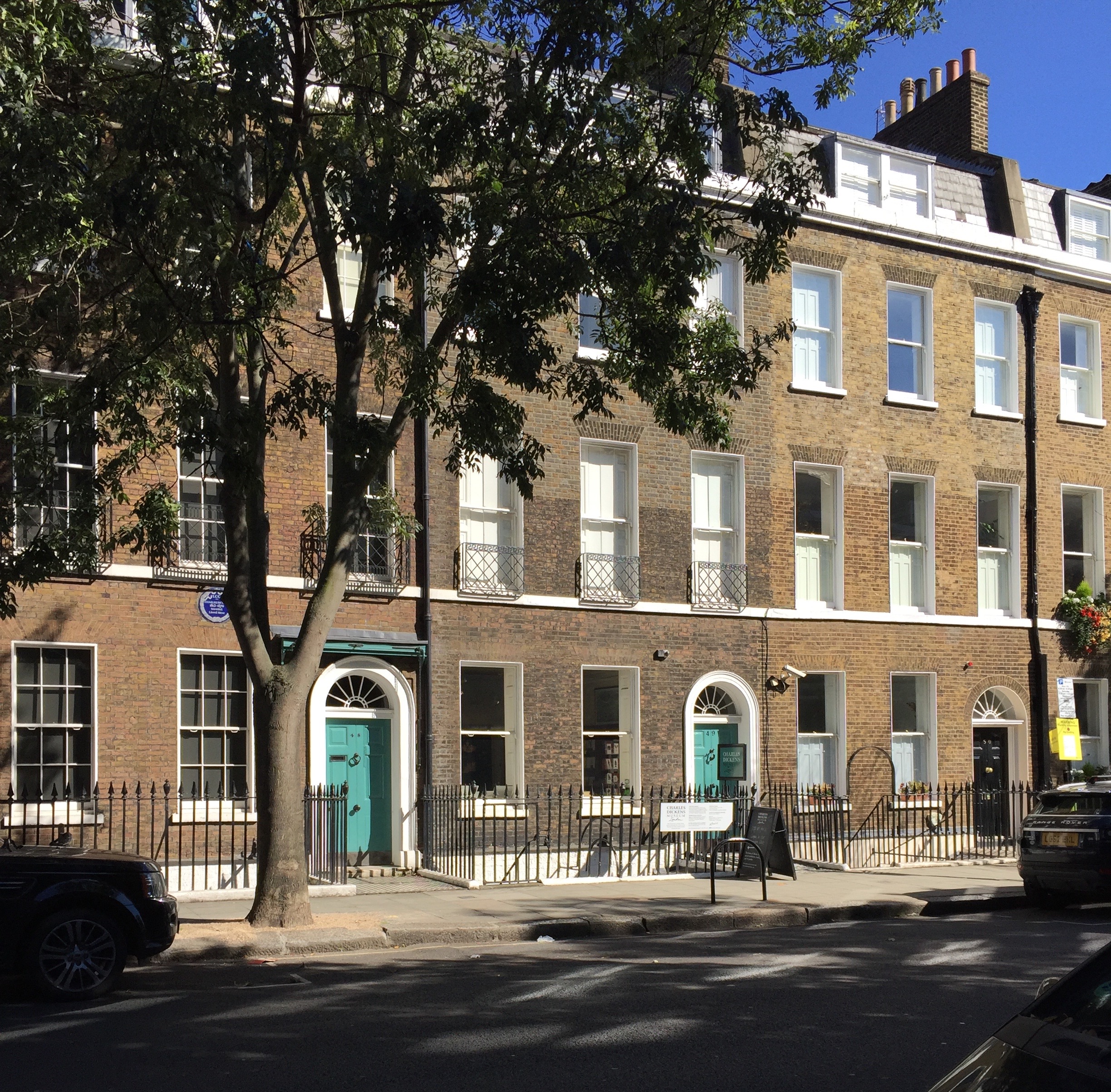
In the last 12 years, I’ve visited the Charles Dickens Museum on Doughty Street in London five times. I tried when we visited the city in 2012, but it but was closed for remodeling, during the 200th anniversary of his birth, no less. In addition to the museum visits, I’ve done a few walks suggested by various guidebooks and maps where you can see what little might be left of the London known and chronicled by Dickens. Some years back, I joined the Dickens Fellowship, a worldwide association founded in 1902 who “share a common interest in the life and works of Charles Dickens.”
It turns out, I follow in a long line of literary tourists, beginning as early as 1865 (five years before the author died) when a friend guided Louisa May Alcott on a tour of sites associated with Dickens. For fans, of which I number myself, the difference between a real site like the house on Doughty Street and the Thames River stairs where Nancy is overheard ratting on Bill Sykes in Oliver Twist is not one of reality versus fiction. Of course it’s fiction. Except when you actually find it.
Lee Jackson, novelist, historian, and academic advisor to the Dickens Museum, knows the real and imagined passions of literary tourists well. In Dickensland: The Curious History of Dickens’s London, he tells the story of literary tourism and Charles Dickens. For a fan of Dickens, it’s both informative and great fun. For people who aren’t fanatics about the subject, it’s a carefully researched and fully documented history of a phenomenon associated with Dickens and perhaps only other author – William Shakespeare.
Jackson explains that the most avid literary tourists happen to be those from North America (I’m in good company). It was American touristsm in fact, who provided the impetus for what is known today as “The Old Curiosity Shop” to accept its fate and become actually that. It was originally an art gallery, and while Dickens might have seen it, it was never the inspiration for the book.
 |
| Lee Jackson |
Dickensland takes you on its own tour, identifying the major sites of Dickens tourism and explaining what connection they did (and didn’t) have. You discover cemeteries, haunted bridges, “great rambling queer old places,” and much more. The author also provides some history of the Dickens Fellowship, how it helped bring the Dickens Museum into existence, and what the museum itself has looked like over the years, including the renovation in 2012 that temporarily closed the place.
Jackson received his doctorate degree from Royal Holloway University of London. He’s written novels, anthologies, and non-fiction books, including A Dictionary of Victorian London (2006), Walking Dickens’ London (2012), Dirty Old London (2014), and Palaces of Pleasure (2019).
Dickensland is a treat for the literary tourist and an entertaining read for those who simply enjoy the works of the man. I count myself fortunate to be both.
Related:
A Week of Dickens: Resources on His Life, Works, Walks, and London.
Some Monday Readings
“Willing to be Useful to His Country”: Robert Q. Shirley of Vicksburg, Mississippi – Jeff Giambrone at Emerging Civil War.
At 200 Years Old, the London National Gallery is Redefining What It Means to Be a ‘National’ Museum – Ann Wallentine at Smithsonian Magazine.
Salman Rushdie Writes Back – Joel Miller at Miller’s Book Review.