Showing posts with label Mississippi. Show all posts

Wednesday, January 25, 2023

Tracing the Life of an Ancestor Isn’t Easy—or Always Accurate


Oral history may not be particularly trustworthy. 

My father was four years old when his paternal grandfather died, so any direct memories he would have had were likely dim. He told me the story, passed down by his father, that his grandfather Samuel Young had fought in the Civil War for the Confederacy, had found himself stranded somewhere in the east when the war ended in 1865, and made his way home primarily by walking. My father said “the Youngs were a family of shopkeepers,” and had lived and worked around Brookhaven in northern Pike Country, and they had owned no slaves. (Pike was a large county; during Reconstruction it was split into two counties, Pike and Lincoln.)


When his grandfather reached home near Brookhaven, Mississippi, my father said, he discovered the family was gone. Neighbors said the entire family had fled to East Texas to escape the devastation of war and Union control. He continued his trek across Louisiana and eventually found his family. At some point, the family returned to Mississippi. My father also told me, again passing down the family story from his father, that Samuel had been too young to enlist, and so became a messenger boy. 


To continue reading, please see my post today at Dancing Priest.


Photograph: My paternal great-grandparents, Samuel and Octavia Young.

Wednesday, December 21, 2022

A Year of Reading the Civil War


For a few years before 2022, I’d been occasionally reading about the American Civil War. It’s something I grew up with; my grandparents were all born after it was over, but their parents lived through it. Tw sets of great grandparents lived through the Union occupation of New Orleans; one set lived in an unoccupied part of Louisiana; and one set survived the war as parts of Mississippi were ravaged by war (and often repeatedly).  

This last group was the Youngs. Three sons and a son-in-law all enlisted in the Confederate army. One, the youngest, was too young to enlist when the war began but somehow signed up as a messenger boy. He was the only one to survive, and he was my great-grandfather Samuel. Not long after the wat, his father died, and Samuel became the family patriarch at the ripe old age of 23 or 24. Samuel lived until 1920; my father was four years old when his grandfather died. 


To continue reading, please see my post day at Dancing Priest.


Photograph: Camp scene, Union soldiers guarding Confederate prisoners; National Archives. 

Monday, December 12, 2022

"The Siege of Jackson, Mississippi" by Jim Woodcock


For most of us, the role of Mississippi in the Civil War revolves around Vicksburg and the months-long siege of that Mississippi River city in 1863 by the army of Ulysses S. Grant. Vicksburg was a critical target for the Union; until it fell, it prevented Union control of the Mississippi River.  

But for Mississippi, the war was far greater a force than only Vicksburg. Northern Mississippi, and cities like Corinth, Holly Springs, and Oxford, experienced the destruction of war before Vicksburg did. From early in the war, the Gulf Coast was effectively controlled by the Union Navy. The state’s citizens experienced increasing degrees of shortages of foodstuffs and basic necessities. 


And then there was Jackson, the state capital.


To continue reading, please see my post today at Dancing Priest.

Monday, December 5, 2022

"Reconstruction in Mississippi" by James Wilford Garner


James Wilford Garner (1871-1938) was born and raised in Pike County, Mississippi, the same county where my paternal great-grandparents were born and raised (during the Reconstruction period, the state legislature split the county into two, with the southern half retaining the name and the north half being renamed Lincoln County). Garner graduated from the Mississippi Agricultural & Mechanical College in 1892 and went on to study at the University of Chicago and Columbia University.  

Garner would become a professor of political science at the University of Pennsylvania and University of Illinois, and he also did extensive teaching work in India. He co-authored a history of the United States with Henry Cabot Lodge, and he published a number of other works on government and political science.


The work he is best known for is his Ph.D. thesis, published in 1901 under the title of Reconstruction in Mississippi. It firmly established him as what was then called the Dunning School, named for Columbia professor William Archibald Dunning. The school of thought generally favored a conservative, more pro-Southern understanding of the post-Civil War Reconstruction period. 


To continue reading, please see my post today at Dancing Priest.

Wednesday, November 9, 2022

"Portraits of Conflict: A Photographic History of Mississippi in the Civil War"


Beginning in 1990 and continuing for the next two decades, the University of Arkansas Press published a series of photographic histories of the Civil War. The volumes were developed by state, using states where a considerable portion of the war was fought. The university press included volumes on Louisiana, Tennessee, Mississippi, Alabama, Missouri, South Carolina, Texas, North Carolina, and Georgia.  

Each volume is structured the same: an overall introduction to what happened to the state and its people during the war, followed by chapters on specific battles, armies, or state events. The emphasis is on the photographs, with each making extensive use of individual portraits of generals and other officers as well as enlisted men. 


Each chapter begins with a narrative, and the photographs follow. An explanatory text accompanies each portrait, explaining who the person was, where they served, what battle or battles they fought, and whether they lived, survived with injuries, or died. 


The volume on Mississippi is entitled Portraits of Conflict: A Photographic History of Mississippi in the Civil War. It was the third volume in the series, published in 1993. 

To continue reading, please see my post today at Dancing Priest.

Monday, October 31, 2022

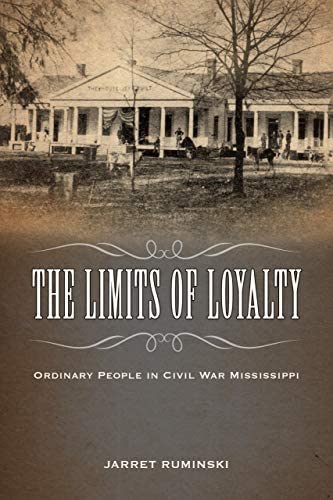
"The Limits of Loyalty" by Jarret Ruminski


We often get images, based on stereotypes, stuck in our heads about history. The antebellum and Civil War periods are no exceptions. We think the South was nothing but large plantations with thousands of slaves. We also might think that every Southerner tightly embraced secession and the war and retained that embrace until surrender in 1865. 

These images are two-dimensional cartoons, with more or less an element of truth. The reality was considerably different. Most Southerners were small farmers, not big plantation owners, who did have an outsized presence in issues of the days. Likely most white Southerners did support secession, but that support began to wane as early as 1862. Fewer than half of white Southerners were slaveowners. And the state of Mississippi is a good example.


In The Limits of Loyalty: Ordinary People in Civil War in MississippiJarret Ruminski takes a deep look at what happened in the state over the period 1861-1865. The time in which people’s nationalist sentiments and actions were most closely tied to the Confederacy was, unsurprisingly, early on. By 1862, as parts of the state began to experience invasion and destruction (and Mississippi experienced considerable amounts of both over the course of the war), sentiment shifted. Other loyalties, like to community and family, began to take precedence over feelings about the Confederacy and even the war. For many, and especially for women left at home with children and small farms and businesses, family survival became the overriding issue.


To continue reading, please see my post today at Dancing Priest

Monday, October 3, 2022

"the Civil War in Mississippi: Major Campaigns and Battles" by Michael Ballard


If there is a state we most associate with the American Civil War, it is Virginia. Numerous battles occurred there; the federal and confederate armies faced each other for four years, most often in a stalemate; and the two enemy capitals ensured that Virginia was a major theater of the war. And it was in Virginia that Robert E. Lee ultimately surrendered to Ulysses S. Grant.  

Some have argued that the United States really won the war farther west – the fall of New Orleans and Vicksburg, the battles around Nashville and Chattanooga, the capture of Atlanta in 1864, and Sherman’s March to the Sea. 


And then there was Mississippi, the second state (after South Carolina) to secede from the Union. The Civil War in Mississippi was more – far more – than Vicksburg. Historian Michael Ballard (1946-2016) tells the story in The Civil War in Mississippi: Major Campaigns and Battles (2011). The book is volume 5 of the Heritage of Mississippi published by the University Press of Mississippi for the Mississippi Historical Society and the Mississippi Department of Archives and History.

To continue reading, please see my post today at Dancing Priest.

Wednesday, April 13, 2022

“The Real Horse Soldiers” by Timothy Smith


From April 17 to May 2 of 1863, a group of some 1,700 Union cavalry traveled from LaGrange Tennessee to Baton Rouge, Louisiana. In less than three weeks, they cut a swath through central Mississippi surprising Confederate forces, Mississippi’s governor, and a number of cities and small towns along the way. Their goal: disrupt Confederate supply lines and draw attention from General Grant’s crossing of the Mississippi River right below Vicksburg. 

The cavalry, under the command of Colonel Benjamin Grierson of Jacksonville, Illinois (and a music teacher in civilian life), were wildly successful. Grierson’s Raid, as it became known, was celebrated in the North and even grudgingly admired in the South. It had pulled off what few thought possible.


One might think that such an event would have been the subject of numerous books. For whatever reasons, possibly including a bias toward the eastern battle front in the Civil War, few book-length accounts are to be found. Dee Brown, author of the Pulitzer Prize-winning Bury My Heart at Wounded Knee, published Grierson’s Raid in 1954. It was not well received by critics, and its reputation has not improved with time. Brown often made fast and loose with his account, inventing conversations and scenes out of whole cloth. Even a non-historian like myself can read it today and see where Brown fudged, or invented, his facts.


To continue reading, please see my post today at Dancing Priest.

Wednesday, April 6, 2022

Grierson's Raid and "The Horse Soldiers"


After I started elementary school, I became the movie partner of my mother. My father rarely went to the movies; my mother had been starstruck since she was a child. During the summer months, and on weekends during the school year, I accompanied her to one of the big theaters in downtown New Orleans to watch the latest movie she was interested in. We started with the Disney films – my earliest remembered movie is Bambi, the 1942 film which I would have seen via re-release in 1956 or 1957. 

My most vivid memory was going to the Saenger Theatre on Canal Street to see The Last Voyage, starring Robert Stack and Dorothy Malone. Released in 1959, it was a tension-filled story about a passenger liner sinking in the Pacific, with rescue boats too far away to reach it before it sank. I cried through most of the movie. My mother felt so bad for taking me to see what was an adult-themed movie that, when it ended, she took me across Canal Street to see Some Like It Hot at the Joy Theatre. It was certainly funny, but it was even more adult-themed than The Last Voyage


That same year, she took me to see The Horse Soldiers, a Civil War epic starring John Wayne and William Holden. (She liked John Wayne, but William Holden was one of her three favorite actors, with Robert Stack and Clark Gable rounding out the list.) The movie was based upon a 1956 historical novel of the same name by Harold Sinclair. The book itself was based upon a true story generally referred to as “Grierson’s Raid.” 


To continue reading, please see my post today at Dancing Priest.

Tuesday, November 6, 2018

From Breathing Britain to Immersion in the Civil War


Researching a historical novel is more than a challenge; it feels like a career.

 I’ve written four novels in a series, with the main characters staying intact throughout. Buzzing around my head is the fifth, but I’m departing from the series to do something completely different.

The new project is still a novel, but it’s not even remotely like what I’ve been doing for the past seven years. Since 2011, I’ve been writing, breathing, talking, reading, researching, marketing, and visiting (five times) all things Britain. Now I find myself in small-town Mississippi.

The idea is based on a piece of my family’s history, and it’s been sitting there, simmering for a very long time. It concerns the American Civil War, and specifically the months immediately after the end of the war. It’s based on an off-hand comment my father made more than 40 years ago: “Your great-grandfather was too young to enlist as a soldier in the army, so he did something else.” It’s the something else that intrigued me, and it was also what he found when he returned home in late 1865 – his family was gone.

To continue reading, please see my post today at the American Christian Fiction Writers blog.

Illustration: Images of the burning of Atlanta, November, 1864, via Library of Congress.

Monday, June 12, 2017

“The World’s Largest Man” by Harrison Scott Key


Harrison Scott Key is funny. I’m reading The World’s Largest Man, published in 2015, and I find myself laughing out loud, not once but many times. This memoir of growing up with a larger-than-life father in Mississippi doesn’t only ring true; it rings familiar. My own father didn’t hunt or fish, but in many respects he resembled Key’s father. I suspect this may be true for many of us who grew up in the South from the 1950s to the 1980s.

We know this man. He does funny things, crazy things, sometimes mean things, sometimes shockingly unexpected and kind things. He can drive his wife and out mother crazy. And if we are not like him, we will believe he is forever disappointed in us.

Key tells his story with humor. He didn’t like hunting, and his father (and his stepbrother) loved it, seeing it not only as something to do but something vital and important to do. He often didn’t know what to think of a son who liked to read, studied hard, enjoyed shopping with his mother (shopping?), and didn’t think the epitome of life’s experiences was sitting in a deer blind in freezing temperatures. Conflict was inevitable.

Key also tells his story with a very subtle pain. The humor betrays the pain. It can’t be helped with a larger-than-life father; a son’s pain is inevitable. And the pain is there in this very funny book.

The World’s Largest Man is officially a memoir, but it reads like two memoirs, one about Key and his father and one about Key and his marriage. It might have better as two books, but it still works as one.

Harrison Scott Key
A contributing editor at Oxford American Magazine, Key has published nonfiction and humor in The New York Times, Outside, The Best American Travel Writing, Southern Living, Salon, Reader’s Digest, and many more. He teaches at the Savannah College of Art and Design. He and his family live in Savannah, Georgia.

The World’s Largest Man won the 2016 Thurber Prize for American Humor. And with good reason. It’s funny and often wildly funny. But then it would have to be, to account for a father like that.


Top photograph by Livin4Wheel via Unpslash. Used with permission.