Showing posts with label genealogy. Show all posts

Thursday, May 7, 2026

Five Ways to Research Your Family History


The writing of my historical novel Brookhaven took about 150 years. 

I must have seen something like this before, but I can’t recall a specific example. Many novels include an acknowledgement page, cutting the people who helped or inspired the author. My historical novel Brookhaven has an author’s note explaining some of the novel’s background. But it also has something you don’t usually see in a novel – a nine-page bibliography.


I included more as a reminder to myself of where the novel come from. 


A grandmother who referred to the Civil War as the “War of Northern Aggression.” A father who told slightly mangled family stories, including one that sounded like an epic journey. A research paper in high school on what the “plantation system” really looked like. A family Bible with a mystery embedded in the birth and death records. A mountain of reading old and new American history books. An aunt who spent decades researching family history, long before the invention of the internet. Discovering I liked, as in really liked, the poems of Henry Wadsworth Longellow, once the top-selling poet and author in the United States who was dropped into the dustbin of literary criticism. 


Photograph: A page of family records in the Bible, pre-preservation.


Some Thursday Readings


This Just In – poem by J.S. Gilbert at Frivolous Quill.


Murmurs in the Cathedral – Jeffrey Streeter at English Republic of Letters.


Third Annual Poetry Prize for Submissions – First Things Magazine.


“A Look at the Heavens,” poem by John Clare – Sally Thomas at Poems Ancient and Modern.


Poet Laura: Mother in Satin – Donna Hilbrt at Tweetspeak Poetry.

Wednesday, January 25, 2023

Tracing the Life of an Ancestor Isn’t Easy—or Always Accurate


Oral history may not be particularly trustworthy. 

My father was four years old when his paternal grandfather died, so any direct memories he would have had were likely dim. He told me the story, passed down by his father, that his grandfather Samuel Young had fought in the Civil War for the Confederacy, had found himself stranded somewhere in the east when the war ended in 1865, and made his way home primarily by walking. My father said “the Youngs were a family of shopkeepers,” and had lived and worked around Brookhaven in northern Pike Country, and they had owned no slaves. (Pike was a large county; during Reconstruction it was split into two counties, Pike and Lincoln.)


When his grandfather reached home near Brookhaven, Mississippi, my father said, he discovered the family was gone. Neighbors said the entire family had fled to East Texas to escape the devastation of war and Union control. He continued his trek across Louisiana and eventually found his family. At some point, the family returned to Mississippi. My father also told me, again passing down the family story from his father, that Samuel had been too young to enlist, and so became a messenger boy. 


To continue reading, please see my post today at Dancing Priest.


Photograph: My paternal great-grandparents, Samuel and Octavia Young.

Wednesday, September 7, 2022

Restoring the Family Bible


More than 40 years ago, my father gave me the Young Family Bible. It had been given to him by his father, who’d received it from his father. The value of the book, as experts like to say, was “intrinsic,” In other words, it was zero, except for what a family member would believe. 

The book as received from my father was wrapped in brown grocery-bag paper and tied with twine. It has sat on a closet shelf in my parents’ house for a long time, probably since they moved there in 1955. I have very vague memories of it from childhood. 


When my father gave it to me, I did the time-honored thing: I put it on a closet shelf. Eventually, I removed the wrapping and twine and wrapped it in acid-free paper and a box. Its value to me and the rest of the family was what it contained – four pages, inserted between the Old and New Testaments, of family births, marriages, and deaths. The earliest date was that of my great-great grandfather’s birth in 1802; the last date was in 1890. All of the events were written in the same hand – my great-grandfather’s Samuel Franklin Young. He also wrote his signature on an inside cover. 


To continue reading, please see my post today at Dancing Priest.

Thursday, May 5, 2022

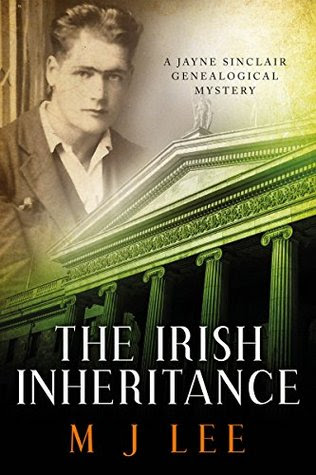
"The Irish Inheritance" by M.J. Lee


Jayne Sinclair is a former police detective, now turned private genealogical researcher. An elderly American dying of cancer gives her what looks to be an almost impossible task: identify his birth parents. All he knows is that, when he was 4, he was adopted from a British orphanage by an American family. He has a photo of his and his adopted father at that time and a book. The child is desperately clutching the book in the photograph: The Lives of the United Irishmen. His birth certificate lists the names of his birth parents. The only problem is that his father died in World War I, six years before the elderly man was born. 

Jayne sets to work. Her husband Paul is not impressed; their marriage is foundering, and Jayne always seems more interested in work than in trying to salvage their relationship. And he’s right; she believes their marriage is dead.


The research task looks almost impossible, and Jayne has only eight days to complete it. Her client is dying from leukemia, and he must return to the United States. Slowly, she makes progress. And she will eventually discover something the reader knows long before she does: someone doesn’t want her to complete the research and has gone so far as to hire a hit man to take care of the problem if necessary. And then elements of the IRA get involved.


M.J. Lee

The Irish Inheritance
 is the first of seven Jayne Sinclair genealogical mysteries by British author M.J. Lee, and it’s a fast-paced, action-packed story that not only entertains but also teaches some 20th century Irish history. Lee alternates the story between Sinclair’s investigation in 2015 with what happened during the Irish Easter Rebellion in 1916 and the uprising against British rule in the early 1920s.


In addition to the Jayne Sinclair mysteries, Lee has also published two other crime-related series, the Ridpath series and the Danilov series. He’s also the author of Samuel Pepys and the Stolen Diary. Writing as Martin Lee, he’s published The Fall, a historical novel about the fall of Singapore during World War II. He lives in the United Kingdom. 


If you like genealogy tied to a current-day mystery, The Irish Inheritance is written for you. And if you only like a good mystery story, it’s written for you as well.