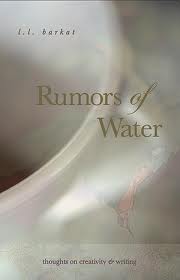
Showing posts with label Rumors of Water. Show all posts

Tuesday, May 1, 2012

It Was Simply Time


When did I know I wanted to be a writer?

At 10, I wrote a mystery story by hand in a paper book bound by my father at his printing business. But I wasn’t considering writing as a career – I was too young and it was just something fun to do.

In high school, my favorite classes were always English: Dickens, Shakespeare, Twain, Harper Lee, Cervantes. I was thinking about medicine as a career – my father had wanted to be a doctor but his dream was short-circuited by the Great Depression.

In college, I took the introductory English classes the English majors had to take – English Lit: Beowulf, Chaucer, the Venerable Bede, the Elizabethans, Milton, Boswell, Goldsmith, the Romantics (all those poets), the Victorians, the Moderns, ending somewhere around T.S. Eliot. In my fraternity, I was the unofficial English tutor for pledges (and some active members) who had trouble with English, which was most of the fraternity. I read scores of papers on Nathaniel Hawthorne’s “Young Goodman Brown” and Faulkner’s “Barn Burning.” Sometime around the end of my freshman year I dumped medicine (all that chemistry) and embraced journalism, teaching myself to type (required) the summer before I started journalism school.

It was in those journalism classes that I began to see writing as a possible career. My first job after graduation was copy editor for a newspaper in Texas. From there I moved into public relations, and then into speechwriting.

When I was 24 and working in Houston for a big oil company, a friend at work and I began talking about writing projects – projects that had nothing to do with work. She was writing non-fiction, about what happens to our minds and personalities as we age, and I was working on a novel. Entitled “Sisters,” it was the story of two elderly, unmarried sisters whose story began in an a tragedy, a tragedy that one of them didn’t know about (yes, I know it sounds like “Whatever Happened to Baby Jane?” but it wasn’t anything like the movie). I never finished it, but it was fun to work on, talk about, and submit to an editor at a writer’s conference.

I wrote short stories when I was 27 and 28. None were accepted for publication.

For the next 25 years, my fiction writing was on hold. It was the time of babies and career and children and little league and career and teenagers and career. Somewhere in there I got a masters degree – in liberal arts, taking a lot of literature seminars like “The Latin American Novel.”

And then in 2002 came the beginnings of Dancing Priest. I’ve described in a number of places how it started – a meeting with a young German minister in Erfurt and hearing a Greek singer on an in-flight music program. That’s how it started, but that’s not why it started.

It was time. That’s all. It was simply time to do it.

In Rumors of Water: Thoughts on Creativity and Writing, L.L. Barkat says this: “I believe a writer can make writing happen, sit down and stir from grass or leaves or snow. But I also believe it takes time to write. Each book I’ve written, in some sense, could not have been written before its time.”

Sometimes, most of the time, it just takes time. The right time.


Over at TweetSpeak Poetry, we’ve been discussing L.L. Barkat’s Rumors of Water. This week completes the discussion of the book, led by Lyla Lindquist. The main post will be up tomorrow.

Tuesday, April 24, 2012

Why Publish?

My head’s swirling. I’m editing, rewriting, drafting, doing other projects, maintaining a rather hectic if not torrid pace when I’m suddenly stopped cold by a question.

Why do I want to publish?

I have one novel published. A second one is being edited.

Why?

It’s not as if the first one has been so wildly successful that I can live off the royalties. So why am I doing this again, when this second one has turned out to be more of a wrestling match than I expected.

Is it because I feel called by God to do this? Actually, no. I’ve talked before about “being called” to be a writer, and I’ve never heard that call. My call is the call of every Christian – to know God, and to honor and serve God in all I do. That includes my family, my friends, my job, mu church, people who don’t particularly like me, how I deal with rudeness and trials and setbacks and successes. That includes writing, too, and publishing a second novel. But I’ve ever felt “called” to publish.

Is it personal pride or vanity? I think the answer to that question is also no. Publishing a book is to travel to the land of disappointments, unmet expectations, surprises, uplifting encouragement and depressing discouragement. The world is not going to beat a path to my door. I’m not going to get oohed and aahed over at writers’ conferences. No, publishing a book isn’t about pride or vanity. If that is even a part of it, you’re going to be brought down to reality pretty quickly.

The fact is, I knew all of this going into it. I had seen enough of others’ experiences to know what to expect. It’s a trial for first-time novelists, but even well established ones find themselves with a large, well known and respected publisher who overlooks marketing (except for a press release), or editors suddenly changing and the latest manuscript of no interest to the new editor, or the publicity firm dropping the ball, or a million other things.

So unless your name is Karen Kinsgbury or Max Lucado or Billy Graham or Stephen King or John Grisham, you can’t take anything for granted (and I suspect even those authors can’t take anything for granted).

So why do I want to publish?

The reason is simple. I have a story to tell, a story that’s been part of my life for a decade or more, and it was and is time to push it out and let others see it.

In Rumors of Water: Thoughts on Creativity and Writing, L.L. Barkat has some good advice about publishing:

Learn if you’re really ready to tackle the story you want to write. Sometimes you need to calculate the cost, and I’m not speaking of the financial cost but the emotional and even spiritual cost. The story you have to tell may still be too raw, too “unborn.”

Write for small audiences first.

Learn how to connect (or network) and how to hold back  or “not network” – there are ways to “not network”).

Understanding the economics of publishing – what a publisher has to risk and what you have to risk if you self-publish.

I followed some of this advice. But for what advice I didn’t follow, I knew I wasn’t following it. And I knew why.

I still went forward.


Over at TweetSpeak Poetry, Lyla Lindquist is leading a discussion on L.L. Barkat’s Rumors of Water. This week, we’re covering the six (short) chapters on publishing. The links for other posts will be live on Wednesday.

Monday, April 16, 2012

Writing Habits


I’m editing and rewriting a manuscript right now, the sequel to Dancing Priest. The characters are mostly the same but the story moves in a very different direction. I think of it as an ongoing love story – but one engulfed by world events.

I read the manuscript straight through this past weekend, when we took a few days off and spent time at Lake of the Ozarks. We had a large room, with a living room and kitchen, and I read in the early morning hours while my wife slept in.

Like its predecessor, this manuscript reads quickly. It has about the same amount of emotional scenes; a couple of times my wife woke up and wandered into the kitchen area to find me sniffling. (Is it okay to cry when you read your own stories?).

I have a lot on my writing plate right now, this manuscript being the most important and time-consuming. It’s the “big” project of the moment, but not the only one:

And, yes. I do have a full-time job, too.

It seems overwhelming, and it would be overwhelming, except that I’ve made it work together. And I find I’m managing my time better than I ever have before.

In Rumors of Water: Thoughts on Creativity and Writing, L.L. Barkat cites several principles to “cultivate and protect” one’s creative center: have goals; rest on a weekly basis; coose writer friends carefully; choose share-timing wisely ( watch whom you share your writing with, how much you share and at what point you share it); and watch for siphons – those projects and things that will drain time and energy away.

I’ve surprised myself with how closely I’ve been following these guidelines.

Two of the columns I write are about poetry, which I’ve been a lot of for years. Reading poetry is a focusing kind of activity for me.

Blog posts are often extensions of other work – what doesn’t fit in a column for The High calling may become a blog post, for example. I waste what I write very sparingly, and very little is ever useless. I keep a lot of things I don’t use immediately for future use. Not much is subject to the delete button.

A lot of what I do could become siphons, except I’ve focused them in a particular way.

All of these writing activities are helping the main project – the manuscript. Writing a poem helps focus my mind, and has even solved a problematic section in the text more than once.

I haven’t shared the manuscript with anyone yet (“choose share-timing wisely!”), and I won’t until I’m satisfied that it’s ready to be read.

And sometimes I rest. Or play.


At TweetSpeak Poetry, Lyla Lindquist is leading us in a discussion of Rumors of Water. The main discussion will post on Wednesday. 

Thursday, April 12, 2012

Voice, Part 2: The Passion of Place

In writing, as in life, a sense of place is important. I define “place” as geography – real and imagined. In my novel Dancing Priest, place stretches from Edinburgh and London to Athens, Los Angeles and San Francisco. In particular, San Francisco occupies an important place in the story, both the “macro” environment of the city itself and the “micro” environment of the area around the fictitious St. Anselm’s Church.

I have been to San Francisco many times, but I’ve never lived there. I’ve been in the approximate area where I located St. Anselm’s Church, so I had a general sense of the location – the warehouses and the nearby shops. San Francisco will be the major setting for the novel’s successor (as yet untitled).

Place is important. And the odd thing is that, the older I get, it’s becoming more important.

I was born and raised in New Orleans, a city that’s unique in the United States. I could and probably would argue that it’s the least American city in the country, more like a Caribbean city. And I was always something of an exception – a Protestant raised in a largely Catholic city; a father from north Louisiana, not a native New Orleanian (and a father with a slight Southern accent that had been largely ground out of by World War II); and my distinctly non-New Orleans accent. My New Orleans-accented mother and my Southern-accented father produced a child who sounded like he was from the Midwest.

Another exception: the suburb I was raised in was the most American suburb in this less-than-American city. By the time I left elementary school, new names were mixing into the classrooms that had previously been full of Thibodeauxs, Charbonnets, Heberts, Melancons, and Chenovas. New names were coming in – Clarks, Pollocks, Pells, Smiths, and Wells – children of the engineers and scientists coming from all over the country to work at the huge NASA facility in the city.

The kids spoke American English instead of New Orleans English, adding to the gumbo of dialects saturating the city. Their parents, who invariably spoke Yankee English, were not quite prepared for a place like New Orleans – and always managed to offend the natives by asking why everything seemed so dirty, like the blind date I had with a girl from Arizona who said the French Quarter resembled the slums in Phoenix.

And it was a time of social change. I can remember as a child separate water fountains and restrooms marked “white” and “colored.” There was a color line on the buses – you knew without being told where to sit. Motels and restaurants were segregated. I attended all-white elementary and middle schools – and an integrated high school. My parents were frantic to get me into a private high school, until I told them I was going to the public school, ending a family trauma that looks rather ridiculous in hindsight but which had been incredibly intense. I was a junior in high school when Dr. Martin Luther King was killed in Memphis; panic gripped New Orleans but nothing happened.

I went to Baton Rouge for college and never again lived in New Orleans. The jobs weren’t there. Like so many of my college friends, I ended up in Texas. And we’ve lived in St. Louis for the last 33 years, and in our current home for almost 26 years, longer than anywhere else.

Yet New Orleans still has a hold on me. I’ve lived in St. Louis longer, and St. Louis is similar in many ways (the same immigrant groups settled both cities; both situated on the Mississippi River; both part of the Louisiana Purchase), but St. Louis is different. For one thing, so much of it is red brick.

New Orleans had much to do with shaping me in numerous ways, perhaps most of all as a writer. The city instills in its natives a certain attitude, a combination of laissez-faire, manners masking an array of social mores, an offbeat humor, and a longstanding mistrust of authority and experts long before it became a national characteristic.

I can still speak the New Orleans voice. I can do a pretty fair imitation of the “Nawlins” accent, and even a Cajun French accent (appropriate for reading The Cajun Night Before Christmas).

But I write in a voice that has been influenced by coffee-and-chicory, Mardi Gras king cakes, the three seasons of summer, July and August, a mother born and raised in the Ninth Ward, finding my way through social upheaval, the most important place in Pirate’s Alley being the Faulkner Book Shop, an elementary school always smelling like steamy thick mud after a heavy rain, streetcars running down the middle of Canal Street, the business district reeking of strong coffee grounds, strange homes called shotgun houses and camelback houses, the beauty of the residences along St. Charles and Esplanade avenues, and the French Quarter itself, with the tackiness of Bourbon Street and the magnificence of St. Louis Cathedral.


Over at TweetSpeak Poetry, Lyla Lindquist has been leading a discussion of Rumors of Water: Thoughts on Creativity and Writing by L.L. Barkat. This weeks’ discussion is about “voice,” about which Barkat says this: “To have voice, a writer must have passions and a sense of place.”


Photograph, bottom: St. Louis Cathedral from Pirate's Alley, French Quarter, New Orleans.

Monday, April 9, 2012

Voice, Part 1: Almost Losing It


“To have a voice,” L.L, Barkat writes in Rumors of Water: Thoughts on Creativity and Writing, “a writer must have passions and a sense of place.”

I think of Wendell Berry, with his passion for a kind of neo-agrarianism and his region of Kentucky. I think of William Faulkner and his passion for a way of life that had disappeared in his native Mississippi. I think of Charles Dickens in Victorian Britain and all of the passions that coursed through his novels (mostly centering in questions of social justice).

We don’t have to be a Berry, a Faulkner or a Dickens to have a voice.

But for a long time, I wondered if I indeed had a writing voice of my own.

From about 1975 to 2006, speechwriting was a significant part of my career. In those three decades, I wrote for 12 CEOs, numerous other corporate executives, people running for office, a school board president and a few non-profit executives as well.

To write a speech for someone else, and to do it well, you have to essentially assume their voice – both their speaking voice and their “personal” voice. Over time, I learned to “channel the speaker” and write in their voice – their stories, their ideas, their hopes, their favorite quotes and authors, their speaking patterns and their idiosyncrasies. I read what they read, I listened to their taped speeches, I watched their videos. I talked with them and listened to them in meetings and conversations.

Most PR people hate speechwriting, and with good reason, Speechwriting is never about you.

The best speeches I wrote sounded exactly like the executive who was speaking. My own desires, messages, thoughts and hopes tended to be suppressed. The time to articulate them was in conversations with the executive about the speech. If he or she liked them, they became the executive’s.

When I stopped writing speeches for others about five years ago to do other things, The thought was in my mind that my voice might be permanently locked up. It was probably no coincidence that I started doing a lot more writing for myself – the series of novel manuscripts, one of which became Dancing Priest; this blog (now three years old and counting); writing for The High Calling, The Master’s Artist and TweetSpeak Poetry; guest posts and articles; and speeches and presentations for myself.

It turns out my voice had only been on the back burner, but it had been there all along. It has been wrapped together with my passions and my sense of place.

I’ll have more about that on Thursday.


Over at TweetSpeak Poetry, Lyla Lindquist is leading a discussion of L.L. Barkat’s Rumors of Water. She’ll be posting on the five short chapters comprising the section on “Voice” on Wednesday. 

Monday, April 2, 2012

Rumors of a Title


Laura Barkat begins her book Rumors of Water: Thoughts on Creativity & Writing with a problem – she’s having difficulty writing, at least on a sustained basis. Too many other things to do, too many distractions and priorities. A friend visits, she talks about the problem and then asks her daughter Sara to get her a glass of water. Sara returns with a “There are rumors of water but I couldn’t find any.”

Sometimes, when the water’s not there, rumors of water may be sufficient.

I am editing the manuscript that is the sequel to Dancing Priest, and I’m having difficulty. The draft is done; the draft has been done for some time. I know the story; I know where the story will go if there are any other volumes in the series. The problem is the title, and it’s indirectly affecting the editing and rewriting.

The problem is I don’t have a title.

The manuscript has had a working title for years. But the working title no longer fits – it would be better for the third volume in the series (assuming there is a third volume) and it would give too much of the story away.

So I’ve cut the manuscript loose from its working title, but don’t yet have a substitute. The story is easy enough to summarize: Michael Kent and Sarah Hughes are married and establishing their family when they are faced with extraordinary circumstances, including death and destruction. The story is still a kind of romance, but it is other things, too, and it speaks to some of the issues our culture and civilization face.

Originally, this manuscript was part of Dancing Priest. But after 150,000 words came pouring out, it had to be divided. The division occurred at a natural place, but the working title for the second manuscript really only fit the very end of the story.

So I’ve been fretting and worrying the idea of the title. Do I keep “Dancing” in it? Likely not, since there isn’t any dancing in this story. So I have to call it something other than “this thing,” and “new manuscript” works for only so long.

I’ve been moving slowly through the editing and rewriting – checking, adding, deleting, amplifying, deemphasizing. The biggest change has been to add certain short scenes at key places, with the effect of adding tension and even some sense of foreboding.

But what do I call this? For now, it’s a story without a name, which makes it something like a person without a name. And a name (or title) is always important. It defines, limits, and expands. It helps frame the story and even serve as something of a centering device.

I’ll take Laura Barkat’s advice and settle for a rumor of title.

Perhaps something like “A Light Shining.”


This week at TweetSpeak Poetry, we’re beginning a discussion of Rumors of Water, led by Lyla Lindquist. For Wednesday, we’re discussing the short selections that comprise the first section, entitled Momentum.

Last year, I reviewed Rumors of Water, and you can find it here.

Thursday, October 20, 2011

"It's Not Exactly What Happened"

In August, writer and poet L.L. Barkat published Rumors of Water: Thoughts on Creativity & Writing (for more information on the book, you can click on the badge to the right). It’s not the usual book you run across on writing; it has a lot to do with children, and teaching, and learning, and stories about Big Bird in China, and weeding vegetable gardens. In short, it’s about writing and life.

Today, I have an interview with Barkat over at The High Calling, in which she talks about book, how it originated, how she wrote it, and what it’s about. Please visit The High Calling to read L.L. Barkat on writing.

Tuesday, September 6, 2011

L.L. Barkat's "Rumors of Water"

It at first seems almost incongruous, to create a book for writers within the structure of the everyday activities of one’s children. But that’s exactly what L.L. Barkat has done in Rumors of Water: Thoughts on Creativity & Writing.

Of course, it helps if you bring extensive experience as a writer, as the author of three previously published books, as the editor and or publisher of four books by other writers (and more on the way), as the managing editor of an online site for faith, culture, work and family, and as a contributing writer for Curator Magazine. And it helps if you’ve been homeschooling your children for several years, and that you were once a public school teacher. But still, it seems something of a stretch.

It works. It works stunningly well. It works so well that I think I’ve just finished one of the best books on writing I’ve ever read.

In 32 pointed and tightly focused chapters, Barkat (and her daughters, Sara and Sonia) walk you through creativity and inspiration, voice, the habit of writing, the structure of writing, publishing, roadblocks and problems, and how and why writing takes time.

Barkat places writing within the context of family and children, within the personal and the everday, within what one experiences in 99 percent of life. She took a similar approach with God in the Yard: Spiritual practice for the rest of us, by spending a set time each day, every day, in her garden. And she found God there, as did the rest of us who read the book.

Without overtly saying so, in Rumors of Water Barkat is telling writers to consider that a children’s game, that minor disappointment, that simple joy of seeing a garden grow, that pain of climbing the steps of a lighthouse are all metaphors – and lessons – for writing.

A visit to a local farm, with her daughters tasting “the reddest strawberries they ever saw,” becomes a lesson in where writing starts: “Writing starts with living. Living starts with somebody caring so much about something that they need to drag you out of your writing chair and take you where you’ll be surprised to find your words.”

A talk about a story her daughter is writing and what to name the main character becomes a discussion of that all-consuming worry most writers have – voice. “Writers worry a lot about this, about voice,” she writes. They are always wondering if they can find one. The truth is that every writer has a voice. It is probably best heard by listening to oneself speak.”

A neighbor teaching her girls about Tai Chi (and how she first heard of it when she saw Sesame Street’s Big Bird in China) opens the door to how to care for your writing: have goals; rest on a weekly basis; choose writer friends carefully; choose share-timing wisely; watch out for siphons.

By telling the stories of Sara and Sonia, Rumors of Water invites you into the Barkats’ home and garden. You are made to feel a welcome guest, and outgoing Sonia might even let you play one of her online games (or maybe not). Sara, shy, will hold back for a time, and watch even if you think she’s not. And then you ask her a question about Sherlock Holmes, and you listen to her respond with the passion and knowledge of a true fan. And in this visit you find yourself enchanted, and a little amazed that you’re understanding your writing in ways you never have before. And you don’t mind when Sonia cons you into weeding her garden, because weeding and pruning are important.

Rumors of Water is more than a book about writing. It is an invitation. And it is a gift.


In addition to Rumors of Water and God in the Yard, L.L. Barkat has also written Stone Crossings: Finding God in the Hard and Hidden Places (one of my all-time favorite books, read straight through one night in the hospital), and InsideOut: Poems. She is managing editor for The High Calling.