Showing posts with label Soviet Union. Show all posts

Wednesday, May 29, 2024

A Classic of the 20th and 21st Centuries: "The Gulag Archipelago"


Fifty years ago, I was a copy editor at the Beaumont, Texas Enterprise. In December of `973, we began receiving a series of alerts from the New York Times News Service, saying the Times had acquired a manuscript of worldwide importance and would be publishing soon. The manuscript was The Gulag Archipelago by Aleksandr Solzhenitsyn. 
 

Solzhenitsyn was living in the Soviet Union at the time. The manuscript had been circulating in samizdat there, and apparently the KGB had gotten its hands on a copy or a portion of a copy. A considerable amount had already been smuggled out to the West. To protect his friends and family, Solzhenitsyn gave the green light to publishing the work in the West, and it would soon be published in French, its first published language, and an English translation was underway.

To continue reading, please see my post today at Dancing Priest.

Some Wednesday Readings


Tales from the road: The kid who died in Mrs. Cross’ yard – John Banks at Civil War Blog.


Winter Rabbits – Carter Johnson at Front Porch Republic.


“Democracy is too prevalent in America” Thomas Gage Arrive in Boston – Rob Orrison at Emerging Revolutionary War Era.


The good news about the left’s growing resort to intimidation – Lewis Andrews at The Spectator. 

How Hadrian’s Wall is Revealing a Hidden Side of Roman History – Julia Buckley at CNN.

Monday, May 9, 2022

"Brisbane" by Eugene Vodolazkin


It begins with a chance meeting on an airplane, traveling from Paris to St. Petersburg. Gleb Yanovsky, a world-famous guitarist, is seated next to a writer, Sergei Nesterov. They eventually agree to write a book about Yanovksy’s life. And this begins years of a collaboration that takes Yanovsky back to his childhood, his youth, and his adulthood, a story that coincides with the decline and fall of the Soviet Union, the creation of Ukraine as an independent state, and the unsettled years that follow. 

Several books have been written about him, Gleb says, but none has told the story of his life. What plays a role in Gleb’s decision to allow Nesterov access for writing a book is that Gleb has been diagnosed with Parkinson’s disease. He’s facing the end of his career.


Yanovsky is Ukrainian, born in Kyiv. His father is an ardent Ukrainian nationalist. Early on, his mother separates and divorces his father. Gleb is essentially reared by his maternal grandmother. His mother’s dream is to live in Australia, and she will eventually correspond with a man in Brisbane and agree to marry him. Gleb remains home. He attends music school, but his father doubts whether the son has a gift for music. But the sound eventually proves the father wrong, although it will be many years in the future. 


Brisbane by Eugene Vodolazkin tells the story of Gleb Yanovsky. First published in Russian in 2018 and now translated by Marian Schwartz, it is a story of music, politics, love, and family. Given the current invasion of Ukraine by Russia, it is also an unsettling book to read. 
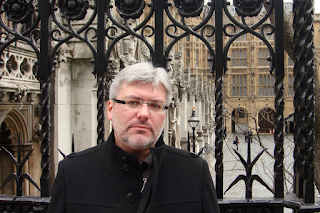
 

Eugene Vodolaazkin

The underlying animosity between Russia and Ukraine is ever-present. Gleb’s father is a Ukrainian; Gleb, educated in both Kyiv and St. Petersburg, feels part of both countries. After the collapse of the Soviet Union and the emergence of an independent Ukraine, Gleb experiences the animosity more directly. 


But the novel is more about music and how music comes to structure a man’s life. It is only by chance that a producer, attending an art gallery show in Munich, happens to hear Gleb play the guitar and hum while he pays (which becomes his artistic trademark). His career doesn’t so much take flight as rockets upward, until decades later when Gleb must confront Parkinson’s disease.


One suspects that Brisbane contains a not inconsiderable number of autobiographic elements. Like his protagonist, Vodolazkin was born in Kyiv and educated in St. Petersburg. Both initially become teachers (Volodolazkin remains one). Both are involved in philology and literature. Voloalazkin works in the department of Old Russian Literature at the Pushkin House in St. Petersburg, where he is an expert in medieval Russian history and folklore. The author of several novels, he was awarded the Aleksandr Solzhenitsyn Literature Prize in 2019. His novel Laurus won the Russian Big Book Award and the Yasnaya Polyana Literary Award


A word about the translation. I don’t speak or read Russian, so I can’t speak to the quality of the translation. But I can say that the novel doesn’t have any of the linguistic awkwardness one can often find in translations. Swartz also has extensive experience in translation works of Russian literature, including Aleksandr Solzhenitsyn’s multi-volume The Red Wheel, his story of the Russian Revolution.


To read Brisbane is to discover conflict, language, music, and life. It’s a wonderful novel. 


Related:


Laurus by Eugene Vodolazkin.


The Aviator by Eugene Vodolazkin.


How the Russian and Ukrainian Languages Intersect in Eugene Volodolazkin’s Brisbane (by Marian Schwartz, the translator).

Tuesday, June 17, 2014

Anna Akhmatova and the Poetry of Resilience


She was born to an upper class family in what is now the Ukraine in 1889. Her father called her poetry decadent, but more as a commentary on poetry than his daughter. She married and had a son; he was raised by her in-laws with her husband’s agreement. She and husband divorced, although that didn’t help her when he was arrested and executed by the Soviets in 1921.

She would marry twice more; her third husband would die in a Siberian labor camp in 1953. Her son was imprisoned from 1949 to 1956. She would see her poetry published and then banned, published and then publication halted. For a long time, she could not publish poetry, and turned to essays and other non-fiction.

Through enough tribulation to last several lifetimes, Anna Akhmatova continued to write poetry. She is now considered one of the icons of the Silver Age in Russian literature (roughly 1880 to 1920), associated with poets and writers like Alexander Blok and Boris Pasternak. In her own lifetime, she became a symbol of hope and survival to millions of Russians.


To continue reading, please see my post today at Tweetspeak Poetry.

Tuesday, May 20, 2014

Poets and Poems: Aleksandr Solzhenitsyn and “Prussian Nights”


It was first job out of college. I was a copy editor at a newspaper in Texas. Turnover was high, and with a few short months I was No. 2 on the copy desk. One of my tasks was sorting through all of the stories from wires services and deciding what should be included in the newspaper.

One day, in late 1973, we received a notice from the New York Times News Service. A manuscript of worldwide importance was soon to be published, and it promised enormous impact on world politics. A few weeks later, we learned what the manuscript was: The Gulag Archipelago by Aleksandr Solzhenitsyn, a detailed and documented account of life in the Soviet Union’s huge network of labor camps.

Solzhentisyn had emerged as a writer during a small sliver of freedom in the early 1960s. His novel One Day in the Life of Ivan Denisovich had been published (or approved for publication) by the Soviet magazine Novy Mir in the early 1960s (translated into English in 1963). Two other manuscripts (Cancer Ward and The First Circle) had circulated in Russia via samizdat and then smuggled out to the West. The Soviets were not pleased when Solzhenitsyn received the Nobel Prize for Literature in 1970. When the non-fiction Gulag was published in early 1974, the Soviet Union responded almost immediately by expelling the writer from the country. He made his way first to Germany, and eventually settled in Vermont, where he continued to write fiction and non-fiction and edit the next two volumes of Gulag.

To continue reading, please see my post today at Tweetspeak Poetry.


Photograph by Nuzrath Nuzree via Public Domain Pictures. Used with permission.

Thursday, August 29, 2013

When Writing a Poem Could Get You Arrested


(This post was originally published at The Master’s Artist, which still exists online but is no longer publishing new material. From time to time I’ll be reposting some of my articles here.)

In free nations, we usually take our freedoms for granted. We don’t think about getting government approval to rent an apartment, buy a car or move to another city. We would likely be outraged if someone told us we had to do that.

What if writing a poem could get you arrested? Would you still write? Would you share your poems with friends? Would you take huge personal risks to keep writing your words?

Elena Shvarts (1948-2010) began writing at 13, during the so-called but short-lived “Khrushchev Thaw” in the Soviet Union, the same short period in the early 1960s when Aleksandr Solzhenitsyn’s One Day in the Life of Ivan Denisovich was published in the Russian literary magazine Novy Mir. It’s hard to imagine the impact on Russian literary imaginations when an account of the Stalinist prison camps was published in an approved Soviet publication. For a short period, it must have seemed something was breaking free.

It didn’t last.

And, so, celebrate the meager light,
Curse not the twilight.
If Christ is to visit us
It will be on such pitiful days as these.
--from “A Gray Day” by Elena Shvarts, translated by Stephanie Sandler

Shvarts continued writing poetry, but none of it was published for the next 27 years, until the Soviet Union itself collapsed. She was 40.

Yet her poetry had found an audience – the samizdat audience, the people who secretly shared writing of all kinds – poetry, fiction, non-fiction – that could not be published in the Soviet Union. Possession of samizdat documents meant arrest. Documents with your name on them meant arrest if they were discovered.

I love fire so
That I kiss it,
Reach out towards it
Wash my face in it,
Since the gentle spirits
Inhabit it, like a bud,
And a band of magic
Thinly rings it.
--from “Candle at a Wake” by Elena Shvarts, translated by Sasha Dugdale

Shvarts published 16 books of poetry and prose, plus a four-volume collected works during her lifetime. That 13-year-old girl became a major figure in the Leningrad underground and widely known and translated after the fall of the Soviet Union.

She wrote about many things in her poetry; her obituary in the Independent said she explored themes of “marginality, poverty and authenticity,” while the one in the Guardian said, “In Shvarts's poetry, the world about her is transformed into a unique and mystical landscape, half real, half Bruegelesque fantasy.” But so many of her readers – the ones who read her in samizdat and the ones who read her published works – knew her as a poet who also wrote about doubt, faith and God.

We are birds in migration from this world to that.
(That sounds coarse, like the German Tod.)
And when our hour is announced‚
When our season nears its end‚
A true compass awakens inside us
And shows the world’s fifth point.
Invisible wings flutter nervously
And the inner gaze slowly turns
In bitter longing‚ as if prophetic‚
Toward the garden it knows: it
Sees miracles‚ and longing
Lengthens‚ doubled‚ as
The caravans fly off.
--“We are birds in migration” by Elena Shvarts, translated by Stephanie Sandler

Born in what was then called Leningrad under Soviet rule, Shvarts died in her beloved St. Petersburg in March, 2010. She was a poet who had written poetry when it was a potential crime against the state, and written it in spite of the state. She lived long enough to see her poetry published freely in her own country and published openly in other countries.

Some works by Elena Shvarts


Photograph by Vera Kratochvil via Public Domain Pictures. Used with permission.