Showing posts with label language. Show all posts

Wednesday, April 29, 2026

Thursday, February 26, 2026

Pass the Crawfish Étouffée and the Boiled Shrimp!


When I read Evangeline by Henry Wadsworth Longfellow in high school, I had no idea that I was not only reading one of his epic poems; I was also reading a fictionalized account of some of my own ancestry and history. 

Yes, I knew I had some French ancestry on my mother’s side, sitting side by side with some German as well. I didn’t know that the German had arrived relatively late, in the mid-nineteenth century, while the French had been there more than a century earlier. And I didn’t know that most of that French had come from Canada, in the maritime provinces collectively called Acadia. A tiny handful of my mother’s French ancestors had come directly from France.


I didn’t know that, at college football games, when I chanted “Hot boudin! Cold coosh coosh! Come on Tigers, poosh, poosh, poosh,” I was using words from my own ancestry. When I read A Cajun Night Before Christmas to my children, I never thought to ask why I could imitate the Cajun accent so well.


To continue reading, please see my post today at Tweetspeak Poetry.


Photograph: Evangeline, a monument to the Acadians, St. Martinsville, La., via Wikipedia.


Some Thursday Readings


Elegy for a Tow Truck Driver – poem by James Matthew Wilson at Rabbit Room Poetry.


Tribes – poem by Sonja Benskin Mesher.


“Portrait d’une Femme,” poem by Ezra Pound – Sally Thomas at Poems Ancient and Modern.


A Worthy, Doomed Metaphysical Poet – David Deavel at The Imaginative Conservative.


“My Shadow,” poem by Robert Louis Stevenson – Joseph Bottum at Poems Ancient and Modern.

Thursday, December 4, 2025

“Everybody in Amsterdam Speaks English.” Not.


It was our 25th anniversary trip – a week in Amsterdam and then a week in Paris. My wife had been to Amsterdam some years before on a business trip; I’d been to neither city. 

We arrived early one May morning. It turned out to be Ascension Day, a public holiday in the Netherlands. We’d reserved seats for a shuttle bus, but as we neared the city center, everything looked like an early Sunday morning. Many shops were closed; little traffic was moving on the streets. Our shuttle driver dropped us off across the canal from the hotel; he decided the street wasn’t wide enough to accommodate his (very small) bus.


We had a lot of luggage. I mean, a lot of luggage. Even then, we didn’t really travel; we migrated.


To continue reading, please see my post today at Tweetspeak Poetry.


Photograph: The Prinsengracht Canal in Amsterdam, via Unsplash.


Some Thursday Readings


A Genuine Petrarchan Note on William Wordsworth’s Ecclesiastical Sonnets – poem by Tom Riley at Society of Classical Poets.


“The Moons” by Grevel Lindop – Malcolm Guite.


Burdens – poem by Maureen Doallas at Writing Without Paper.


A king goes out to cheer his men on the night before battle – Anthony Esolen at Word & Song.


Top 10 Dip into Poetry – Tweetspeak Poetry.

Thursday, October 9, 2025

“Your Accent! You Can’t Be from New Orleans!”


When you’re born and raised in a city like New Orleans, you become aware of certain things very early on. 

First, there’s food. The basic New Orleans food groups are red beans and rice (on Mondays), crawfish, shrimp, beignets, and drive-thru daiquiris to go. A fifth food group might be the muffuletta. When I’d stay with relatives in Shreveport in north Louisiana, one aunt would make sure she fixed rice, because she worried I might be homesick.


Second, there’s weather. You’ve never met humidity like what saturates New Orleans. When you live in a place bounded by a lake, a river, and a gulf not too far away, and it’s built on swamp and bayous, then you will know what real humidity is like.


Third, there’s the accent. It’s not exactly unique; there are echoes of the New Orleans accent in Brooklyn and even south St. Louis. It’s a multicultural gumbo of influences, including French, Spanish, Cajun, Black American, Jewish, Italian, and German, embedded within American English. New Orleanians would be completely at home ordering in a crowded deli in Brooklyn.


To continue reading, please see my post today at Tweetspeak Poetry.


Photograph: Beignets by Julian Rosser via Unsplash. Used with permission.


Some Thursday Readings


“Coyote,” poem by Bret Harte – Joseph Bottum at Poems Ancient and Modern.


Elegy: #LeilaAlaoui – Maureen Doallas at Writing Without Paper.


Alexander Pope’s “To Lady Mary Wortley Montagu” – Karen Swallow Prior at The Priory.


“Lepanto,” poem by G.K. Chesterton – The Imaginative Conservative.


Coleman’s Bed – poem by David Whyte.

Thursday, September 4, 2025

When You Don't Speak Czech or German


It was 2002. Four of us comprised a communications team, sent to Eastern Europe to talk with missionaries all over central Europe. Our team was all Americans, with one of us based in Budapest and three of us in St. Louis. Since everyone we would be talking with was American or spoke English, we were assured we would not have a language problem. 

Right.


It was a packed schedule. In six days, we would be in Budapest, Bratislava, Prague, Dresden, Erfurt, Dresden again, Prague and Brno, and then a return for a final day in Budapest.


To continue reading, please see my post today at Tweetspeak Poetry.


Photograph: a village in the Sudeten Mountains, similar to one where we stopped to eat dinner. Credit: lur. Ch via Pexels. Used with permission.


Some Thursday Readings


“The Alchemist,” poem by Louise Brogan – Sally Thomas at Poems Ancient and Modern.


English Poet, Catholic Exile – Joseph Pearce at The Imaginative Conservative.


He said – poem by Sonja Benskin Mesher.


Poet Laura: In the Glow of the Desert – Sandra Fox Murphy at Tweetspeak Poetry.


“Moo!,” poem by Robert Hillyer – Joseph Bottum at Poems Ancient and Modern.


Saturday, December 31, 2022

Saturday Good Reads - Dec. 31, 2022


A long-cherished hymn – do I need to name it? – is turning 250 years old. Faith writer Lisa LaGeorge has a two-part discussion on how it came to be. Part 1 is here. Part 2 is here. You read the lyrics, and they seem timeless. 

If you get your news only from the newspaper or other traditional media, here’s a little of what you would not know about what happened with Twitter. Big-name scientists were suspended or shadowbanned when they questioned whatever happened to be the prevailing government policy. That included tweeting longstanding information from the Centers for Disease Control. The FBI, despite its “nothing to see here, move along, move along” response, was actively involved in suppressing anything about the Hunter Biden laptop or even campaign jokes about then-candidate Joe Biden. And another government agency, only referred to as “OGA” or “Other Government Agency” in emails between the FBI and Twitter, was also involved in managing what was happening. The “OGA” is believed to be the CIA. David Zweig at The Free Press looks at how Twitter rigged the COVID debate. Jennifer Sey at The Spectator considers the unholy alliance between government and Big Tech.


Wendell Berry has published a highly regarded book about racism. But Berry, true to the independent mind and thinker that he is, also has a problem with cancel culture, and he publicly criticized plans by the University of Kentucky to cover up a mural in its Memorial Hall.


More Good Reads


Faith


Buried story of 2022? The persecution of Christians keeps surging around the world – Richard Ostling at Get Religion.


C.S. Lewis’ Wartime Sermons – Bradley Birzer at The Imaginative Conservative. 


When the City of Man Creaks – A.W. Workman at Entrusted to the Dirt.


Life and Culture


The great anti-ESG backlash – Oliver Wiseman at The Spectator.


Yearning for Roots – Peter Mommsen at Plough Quarterly.


The Simple Charm of ‘All Creatures Great and Small’ – Elizabeth Hance at The Gospel Coalition.


Poetry


The Present—Tense – Damian Robin at Society of Classical Poets.


Gold, Frankincense and Myrrh – Agatha Christie at Kingdom Poets (D.S. Martin).


Freedom in Forgiveness – Dan Tuton at Society of Classical Poets.


Utility – Sonja Benskin Mesher.


Art


Edward Hopper’s America: The popular perception of the loneliness in the painter’s work could not be more wrong – William Newton at The Spectator.


Language


Rummaging the Word Hord – Jesse Russell at Front Porch Republic.


Ukraine


Was the rift between Russia and the West inevitable? – Robert Service at The Spectator.


American Stuff


The Metropolis of Tomorrow – Andrew Wanko at St. Louis History Museum.


Sing We the Song of Emmanuel – Keith & Kristyn Getty


 Painting: Man Reading a Letter, oil on oak panel by Adriaen Brouwer (1605-1638)

Monday, May 9, 2022

"Brisbane" by Eugene Vodolazkin


It begins with a chance meeting on an airplane, traveling from Paris to St. Petersburg. Gleb Yanovsky, a world-famous guitarist, is seated next to a writer, Sergei Nesterov. They eventually agree to write a book about Yanovksy’s life. And this begins years of a collaboration that takes Yanovsky back to his childhood, his youth, and his adulthood, a story that coincides with the decline and fall of the Soviet Union, the creation of Ukraine as an independent state, and the unsettled years that follow. 

Several books have been written about him, Gleb says, but none has told the story of his life. What plays a role in Gleb’s decision to allow Nesterov access for writing a book is that Gleb has been diagnosed with Parkinson’s disease. He’s facing the end of his career.


Yanovsky is Ukrainian, born in Kyiv. His father is an ardent Ukrainian nationalist. Early on, his mother separates and divorces his father. Gleb is essentially reared by his maternal grandmother. His mother’s dream is to live in Australia, and she will eventually correspond with a man in Brisbane and agree to marry him. Gleb remains home. He attends music school, but his father doubts whether the son has a gift for music. But the sound eventually proves the father wrong, although it will be many years in the future. 


Brisbane by Eugene Vodolazkin tells the story of Gleb Yanovsky. First published in Russian in 2018 and now translated by Marian Schwartz, it is a story of music, politics, love, and family. Given the current invasion of Ukraine by Russia, it is also an unsettling book to read. 
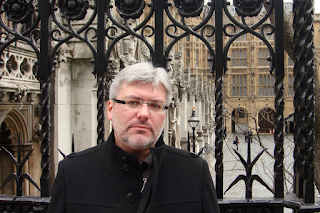
 

Eugene Vodolaazkin

The underlying animosity between Russia and Ukraine is ever-present. Gleb’s father is a Ukrainian; Gleb, educated in both Kyiv and St. Petersburg, feels part of both countries. After the collapse of the Soviet Union and the emergence of an independent Ukraine, Gleb experiences the animosity more directly. 


But the novel is more about music and how music comes to structure a man’s life. It is only by chance that a producer, attending an art gallery show in Munich, happens to hear Gleb play the guitar and hum while he pays (which becomes his artistic trademark). His career doesn’t so much take flight as rockets upward, until decades later when Gleb must confront Parkinson’s disease.


One suspects that Brisbane contains a not inconsiderable number of autobiographic elements. Like his protagonist, Vodolazkin was born in Kyiv and educated in St. Petersburg. Both initially become teachers (Volodolazkin remains one). Both are involved in philology and literature. Voloalazkin works in the department of Old Russian Literature at the Pushkin House in St. Petersburg, where he is an expert in medieval Russian history and folklore. The author of several novels, he was awarded the Aleksandr Solzhenitsyn Literature Prize in 2019. His novel Laurus won the Russian Big Book Award and the Yasnaya Polyana Literary Award


A word about the translation. I don’t speak or read Russian, so I can’t speak to the quality of the translation. But I can say that the novel doesn’t have any of the linguistic awkwardness one can often find in translations. Swartz also has extensive experience in translation works of Russian literature, including Aleksandr Solzhenitsyn’s multi-volume The Red Wheel, his story of the Russian Revolution.


To read Brisbane is to discover conflict, language, music, and life. It’s a wonderful novel. 


Related:


Laurus by Eugene Vodolazkin.


The Aviator by Eugene Vodolazkin.


How the Russian and Ukrainian Languages Intersect in Eugene Volodolazkin’s Brisbane (by Marian Schwartz, the translator).

Tuesday, May 5, 2020

Poets and Poems: River Dixon and "Left Waiting"


Time is our greatest asset, poet River Dixon writes in the introduction to his poetry collection Left Waiting: And Other Poems. It can be painful, unforgiving, and indifferent, he says. Squandering it can be devastating. “But time also gives us those moments when we can step back, put down the load we carry and recognize that there is something more at work here than what we can define. It’s these moments that we find another precious commodity: words.” 

Time and words are themes running through Left Waiting. There is a sense of time fading, like the dying rays of the sun and like what happens when as we age, and decades seem to pass increasingly faster. Where did the time go? How did the children grow up so quickly? I blinked and the four-year-old was graduating from college.

To continue reading, please see my post today at Tweetspeak Poetry.

Tuesday, May 22, 2018

Poets and Poems: Susan Lewis and “Zoom”


I step out of the carriage, walk up the steps, and I can already hear the music. I enter through the wide doorway, and the music becomes louder. It is Susan Lewis’s language ball. I’m not sure if it’s a fancy-dress ball or a masquerade; I quickly realized I better be prepared for either, or both. 

It’s called Zoom: Poems, and zoom you will, as you hurtle down made, partially made, and remade hallways of words, metaphors, images, and familiar phrases made unfamiliar by the substitution of expected words with the unexpected. Zoomis a romp, some 57 poems of a romp that confuses, bewilders, and ultimately entertains as you understand what the hostess of the ball is up to. She’s celebrating an honored guest.

To continue reading, please see my post today at Tweetspeak Poetry

Wednesday, July 20, 2016

It started with language


I noted last week that, when I became a Christian my senior year in college, I noticed almost immediately that things seemed different. I couldn’t explain exactly what was different, but I knew deep within my soul that something profound had happened and something fundamental had changed.

One of the first things I do remember was sensitivity to spoken language: the kind of language I was used to hearing and the kind of language I was used to using myself. It was more than profanity, as obvious as that could be. It was also the cynicism, the sneering, the sardonic remarks, the desire to be thought deep and smart.

I became sensitive, almost overly sensitive, to language – what was coming out of my mouth and what was coming out of others’ mouths. What began as awareness gradually became something hurtful to my ears. And while I knew I was forgiven, and would go on being forgiven, my attitudes were changing.

Once I started my professional career, this sensitivity to language grew. I was not someone who wore his faith on his sleeve – I didn’t afflict co-workers with tracts or mini-sermons. But somehow people knew. For a long time, from the mid-1970s to the late 1990s, people would apologize for using bad language in my presence, or a raunchy joke would stop if I walked into a meeting room. (I should say that the culture has changed enormously since around 2004 – and nothing was sufficient to stop the common use of profanity in the workplace.)

But this “something different” inside of me was limited to language. Slowly it began to changes actions – things I did or didn’t do. It affected choices I made. It changed how I treated people. And, in the workplace, it made me extraordinarily aware of injustice, people being treated badly, people being used and disregarded. The more I heard about the importance of people, the more I saw just the opposite happening.

In The Discipline of Grace: God’s Role and Our Role in the Pursuit of Holiness, Jerry Bridges says that “…our sin is a burden that afflicts us rather than a pleasure that delights us.” That is exactly what started after I became a Christian. Things changed. Things inside me changed. I more and more recognized things about myself that I had taken for granted or never even considered. And slowly, I began to change.

You don’t reach an end-point here. This process never stops.

But I can say that the sensitivity becomes more acute.

Led by Jason Stasyszen and Sarah Salter, we’ve been reading The Discipline of Grace by Jerry Bridges. To see what others had to say on this chapter, “We Died to Sin,” please visit Sarah at Living Between the Lines.


Photograph by George Hodan via Public Domain Pictures. Used with permission.