Showing posts with label T.S. Eliot. Show all posts

Wednesday, February 18, 2026

Some Wednesday Readings


Love Along the Raid: A Morgan’s Raiders Love Story – Caroline Davis at Emerging Civil War. 

Old Tom’s Ash Wednesday – Bradley Birzer.


T.S. Eliot’s Long Lent – Dwight Longenecker at The Imaginative Conservative.


Britain: Westminster is running out of time – Lee Cain at The Critic Magazine.


The Vikings of Orkney – Warren Frye at The New Criterion.


Concerning Kipling – poem by George Bradley at Literary Matters.


Photograph: Ring of Brodgar Stone Circle and Henge, Orkney Islands, Scotland – Maxwell Andrews at Unsplash. Used with permission.

Tuesday, November 18, 2025

The Manuscript of "The Waste Land" by T.S. Eliot


A favorite place of mine to visit in London is Waterstone’s Bookstore in Piccadilly. reputedly the largest book shop in Europe. The store has eight stories but only five floors. Because the building includes a lower ground floor (we Americans would say basement), a ground floor (our first floor), a mezzanine level followed by four official floors and the official fifth floor being the restaurant. 

The restaurant looks down to Jermyn Street and south toward Trafalgar Square. From a window table, you can see some of the famous St. James-area shops below, and a straight view from the window depicts rooftops and spires of some of the best-known buildings in Westminster. Piccadilly Circus is about a block east, and Hatchards Bookstore and Fortnum & Mason a block west. The Royal Academy of Arts is across Piccadilly, and the Ritz Hotel is about a two-minute walk away. St. James Palace, which fronts the complex that includes the royal residence of Charles III at Clarence House, is “down the block and around the corner,” give or take a couple of blocks.

To continue reading, please see my post today at Tweetspeak Poetry.

Some Tuesday Readings


Leaving the Island (Inishbofin) – poem by David Whyte.


When Enemies Forgive Each Other – Spencer Klavan at the Free Press on The Iliad.


Three Acorns from Emily’s Yard – poem by Andrea Potos at Every Day Poems.


“Life and Art,” poem by Aldous Huxley – Sally Thomas at Poems Ancient and Modern.


Thursday, October 30, 2025

"On Frost and Eliot" by William Pritchard


William Pritchard is the Henry Clay Folger Professor of English, Emeritus, at Amherst College. He received his A.B. degree from Amherst and his M.S. and Ph.D. degrees from Harvard University. His teaching has focused on 20th century poetry and fiction, but’s also taught on Shakespeare and major English writers from the 17th to the 20th centuries. 


His books include Updike: America’s Man of LettersEnglish Papers: A Teaching LifeRandall Jarrell: A Literary Life, and Frost: A Literary Life Reconsidered. He writes reviews for such newspapers as the Boston GlobeChicago Tribune, and Times Literary Supplement, and is both an advisory editor and essayist for the Hudson Review

Pritchard is, in short, a literary critic. And he’s collected his reviews, articles and essays on the two most influential poets of the 20th century under the title of On Frost and Eliot

To continue reading, please see my post today at Tweetspeak Poetry.

Some Thursday Readings


A Dream Song – poem by George MacDonald at Rabbit Room Poetry.


“October,” poem by Robert Frost – Sally Thomas at Poems Ancient and Modern.


“The Birthplace,” poem by Robert Frost – Anthony Esolen at Word & Song.


Wednesday, January 8, 2025

Some Wednesday Readings


Papa’s Century – David Warren at Essays in Idleness. 

“The Sensation of Seeing”: How T.S. Eliot Defamiliarizes the Christmas Story – Carter Johnson at Front Porch Republic. 


“Twelfth Night,” poem by Sally Thomas – Joseph Bottum at Poems Ancient and Modern.


Inside Columbia University’s ‘Museum of Terror’ – Maya Sulkin at The Free Press.


Sherlock Holmes vs, the KKK: Sir Arthur Conan Doyle, the Civil War, and Slavery – Kevin Donavan at Emerging Civil War.


Faith on the Hill: The religious composition of the 119th Congress – Jeff Diamant at Pew Research Center.


Lincoln’s Conservative Advisor: Attorney General Edward Bates by Mark Neel – review at Civil War Books & Authors.


In the Winter Garden – Spitalfields Life.


Poet Laura: New Year, New Lists – Dheepa Maturi at Tweetspeak Poetry.


Je suis Charlie, ten years on – Freddie Attenborough.


Top photograph: Edward Bates, Attorney General under Abraham Lincoln

Monday, November 4, 2024

Some Monday Readings


The New Push for Censorship Under the Guise of Combating Hate – Paul Thacker at Tablet Magazine. 

A Blockbuster Met Exhibition Takes Visitors Back to Siena to Trace the Origins of European Painting – Christian Kleinbub at Art in America.


“Poor Eddy”: A New Life of Edgar Allan Poe – Mark Jarman at The Hudson Review


Law Student Faces Expulsion for ‘Aggressive Pointing’ – Olivia Reingold at The Free Press.


Appreciations: Bram Stoker’s Dracula – Eduard Habsburg-Lothringen at The Lamp Magazine.


The other side of TS Eliot – Jeremy Noel-Tod at Prospect Magazine.


Do the Hard Work of Publishing – Terry Whalin at The Writing Life.


Murders for November – Jeremy Black at The Critic Magazine.


James Mackinnon, Artist – Spitalfields Life.


A New Mozart Work is Discovered – Stephen Klugewicz at The Imaginative Conservative.

Monday, April 29, 2024

“T.S. Eliot: Culture and Anarchy” by James Matthew Wilson


From the beginning of his poetry and writing career, T.S. Eliot was considered of a similar mind as the poet and cultural critic Matthew Arnold (1822-1888). One of Arnold’s best-known works was Culture and Anarchy (1869), in which he presented culture (and poetry) as the replacement for religion as the bulwark against anarchy.  

However associated they may have been, Eliot spent a great deal of time and effort correcting what he saw as Arnold’s misunderstandings, especially about religion and the idea of culture substituting for it. The poet wasn’t so much in the business of substitution as he or she was in recovering the idea that it wasn’t only the natural that composed the world; it was also the supernatural, and it was the supernatural that had been lost.


In the 46-page essay (with 16 pages of notes) T.S. Eliot: Culture and Anarchy, poet and professor James Matthew Wilson explores the similarities and differences between Arnold and Eliot, explains where Eliot sought to correct what he saw as Arnold’s errors, and in the process provides an excellent introduction to Eliot, his poetry, and the thought that lies behind it. Wilson focuses on Eliot’s major poems – The Love Song of J. Alfred Prufrock, the poem that made Eliot famous; The Waste Land, which solidified his poetic reputation; The Hollow Men; and Four Quartets, which likely played a major role in Eliot being awarded the Nobel Prize for Literature.


James Matthew Wilson

Wilson, the Cullen Foundation chair in English Literature and the founding director of the MFA program at University of St. Thomas in Houston, is both a poet and a poetry critic. His poems and articles are published in such magazines and journals as The New CriterionFront Porch RepublicHudson ReviewRaintown ReviewThe Weekly StandardDappled Things, and other literary and political publications. Her serves as poet-in-residence of the Benedict XVI Institute, scholar-in-residence of Aquinas College, editor of Colosseum Books, and poetry editor of Modern Age Magazine

He’s published 14 books, including his first full-length poetry collection, Some Permanent ThingsThe Catholic Imagination in Modern American Poetry (2014); The Fortunes of Poetry in an Age of Unmaking (2015); and The Vision of the Soul: Truth, Goodness, and Beauty in the Western Tradition (2017). The Hanging God: Poems was published in 2018. 

The publisher of Wilson’s monograph, Wiseblood Books, has published several of these essays in affordable editions. The essays cover a variety of authors and topics under the general heading of faith, culture, and literature.

Related:

James Matthew Wilson and The Hanging God.


James Matthew Wilson and Some Permanent Things.


James Matthew Wilson and The Strangeness of the Good.


Some Monday Readings


It Didn’t End with Lee’s Surrender at Appomattox, Part 1 and Part II – Tonya McQuade at Emerging Civil War.


George Ticknor: The autocrat of Park Street – Michael Connolly at The Imaginative Conservative. 


Bookish Diversions: The Puzzle of Publishing – Joel Miller at Miller’s Book Review.


Things Worth Remembering: Allan Bloom on the “Charmed Years of College” – Douglas Murray at The Free Press.


The London Data Store – A London Inheritance.

Tuesday, December 26, 2023

Some Tuesday Readings - Dec. 26, 2023


The Journey of the Three Wise Men – Douglas Murray at The Free Press. 

Our godless era is dead – Paul Kingsnorth at UnHerd.


Heartbeats at Christmas – Jacob Phillips at The Critic Magazine.


Mosaic of the Nativity: Serbia, Winter 1993 – poem by Jane Kenyon at Kingdom Poets (D.S. Martin).


Ruddy Glory: The Resonance of Rudolph the Red-Nosed Reindeer – Joel Kurz at Front Porch Republic.


The Ultimate Christmas Gift – poem by Susan Jarvis Bryant at Society of Classical Poets.


The Ghosts of Old London – Spitalfields Life.


Photograph: Entrance to the Oxford Arms, from “The Ghosts of Old London.”

Tuesday, September 26, 2023

Do You Remember the First Poetry Book You Bought?


My mother was a great one for reading aloud to her young children. Some of my earliest memories, notwithstanding putting the dog in the oven or pouring shoe polish on the sofa, are of my mother reading to me. I learned many Mother Goose nursery rhymes sitting next to her on the (repaired) sofa. Story time involved a big green book entitled Stories Children Love by Watty Piper, first published in the 1920s with the kinds of illustrations popular for children at the time. 

I still have that book. I loved the stories filled big bad wolves, evil stepmothers, giants, and ogres. The binding is now wearing thin, but it’s still intact. You can find the listing on Amazon, but it’s “currently unavailable.” 


I was the middle child, with fairly large gaps between me and my two brothers. Mother read to all three of us, but for whatever reason, I turned out to be the major reader in the family. That became a lifelong habit, and I give full credit to my mother for instilling a love of reading and books in me. 


To continue reading, please see me post today at Tweetspeak Poetry.


Some Tuesday Readings


Light rain – poem and artwork by Sonja Benskin Mesher.


More of this, please: Ilya Kaminsky writes a poetic response to Giacometti – Janet Manley at Literary Hub.


A salvaged word – Kelly Belmonte at All Nine.

Tuesday, December 20, 2022

Poet Matthew Hollis Writes a Biography of “The Waste Land”


British poet and writer Matthew Hollis has told the story of a poem, arguably the most significant poem of the 20thcentury.  

The year 1922 was an amazing year for authors and literary creations. The Shakespeare & Co. Bookstore in Paris published Ulysses by James JoyceSinclair Lewis published Babbitt. F. Scott Fitzgerald wrote The Beautiful and the Damned. Herman Hesse published SiddharthaVirginia Wolff wrote Jacob’s Room. And T.S. Eliot published that poem, The Waste Land. Literary Modernism was being born, and Joyce, Wolff, and Eliot had much to do with it.


To continue reading, please see my post today at Tweetspeak Poetry.

Tuesday, August 16, 2022

“Eliot After ‘The Waste Land’” by Robert Crawford


After T.S. Eliot (1888-1965) published The Waste Land in 1922, it seemed that there might be a creative dry spell. As far as poetry was concerned, there was. He was struggling with his marriage and the declining mental health of his wife, Vivien; he was editing his literary magazine Criterion; and he was maintaining a full-time job in banking. The next year, he transitioned from banker to editor at Faber & Gwyer (eventually to become Faber & Faber), where he stayed for the next four decades. 

It is the second half of Eliot’s life, from 1923 to his death in 1965, that is the focus of Eliot After ‘The Waste Land’ by British poet and writer Robert Crawford. Crawford completed the first volume, The Young T.S. Eliot, in 2015. He’s completed the monumental biography seven years later, and, as he notes in the introduction, this biography has the benefit of the writer’s access to the extensive correspondence of Eliot and Emily Hale, his romantic interest for a considerable period of time. The letters were finally made available in 2020. 


To continue reading, please see my post today at Tweetspeak Poetry

Tuesday, October 19, 2021

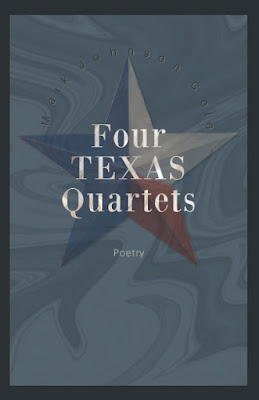
Poets and Poems: Mark Johnson Cole and “Four Texas Quartets”


Mark Johnson Cole loves the poetry of T.S. Eliot. And he loves his state of Texas. And while undoubtedly many Texas share a love of Eliot’s poetry, Cole may have done something unique. He married Eliot’s Four Quartets and Texas history and current events to create Four Texas Quartets. In a time when poetry is being revitalized on Instagram, when novels are being written in poetic form, and collections and even Poetry Magazine often mash up poetry with art and photographs, Four Texas Quartets is a creative standout. 

A native Oklahoman but reared in Texas and currently living near Houston, Cole holds seven degrees. He’s been a working attorney and a local government official. He studied German and then philosophy in graduate school. He studied law and theology in New England, Germany, Liechtenstein, London, and the Midwest. 


Over time, he says, he discovered that philosophy was becoming less personally important and poetry becoming more so. He discovered the poetry and prose of Eliot and the importance of “his thought in the history of the culture of the West.” And from there he began to study writers like John GravesWendell BerryJ. Frank Dobie, and Larry McMurtry.


To continue reading, please see me post today at Tweetspeak Poetry.

Tuesday, February 26, 2019

In Praise of Reading Poetry


Like most of us, I read poetry – a lot of poetry – in high school and college English classes primarily because it was assigned. I was much more interested in fiction (Dickens!) and noir mysteries (Dashiell Hammett!) than I was in Tennyson, Wordsworth, Coleridge, and the Elizabethans.

My attitude changed with T.S. Eliot and “The Love Song of J. Alfred Prufrock.” It was first published in 1915, and Poetry Magazine published it only as a favor to Ezra Pound. The editors were so uncomfortable with it that they placed it at the back of the issue. But it was our first great modernist poem, and it changed poetry forever. A high school senior, I read that poem, and I was mesmerized. I went to the local bookstore and bought a small paperback edition of Four Quartets (I still have it; it’s now more than 50 years old).

It was at work as a corporate speechwriter that I discovered the practical advantages of poetry.

To continue reading, please see my post todayat the ACFW Blog.

Photograph by Thought Catalog via Unsplash. Used with permission.

Tuesday, August 21, 2018

A Strangely Contemporary Verse Play: “Murder in the Cathedral” by T.S. Eliot


In 1934, T.S. Eliot worked with the produced E. Martin Browne to produce a verse play called The Rock. If the idea of a verse play or verse drama sounds strange, it’s how plays have been written for most of human history. The famous tragedies of ancient Greece are verse plays, as are the plays of William Shakespeare. Eliot and Browne wrote produced the play, and it was successful enough that they were asked to write one for the Canterbury Festival in 1935.

Eliot chose the murder of Archbishop Thomas Becket by agents of Henry II in 1170 as the play’s subject. He relied heavily on the account of the murder by Edward Grim, a clerk from Cambridge who was at Canterbury Cathedral on the night of December 29 when the murder occurred. Grim’s account of Becket’s death is a short one, included in his biography of St. Thomas published some 10 years after the event. But Grim was there, and it was an eyewitness account.

To continue reading, please see my post today at Tweetspeak Poetry.

Photograph: T.S. Eliot in 1934, shortly before writingMurder in the Cathedral.

Tuesday, November 7, 2017

What Made 1922 a Literary Watershed Year?


The year 1922 isn’t especially remembered as a year of major significance (it wasn’t a presidential election year, for one thing), but it was a momentous year in history nonetheless. The Union of Soviet Socialist Republics (USSR) was formed after five years of civil war. Gandhi was sentenced to prison in India by the British. The first successful treatment of diabetes with insulin was reported in Canada. The BBC was formed in the UK. The Lincoln Memorial was dedicated. Reader’s Digest was launched, and soon became the most popular magazine in America. And speaking of civil war, one erupted in Ireland.

In literature, 1922 is now considered to have witnessed a revolution in fiction and poetry. More than a decade later, the writer Willa Cather called 1922 “the year the world broke in two,” and that sentiment has been borrowed for the title of one of two recent books on what happened in the literary world that year. – events that still affect literature almost 100 years later.


To continue reading, please see my post today at Tweetspeak Poetry.