Showing posts with label Workplace. Show all posts

Wednesday, September 9, 2026

This Didn’t Happen to a Friend of Mine


It showed up as a Facebook memory, a story I hadn’t thought about in years. I’d posted in August of 2009 on my blog and linked it from Facebook. The title was, “This Happened to a Friend of Mine.” The post received a grand total of one comment, from someone named “Anonymous.”


I started reading it. And I realize it hadn’t happened to a friend of mine. The premise was a variation of “asking for a friend.”


Seventeen years later, I’m not sure why I posted it. The situation had happened two months before. The account I posted was mostly true but not entirely, some things disguised or slightly changed to discuss what happened without pointing to specific people. It was an incredible difficult time, the kind of story that happens all the time in the corporate world but never makes LinkedIn. 


To continue reading, please see my post today at Dancing Priest.


Photograph by Arlington Research via Unsplash. Used with permission.


Some Wednesday Readings


Murders for September – Jeremy Black at The Critic Magazine.


Sweat the Technique: On Writing Process and Possibilities – Lincoln Michel at Counter Craft.


Wendell Berry and the Choice of Life – Elizabeth Stice at Front Porch Republic.

Tuesday, January 10, 2023

It’s Poetry at Work Day 2023!


In 2014, I hit a wall at work. I was marginalized. I was being paid for work far below my experience and capabilities. Wanting to get up in the morning was increasingly problematic. I made attempts to move to other positions, including one major attempt, but the job was handed off to someone who was a problem in an unrelated division whom they need to move somewhere. The individual was told to come to me for guidance and mentoring.  

It wasn’t the first wall I’d ever encountered in my career, but it was the last one. In the early fall, I told my boss I was retiring in May. Surprisingly, to me at least, the news was not received well. It wasn’t that I was irreplaceable in my job; the work was easy and unchallenging. I never learned why my boss and others were so upset.


To continue reading, please see my post today at Tweetspeak Poetry.

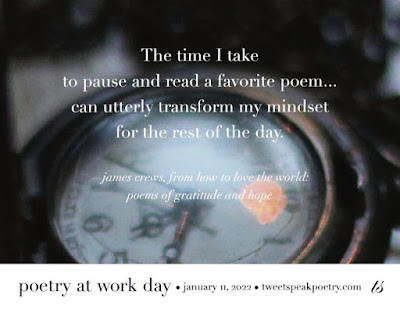
Tuesday, January 11, 2022

Tuesday, Jan. 11: It’s Poetry at Work Day 2022!


It’s Poetry at Work Day, and I find myself thinking about names in the workplace.   

I’ve been long fascinated with the names of characters in the works of Charles Dickens. Many of them are descriptive of the characters they represent. Some he made up out of whole cloth. And some were borrowed, or stolen, from the names of real people. “Pickwick,” for example, came from the name of the owner of a coach firm in Bath. “Oliver Twiste” was the name of a real person. Dickens borrowed, and sometimes barely disguised, the names of friends, acquaintances, neighbors, and people mentioned in newspapers. 


The names of these characters often contain their own poetry. While reading a paper from 1917 on the origins of the names of Dickens’s characters, I began to think about the names, and the poetry of names, of people I’ve known over more than four decades of work life. My own last name likely started life a millennium or two ago to differentiate a father from a son, or an older and younger brother. 


To continue reading, please see me post today at Tweetspeak Poetry.

Tuesday, August 4, 2020

The Poet at Work


I was working in communications for a Fortune 500 company. A large portion of the day-to-day work was meetings. We had a team-based culture, and to our work, our teams had to meet. 

The teams, and the meetings, proliferated. We had departmental meetings. We had cross-functional meetings. We had committee and subcommittee meetings. We had telephone meetings, video meetings, and online chat session meetings. We had one-on-one meetings. We had staff meetings. We had briefing sessions, strategy discussions, and crisis planning meetings. We often had meetings to plan meeting agendas.

I often wondered if the curse placed upon Adam and his work for eating of the Tree of Knowledge possibly included meetings.

To continue reading, please see my post today at Dancing Priest.

Tuesday, January 14, 2020

Looking for Workplace Wisdom: It’s Poetry at Work Day 2020


It’s Poetry at Work Day 2020, and I went looking for wisdom literature about work. Many of us have had experiences with works, jobs, employment, and bosses that might make us doubt if the word “wisdom” even belongs in the same sentence with “work.” And while we all have stories to tell, it’s clear that wisdom can be found in the workplace. One of the best pieces of advice I was given as a developing corporate speechwriter was to read the poetry of T.S. Eliot, Wallace Stevens, and Dylan Thomas. These three high priests of modernist poetry offered more than their profound poetic insights and how things could be said in a speech; they offered a way of looking at and understanding the world. 

My search took me to lists of great books about business and work. Fortune has a list. CNBC has a list. Amazon has a book about the top 100 business books of all time. Bloggers have lists. I found almost as many lists of best business books as I did books. 

To continue reading, please see my post at Tweetspeak Poetry

Monday, May 27, 2019

Poetry at Work, Chapter 20: The Poetry of Retirement


I might have retired twice from the same company.

I officially retired in 2015, and I’d had given a year’s notice. I could have continued working, but the fact was that my skills, experience, and abilities were being wasted. I could have continued for a few more years, perhaps hoping for another general downsizing and a severance package, but work had become almost painful. 

When I told the head of the department of my plan to retire, the response was surprising. He became angry. It wasn’t as if I was irreplaceable. Without really knowing, I suspect it was more a case of I was doing it on my timetable, and it wasn’t something the department was planning on its timetable.

To continue reading, please see my post today at Literary Life.

Monday, May 20, 2019

Poetry at Work, Chapter 19: The Poetry of Workplace Restoration


For a long time, I had what several of colleagues called the most interesting office at work. Because I was a speechwriter, I was expected to (a) read everything the CEO did, (b) read a lot of business books, particularly popular ones, (c) study books about speechwriting, and (d) read books on current issues. All of which meant I was doing a lot of reading. And the CEO likcd to read the novels of John Updike, just about anything by Charles Dickens, and anything published on the subject of Winston Churchill.

For a reader like me, this was a great job. 

One end of my office was floor-to-ceiling bookshelves. Another wall had a smaller but still sizeable bookshelf. I also had a row of books on a credenza. It’s no surprise that my office was known as the building library. 

My “frequently consulted” books included poetry. That was by design. I had several old American poetry anthologies, and my Norton’s Anthology of English Literature (college textbooks) included considerable poetry by British writers. 

To continue reading, please see my post today at Literary Life.

Monday, May 13, 2019

Poetry at Work, Chapter 18: The Poetry of Electronic Work


Think back 25 years (if you’re old enough). It sounds almost quaint today, but email was just beginning to come into its own. At the company where I was working, with more than 40,000 people, some 5,000 had been brought into the email system. Eventually, all would be, but 5,000 was enough to give us critical mass for a new communications venture – an email newsletter for employees. 

To show how new this was, only one other company in the United States had an employee email newsletter. I hoped we would be the second.

I had meetings with the people in charge of the email system – not only were there various departments, there was also an email council overseeing email operations. My proposal was a text-only newsletter to be sent to the 5,000 people on email.

The response was something akin to asking people to sit in a room full of rats infected with bubonic plague. I didn’t know what I was asking. There were too many hardware platforms. I didn’t understand the technical aspects of the work. The system could crash. The company was too diverse for people to care about what was happening in other divisions. To be fair, these objections came not only from IT people but also from my own communications colleagues.

To continue reading, please see my post today at Literary Life.

Monday, May 6, 2019

Poetry at Work, Chapter 17: The Poet Blogs the Layoff


Layoffs were coming. The big announcement from the CEO was circulated by email. It was a masterpiece of vagueness. It didn’t say how many people would be affected. It didn’t say when the affected people would know. It did say there would be a severance program, although it included no details. 

In short, the important things people wanted to know weren’t communicated. I’m sure management congratulated itself on communicating, but the rumors had already been circulating and people were already far beyond “layoffs are coming.” What people also knew was that the people being laid off might be the fortunate ones. Those who remained would likely be reorganized, with more work and fewer people to get it done.

Having been through this before at another company, I had a better idea of what would happen and what people really cared about that colleagues who hadn’t been through it, especially younger colleagues. A small group came to me and asked if I would consider blogging about my past experience on the company’s intranet. I said I’d think about it.

To continue reading, please see my post today at Literary Life.

Monday, April 29, 2019

Poetry at Work, Chapter 16: The Poetry of Unemployment


It happens to most of us, at one time or another in our careers. You’re called into the boss’s office and discover there’s an HR person waiting as well. Yep, you’re being laid off.

Sometimes you’re expecting it; sometimes you’re not. In my case, I knew it was coming. A work colleague had found out and couldn’t keep it to herself. She tried to look appropriately sad and concerned, but it didn’t work. She was actually rather gleeful (yes, there was a history here). I looked at her and said, “You won’t understand this, but a considerable amount of good will come out of this for me.” Her almost angry response: “You’re just in denial.” 

Perhaps I was. I felt my ears grow warm, a sure indication that I fully understood what was happening. And I really upset the process when I walked from her office to my boss’s office and told him I knew I was shortly to be laid off. He blew up – because it upset the usual process for these “elimination” programs. 

To continue reading, please see my post today at Literary Life.

Monday, April 22, 2019

Poetry at Work, Chapter 15: The Poetry of the Best Job You Ever Had


It started with a phone call from a friend. “Did you see the job ad in the paper?” he said.

“What job ad?” I said.

“The city school district is looking for a communications director. You’d be perfect.”

“Do you hate me or something?” I said.

The city school district was indeed looking for a communications director. The district was in organizational chaos. A reform school board had brought in a management consultant firm from New York to reorganize the district. Schools had been closed. Central office staff had been laid off – some 800 people. Management of cafeterias, school buses, and other services was being outsourced. The management firm was doing what had to be done, but the district was so strangled by its own politics and so intertwined with city politics that it was impossible to try to make the changes from within. 

To continue reading, please see my post today at Literary Life.

Monday, April 15, 2019

Poetry at Work, Chapter 14: The Poetry of Interpersonal Conflict


A conflict in the workplace is not uncommon. A workplace conflict battled out on Facebook, however, pulling in co-workers and the company, is not something you see every day.

It happened at my company. And Human Resources asked that my team, the corporate social media team, do something about it. The fact that it was happening outside business hours was a complication. 

It was a nasty fight. Things someone would never say in an office setting were erupting on a daily basis. Friends and family members were egging the two combatants on. At the time, social media were relatively new, and this was something new on social media. Twitter trolling parties were already common, but I’d never seen two fellow employees arguing on Facebook.

To continue reading, please see my post today at Literary Life.

Monday, April 8, 2019

Poetry at Work, Chapter 13: The Poetry of the Crisis


There’s nothing like a good crisis to demonstrate how little control an organization has. There’s also nothing like a good crisis to uncover the poetry in our souls.

A product cancellation was looming, the cancellation to be imposed by a government agency. Thousands of jobs were at stake, not to mention income, corporate stock price, reputation, and significant disruptions for customers. The crisis had been coming for nearly a year, contained within official communications between the government and the company.

As time passed, internal anxiety grew. In the communications area, we were a relatively minor player, except for the moment at which the crisis would go public. Then we would occupy the most important position in the overall situation. Blow it there, and the product would be destroyed in the marketplace.

To continue reading, please see my post today at Literary Life.

Monday, April 1, 2019

Poetry at Work, Chapter 12: The Poetry of Transparency


It was the days before PowerPoint. Holding our overhead transparencies, three of us sat waiting to be called into the management meeting. We were three public relations people, three poets, working for a chemical company. And it was our job to explain to the people running the company why we had to tell people how much pollution the company was responsible for, and, more to the point, what we thought the company should do about it.

If you know anything about working for corporations, you know that this would not be a moment to inspire self-confidence. In fact, we expected to be shredded.

A new federal law had been implemented. Companies large and small had to publish, annually, how much toxic emissions were emitted each year from operations. Our chemical company would be reporting big numbers. So would automobile and tire manufacturers, and steel makers. So would newspapers (toxic emissions are associated with printing presses). All manufacturers were affected, but especially chemical companies.

To continue reading, please see my post today at Literary Life.

Monday, March 18, 2019

Poetry at Work, Chapter 10: The Poetry of Beauty in the Workplace


The worst view I ever had from my assigned office at work was of the building’s designated smoking area. I had the most coveted type of office – a closed-door office, with a window. Except the window faced the smoking area outside the building, with its awning-like protection and clouds of smoke.

The best view I ever had from my assigned office at work was that same office – after smoking was banned entirely from the campus. No more plastic awning. No more clouds of smoke. Just an uninterrupted view of nearby woods.

If someone asked you to describe beauty at your workplace, you would likely think of architectural structures, window views, fountains, waterways, or woods. You might think of people, but today’s cultural and work environments require that great care be taken when talking about people. 

To continue reading, please see my post today at Literary Life.

Tuesday, March 12, 2019

Poetry at Work, Chapter 9: The Poet in the Culture of Control


For most of the 20thcentury, the structure of corporations was based on the technology of mass production. It was a command-and-control model, with managers directing workers, who had a very specific task to accomplish. It was not unlike the military.

In the 1970s, that structure began to break down. It was almost odd – an organizational model that had survived two world wars and the Great Depression was breaking down for what appeared to be smaller factors. Inflation raged almost out control (I remember a prime lending rate of 21 percent); oil embargoes were turning major industries like petroleum refining, chemical manufacturing, and automobiles on their heads. National psychological blows happened as well, contributing to the disruptive environment – the Watergate crisis, the end of the Vietnam War, and the Iranian revolution that led to Americans being held hostage for more than a year. The reckoning started in the 1980s, as company after company reorganized (over and over again), laid people off (over and over again), and often went out of business altogether. At the end of the 1980s, Tim Berners-Lee invented what would become the worldwide web.

It was an unsettled time to work for a large company.

To continue reading, please see my post at Literary Life.

Monday, March 4, 2019

Poetry at Work, Chapter 8: The Poetry of the Organization Chart


I was sitting with a woman in the Human Resources Department. There had been a reorganization of our department, part of a general reshuffling across the company, and I’d been assigned to sit with her to work out the new organization chart. 

You would think this was something of a useless exercise. Shouldn’t it be a simple matter of “here’s the boss, here are his or her direct reports, and here’s who reports to them.” But it was anything but simple, and I was to get a lesson in the Byzantine art form of corporate organization charts.

First, she pointed out, not all of the boss direct reports had the same title. Some were directors; some were managers. Next, there were directors and there were directors – a title wasn’t necessarily indicative of grade level, and grade level was everything. The chart had to indicate that by a subtle positioning of the boxes, with some slightly more elevated than the others. The same thing applied to the managers. Then there was the problem of some managers have more people reporting to them than directors did. 

To continue reading, please see my post today at Literary Life.

Monday, February 18, 2019

Poetry at Work, Chapter 6: The Poetry of the Organization Chart


I was sitting with a woman in the Human Resources Department. There had been a reorganization of our department, part of a general reshuffling across the company, and I’d been assigned to sit with her to work out the new organization chart. 

You would think this was something of a useless exercise. Shouldn’t it be a simple matter of “here’s the boss, here are his or her direct reports, and here’s who reports to them.” But it was anything but simple, and I was to get a lesson in the Byzantine art form of corporate organization charts.

To continue reading, please see my post today at Literary Life.

Monday, January 14, 2019

Poetry at Work. Chapter 1: How to Recognize a Poet


If there is such a thing as a poetic movie, the 2016 film Paterson is perhaps the archetype. The actor Adam Driver plays a bus driver named Paterson, who listens to the conversations of his passengers, colleagues, and friends, and to his own interior conversations, and writes poetry. He works in Paterson, New Jersey, and the man Paterson and the town Paterson eventually come to be seen as of the same essence. Person becomes place becomes person. Poetry constitutes a sizeable portion of the dialogue.

Not coincidentally, Paterson also happens to be the hometown of the modernist poet William Carlos Williams, who practiced medicine there. Over a period of decades, he wrote a five-book collection entitled – what else? – Paterson (among a lot of other works). Williams was a physician, and he was a poet. Like the bus driver in the movie, Williams recognized and recorded the poetry of his daily work.

To continue reading, please see my post today at Literary Life.

Tuesday, January 8, 2019

It’s Poetry at Work Day – Discovering the Poetry of Gratitude


Today we celebrate Poetry at Work Day – the day each year we bring poems to work, share them with colleagues, read them aloud in small (or large) groups, perhaps leave a few on cafeteria tables, wallpaper them on our computer screens, and generally celebrate poetry in the workplace.

Last spring, I found myself rediscovering poetry at work. And rediscovering a sense of gratitude about work.

Three years previously, I had retired (a bit early). It was one of those “You know, it’s just time to go” kind of decisions. I still had much to offer, but, well, I’ll just leave it at that. It was time to go. I can truthfully say I have never regretted the decision. I miss the people I worked with, but I didn’t miss the organizational politics, the constant internal upheavals, and the frenzied “every day a new crisis” atmosphere. And I put my newly found free time to good use – writing, including two novels; editing; work with online publications; and spending more time with the grandchildren.

To continue reading, please see my post today at Tweetspeak Poetry.