Showing posts with label work. Show all posts

Wednesday, September 9, 2026

This Didn’t Happen to a Friend of Mine


It showed up as a Facebook memory, a story I hadn’t thought about in years. I’d posted in August of 2009 on my blog and linked it from Facebook. The title was, “This Happened to a Friend of Mine.” The post received a grand total of one comment, from someone named “Anonymous.”


I started reading it. And I realize it hadn’t happened to a friend of mine. The premise was a variation of “asking for a friend.”


Seventeen years later, I’m not sure why I posted it. The situation had happened two months before. The account I posted was mostly true but not entirely, some things disguised or slightly changed to discuss what happened without pointing to specific people. It was an incredible difficult time, the kind of story that happens all the time in the corporate world but never makes LinkedIn. 


To continue reading, please see my post today at Dancing Priest.


Photograph by Arlington Research via Unsplash. Used with permission.


Some Wednesday Readings


Murders for September – Jeremy Black at The Critic Magazine.


Sweat the Technique: On Writing Process and Possibilities – Lincoln Michel at Counter Craft.


Wendell Berry and the Choice of Life – Elizabeth Stice at Front Porch Republic.

Wednesday, July 22, 2026

Looking Back at a Crazy Job


I’ve spent a few weeks reflecting on my incredibly short, and incredibly long, eight months with St. Louis Public Schools. What began with the strangest job interview I ever had, the weirdest first day on the job, and the ongoing chaos of every single day ended with a very quiet farewell.  

In previous jobs in corporate communications, I’d experienced periods of media blitzes and controversies. But I’d never experienced a job in which every day was a media blitz, every day was a controversy, and I had to work and publicly communicate in a highly political environment where it was difficult to know who was telling the truth, whose information was accurate, and who was trying to help or merely trying to gain an edge on an opponent. 


To continue reading, please see my post today at Dancing Priest.


Photograph: St. Louis Public Schools headquarters building by St. Louis Public Schools.

Some Wednesday Readings


6 Enjoyable Ways to Read Classic Novels –or Pretty Much Anything – Joel Miller at Miller’s Book Review.


Goodness Will Come Back for You – Lara d’Entremont at A Mother Held.


Of Steamrollers and Hummingbirds – Andrew Roycroft at New Grub Street.


Swan Upping on the Thames – Spitalfields Life.

Wednesday, July 15, 2026

The Scenes That Stick from a Chaotic Job


I worked as director of Communications for St. Louis Public Schools for eight months. It was the position I worked for the least amount of time in my entire career, the most chaotic job I ever held, and the one that likely remains the most vivid in my memory.  

Perhaps it was the political battles inside the district, the arrests at school board meetings, the ongoing protests, my boss getting doused with a pitcher of water by a member of the school board, the typical chaotic day of an urban school district. It might have been the constat media exposure, starting my first day (eight separate interviews on a teacher sick-out) and continuing until my last day. I did more media meetings and discussions in those eight months than the rest of my career combined.


A lot of scenes have stuck with me; a few even got worked into my five Dancing Priest novels. 


To continue reading, please see my post today at Dancing Priest.


Photograph of Headquarters by St. Louis Public Schools.


Some Wednesday Readings


Van Eyck: The Portraits – National Gallery, London.


Does Christian Fiction Exist? – Tessa Carman at Mere Orthodoxy.

Wednesday, July 8, 2026

Communicating Through the Chaos


If I had any doubts from the job interview, the first day on the job was confirmationThe next few months underscored it. If I could summarize it one word, my job as Director of Communications for St. Louis Public Schools was all about chaos.  

Every day was chaotic. Little if anything could be anticipated or planned for. I often looked at the office telephone (and my Blackberry; that was the phone we used) as the enemy. You answered a call, and your day instantly changed.


I learned that I wasn’t the only one dealing with chaos. The man brought in to take over the district’s finances (which were a train wreck; the district was not only technically but actually bankrupt) was a former corporate CFO.  He dealt with impossible tasks every day. His wife later told me that she worried most about public meetings – Board of Education meetings, town halls, outreach meetings – because anything could and often did happen. She would look for me making a statement on TV news, and then she knew her husband was okay.


The district had all the problems of an urban school system – money problems, crime, declining educational standards and test scores, dropping enrollments, school consolidations. An outside management firm had been brought in to try to transform the district; school closures, budget reductions (the communications budget was reduced from $1 million to $20,000, and that had been spent by the time I arrived).


To continue reading, please see my post today at Dancing Priest.


Photograph by Wayee Tan via Unsplash. Used with permission.


Some Wednesday Readings


Beyond the Modern Myths of Ancient Athens – Arlene Saxonhouse at Church Life Journal.


Winston Churchill, American Patriot – Michael Lucchese at Acton Institute.


“Malefactors of Great Wealth” – Burton Folsom at The Coolidge Review.


Writing My Novel on My Phone (and Through Grief) – Ros Hill at Writer’s Digest.


The Road Vanished Before We Reached Dinner – Riyanka Paul.


Sunday, March 15, 2026

Not only our work


After Leviticus 2:1-2
 

We offer not only

our work to the Lord,

we are to offer

the best of our work,

not the grain

but the flour,

flour with oil

poured on it,

with frankincense

the offering becomes

a rite, a handful

taken with the oil,

burned as 

a memorial to the Lord,

pleasing in its aroma,

given from the heart.


Photograph by Nick Hawkins via Unsplash. Used with permission.


Some Sunday Readings


On Praying Psalm 130 – poem by Joel Kurz at Mere Orthodoxy.


8 Things Caregivers Should Know About Dementia – Gaye Clark at The Gospel Coalition.


Faithful Churches Can Rescue Cities – Greg Morse at Desiring God.

Friday, March 13, 2026

An offering from work


After Leviticus 1:1-4
 

Work is that

five-day thing,

left behind

on the weekend

when we rest,

when we relax,

when we worship.

But not left

behind exactly,

because we’re

instructed to bring

our work, the fruits

of our work,

to worship, given

as an offering

to the Lord. 

Knowing it is

an offering

changes what

we understand

work to be.


Photograph by Josh Boot via Unsplash. Used with permission.


Some Friday Readings


“God’s Indignation,” poem by Commodianus – D.S. Martin at Kingdom Poets.


Life with the Machines – Ian Harber at Mere Orthodoxy.


In the Desert of the Heart – Paul Kingsnorth at The Abbey of Misrule.


“Savior, Like a Shepherd Lead Us,” hymn by Dorothy Ann Thrupp – Anthony Esolen at Word & Song.


The Growing Power of Willful Ignorance – Seth Lewis.

Monday, March 9, 2026

Some Monday Readings - March 9, 2026


AI Doesn’t Reduce Work – It Intensifies It – Aruna Ranganathan and Xingqi Maggie Ye at Harvard Business Review

Grief Goes Hand in Hand with Gratitude: A Book Review of Marce Catlett by Wendell Berry  – Matt Wheeler at The Rabbit Room.


The Passage in The Lord of the Rings Tolkien Couldn’t Read Without Weeping – Trevin Wax at The Gospel Coalition.


Speaking Through the Ages: John Aubrey at four hundred – Peter Davidson at Literary Review.


Don’t Know Jack About the Other C.S. Lewis? – Joel Miller at Miller’s Book Review.


The Nature of Nostos – K.S. Bernstein at Apple Blossoms in a Mournful Wood.


Murders for March – Jeremy Black at The Critic Magazine.


“A Spiral Spiritual Climb into God” and Other Poems – Katie Andraskie at Katie’s Ground.


Willing If Asked – Terry Whalin at The Writing Life.


Illustration: John Aubrey (1626-1697)

Sunday, March 23, 2025

How shall we then work


After Genesis 1:27 - 2:15
 

Created perfectly, to be done

perfectly, work joined

the rest of creation with

the fall, cursed life the rest

of creation was cursed. It

became what we know as 

work – hard, difficult,

exhausting, often deceptive,

confusing, harsh, humiliating –

all the things that happened

when man fell.


To redeem work, as to redeem

life, a sacrifice was needed,

required, mandated. And

the sacrifice was made,

redeeming us and pointing

to the way work is to be done.

Still fallen, as we are still

fallen, the light illuminates

the path for our work. 

We are to work as the redeemer’s

servants.


Photograph by Jesse Orrico via Unsplash. Used with permission.


Some Sunday Readings


In Case I Die Unexpectedly – poem by Rachel Welcher at Mere Orthodoxy.


The Future of New Calvinism – Tim Challies.


Fear – Bill Grandi at Living in the Shadow.

Friday, March 21, 2025

It began with work


After Genesis 1:27 – 2:15
 

From that first movement

of the beginning, it was

work. Creation was

work, a weaving

of created things. Into

man life was breathed,

a garden planted, land

fertilized to produce and

sustain life. Everywhere

you look in creation,

you find work, infused

into life from the start.

And it was good.


With the fall, work fell

as well. What began as

a blessing became

a curse. The day will

come when work, too,

will be restored. That day

is at hand.


Photograph by Maxime Agnellia vis Unsplash. Used with permission.


Some Friday Readings


The Lord Will Come and Not Be Slow – poem by John Milton at Kingdom Poets (D.S. Martin).


The Theology of Work and the Stay-at-Home Mom: Embracing the Value of Our Calling – Shiphrah Lakka at IndiAanya.


Cuddy, a sonnet for St. Cuthbert – Malcolm Guite.


Speak Life – poem by Jesse Baker at Rabbit Room Poetry.

Wednesday, February 26, 2025

Some Wednesday Readings


The Most Valuable Class I Ever Had – Chris Martin at FYI.

The Nazis Did Not ‘Weaponize’ Free Speech. They Crushed It – Andrew Roberts at The Free Press.

Catchin’ Sheeps: The Value of Hard Work – Kirk Brooks at Front Porch Republic.
No winners in Germany – Elisabeth Dampier at The Critic Magazine.

Bedazzled by Brainwork – Andrew Klavan at The New Jerusalem.

Here and There: Reading Hannah More – Joseph Bottum and Karen Swallow Prior at Poems Ancient and Modern.

A BBC Documentary – Brought to You by Hamas – Adam LeBor at The Free Press.

Lydia Maria Child and the Anguish of War – Frank Cirillo at Emerging Civil War.

“End of Winter,” poem by Luise Gluck – Andrew Roycroft at New Grub Street.

The Jumblies Sail Again – poem by Jennifer Trafton at Rabbit Room Poetry.

Engraving: Lydia Maria Child.

Thursday, July 25, 2024

Some Thursday Readings


No, Taylor Swift is not Mary Shelley – Henry Oliver at The Common Reader. 
 

Left in the Rain – poem by Renee Emerson at Story Warren.


Remember when Atlanta’s eastside was a battlefield? – Thomas Wheatley at Axios.


No Mystery: The Enduring Appeal of Inspector Maigret – Adam Hill at Miller’s Book Review.


Ranked: Average Working Hours by Country – Marcus Lu at Visual Capitalist.


Story Only God Could Write: One Church Transforms Lives of 77 Kids Without Families – Billy Hallowell at Faithwire.


The Wise Men – poem by G.K. Chesterton at Rabbit Room Poetry. 

Painting: Mary Shelley, oil on canvas (1840) by Richard Rothwell (1800-1868)

Tuesday, January 9, 2024

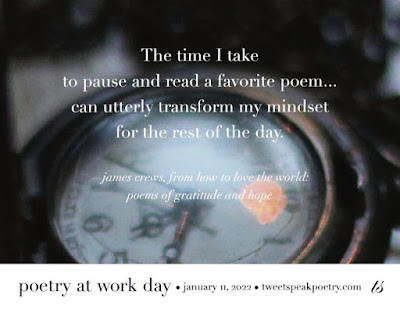
It's Poetry at Work Day 2024!


I had lunch with a friend and former colleague last week. We hadn’t worked together since 2015, and I hadn’t seen her since 2018. But we were Facebook friends, and in the intervening years stayed aware of families and careers.  

While we talked, I was reminded of a year in both of our lives, and the lives of some 23 other colleagues. From 2008 to 2009, the group of us were part of something not seen before and never seen again in our company – the almost overnight creation of a 25-person department focused on new technologies, straightforward communications with employees, and dealing in a new way with issues (of which there were a multitude) besetting the company.

To continue reading, please see my post today at Tweetspeak Poetry.

Some Tuesday Readings


Realism in Modern Art – Joseph Pearce at The Imaginative Conservative.


Poetry Prompt: Journeys! Or…Veni, Vidi, Vici – L.L. Barkat at Tweetspeak Poetry.


Boxing – poem by Zack Eswine at Rabbit Room Poetry.


The Kingdom of the Hwicce – Annie Whitehead at Casting light upon the shadow. 

Tuesday, January 10, 2023

It’s Poetry at Work Day 2023!


In 2014, I hit a wall at work. I was marginalized. I was being paid for work far below my experience and capabilities. Wanting to get up in the morning was increasingly problematic. I made attempts to move to other positions, including one major attempt, but the job was handed off to someone who was a problem in an unrelated division whom they need to move somewhere. The individual was told to come to me for guidance and mentoring.  

It wasn’t the first wall I’d ever encountered in my career, but it was the last one. In the early fall, I told my boss I was retiring in May. Surprisingly, to me at least, the news was not received well. It wasn’t that I was irreplaceable in my job; the work was easy and unchallenging. I never learned why my boss and others were so upset.


To continue reading, please see my post today at Tweetspeak Poetry.

Tuesday, January 11, 2022

Tuesday, Jan. 11: It’s Poetry at Work Day 2022!


It’s Poetry at Work Day, and I find myself thinking about names in the workplace.   

I’ve been long fascinated with the names of characters in the works of Charles Dickens. Many of them are descriptive of the characters they represent. Some he made up out of whole cloth. And some were borrowed, or stolen, from the names of real people. “Pickwick,” for example, came from the name of the owner of a coach firm in Bath. “Oliver Twiste” was the name of a real person. Dickens borrowed, and sometimes barely disguised, the names of friends, acquaintances, neighbors, and people mentioned in newspapers. 


The names of these characters often contain their own poetry. While reading a paper from 1917 on the origins of the names of Dickens’s characters, I began to think about the names, and the poetry of names, of people I’ve known over more than four decades of work life. My own last name likely started life a millennium or two ago to differentiate a father from a son, or an older and younger brother. 


To continue reading, please see me post today at Tweetspeak Poetry.

Thursday, August 20, 2020

The Poetry of Speechwriting


The most solitary job in corporate America is not the position of CEO. It’s the position of the CEO’s speechwriter. It can be the loneliest job as well.

I spent about two thirds of my career in speechwriting. Forty years ago, no one aspired to be a corporate speechwriter. You would find people who wanted to be presidential or political speechwriters, but most people who ended up in corporate speechwriting did so by accident. In my own case, I was 25 years old and assigned to a huge issue threatening to disrupt the company. The executive in charge of marketing needed a speech on the topic. The regular speechwriters are unavailable, so I was asked to do it. My strength was, in this case, knowing the subject matter. I had written speeches for myself; I had taken a course in American speeches in college. But I hadn’t written for someone else. 

To continue reading, please see my post today at Dancing Priest.

Photograph by Alem Omerovic via Unsplash. Used with permission.

Sunday, August 16, 2020

The Poetry of the Organization Chart


I was sitting with a woman in the Human Resources Department. There had been a reorganization of our department, part of a general reshuffling across the company, and I’d been assigned to sit with her to work out the new organization chart. 

You would think this was something of a useless exercise. Shouldn’t it be a simple matter of “here’s the boss, here are his or her direct reports, and here’s who reports to them.” But it was anything but simple, and I was to get a lesson in the Byzantine art form of corporate organization charts.

First, she pointed out, not all of the boss direct reports had the same title. Some were directors; some were managers. Next, there were directors and there were directors – a title wasn’t necessarily indicative of grade level, and grade level was everything. The chart had to indicate that by a subtle positioning of the boxes, with some slightly more elevated than the others. The same thing applied to the managers. Then there was the problem of some managers have more people reporting to them than directors did. 

To continue reading please see my post today at Dancing Priest.

Photograph by Alex Kotliarskyi via Unsplash. Used with permission.

Sunday, August 9, 2020

The Poetry of the Interview


It was the strangest interview I’ve ever participated in – on either side of the table.

A friend had talked me, or conned me, into interviewing for a job with St. Louis Public Schools – the director of communications. 

The school district was in chaos – an outside management firm had been brought in to run the district, schools were being consolidated and closed, services were being outsourced, central office layoffs had emptied more than half of the headquarters building, and protests by parents, students, employees, former employees, teachers and the teachers’ union were daily. School board factions were fighting each other through the news media. The news media was already showing up early each morning at the district’s administration building – knowing there would always be a new crisis to report.

And I wanted to insert myself into that?

To continue reading, please see my post today at Dancing Priest.

Photograph by Marten Bjork via Unsplash. Used with permission.

Sunday, July 12, 2020

The broad view of work


After Matthew 25:14-30

A blessing
or a curse,
a chariot
or a hearse,
a bane
or a boon,
all of these
simultaneously
are this thing
we call work.

Fundamentally human
ordinately divine,
it carries the burden
of dignity, of gravitas,
no matter how high
or low (he looked
at work and saw
it was good) (he didn’t
say it was easy). It is
all sacred, because
of its ordinance. It’s all
blessed, because
of its meaning. To hand
a bag of burgers
and fries through 
a drive-thru window 
is a holy act,
a holy calling.

Photograph by Jeremy Bishop via Unsplash. Used with permission.

Tuesday, January 14, 2020

Looking for Workplace Wisdom: It’s Poetry at Work Day 2020


It’s Poetry at Work Day 2020, and I went looking for wisdom literature about work. Many of us have had experiences with works, jobs, employment, and bosses that might make us doubt if the word “wisdom” even belongs in the same sentence with “work.” And while we all have stories to tell, it’s clear that wisdom can be found in the workplace. One of the best pieces of advice I was given as a developing corporate speechwriter was to read the poetry of T.S. Eliot, Wallace Stevens, and Dylan Thomas. These three high priests of modernist poetry offered more than their profound poetic insights and how things could be said in a speech; they offered a way of looking at and understanding the world. 

My search took me to lists of great books about business and work. Fortune has a list. CNBC has a list. Amazon has a book about the top 100 business books of all time. Bloggers have lists. I found almost as many lists of best business books as I did books. 

To continue reading, please see my post at Tweetspeak Poetry

Monday, May 27, 2019

Poetry at Work, Chapter 20: The Poetry of Retirement


I might have retired twice from the same company.

I officially retired in 2015, and I’d had given a year’s notice. I could have continued working, but the fact was that my skills, experience, and abilities were being wasted. I could have continued for a few more years, perhaps hoping for another general downsizing and a severance package, but work had become almost painful. 

When I told the head of the department of my plan to retire, the response was surprising. He became angry. It wasn’t as if I was irreplaceable. Without really knowing, I suspect it was more a case of I was doing it on my timetable, and it wasn’t something the department was planning on its timetable.

To continue reading, please see my post today at Literary Life.