Showing posts with label arts. Show all posts

Monday, February 27, 2023

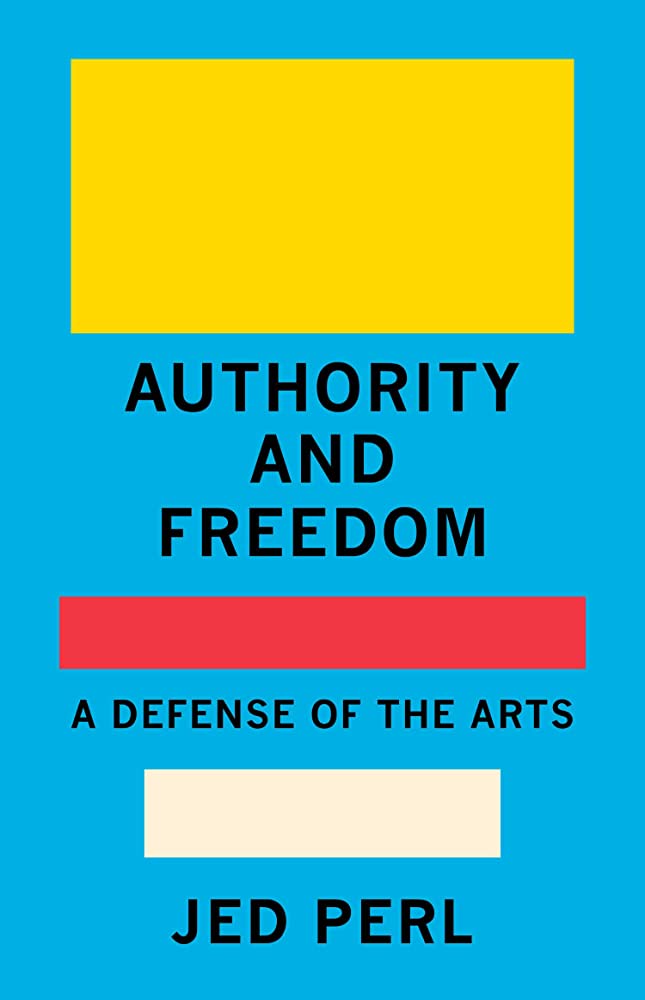
"Authority and Freedom" by Jed Perl


It’s increasingly difficult to read anything, see anything at the movie theater or on television, or visit an art museum or other cultural institution without being assaulted at some point by politics, and primarily (but not exclusively) leftist politics. It’s as if poets, novelists, artists, cinematographers, television script writers, and other culture creators have caught some kind of mass psychosis which mandates they inflict the rest of us with it. The sometimes-astonishing thing is how uniform the thinking behind it seems to be.  

Longtime art critic Jed Perl offers some resistance to this phenomenon. In Authority and Freedom: A Defense of the Arts, he argues that art transcends politics, that it has its own internal dynamic that sets it apart from whatever might be the prevailing political ideology of the moment. 


The value of art, he says, can be found in “remembering what attracted us to literature, music, and the visual arts in the first place, often when we were kids…They took us out of ourselves; they felt irresponsible, irrepressible, liberating.” Put another way, we got carried away, transported to another time and another place.


Jed Perl

He describes how artists are always caught between the poles of authority and freedom, and how the tension between the two is what leads individuals to create art. He explores the idea of vocation or calling (which has its origin in religion). He says that the arts “have a paradoxical place in our world. They’re essential because they stand apart.” And he examines what he sees as the cyclical nature of the understanding of the arts, that there have been only two brief periods in the last 150 years in the United States and Western Europe where the arts were understood as having their own significance. (And the current moment is not one of the two.)


Perl has held a number of important positions in art criticism, including being the art critic at The New Republic for 20 years and a contributing editor at Vogue for 10. He is also a regular contributor to The New York Review of Books. He has also published several books: Paris Without EndGallery GoingEyewitnessNew Art CityAntoine’s AlphabetMagicians and Charlatans, and a two-volume biography of Alexander Calder. He lives in New York City.


Authority and Freedom is a short book – 161 pages including 11 pages of footnotes – but it’s an important book. It ranges across the breadth and depth of art, and not only Western art. It considers the place of our in our civilization and our individual lives. And it says that, often despite our best conforming efforts, art stands outside ideology.

Monday, February 13, 2017

“The Arts and the Christian Imagination” by Clyde Kilby


It’s become more common today to see churches, denominations, and religious organizations begin to embrace and grapple with the role of the Christian (and the church) in the arts. But it’s been a long time coming.

The reason for that long time coming has been what can only be called antagonism, likely born in the Protestant Reformation. Protestants not only looked to reform theology; they also were done with icons, church paintings, and statues, seeing these as idolatrous. In the late 19th and early 20th centuries, fundamentalists and others turned their backs on culture, both popular and “high.” Art, movies, magazines, novels, and other aspects of culture were often considered a danger.

By the 1970s, a Christian imitation of popular culture had begun to appear, especially in music, self-help books, and fiction. “CCM” or “Christian Contemporary Music” became widely known, and secular music producers began buying up Christian labels. The same thing has happened over time with Christian books, with many Christian publishers now subsidiaries or imprints of larger secular concerns. But much of what is called Christian is still clearly separated from the general culture.

Also in the 1970s, Francis Schaeffer was one of the first spokesmen for Christians to re-engage with the culture at large. He, and many others, could clearly see the decay of secular culture – essentially what was happening without the redeeming “salt” of Christianity. The decline seemed to be happening quickly, but it had actually been happening for more than a century.

But before there was Francis Schaeffer, there was Clyde Kilby.

Kilby (1902-1986) was a long-time professor of English and department head at Wheaton College in Illinois. He also happened to be a passionate advocate for the arts. He taught literature and poetry and fought the good fight to defend both, and especially poetry. He was heavily influenced by British Christian writers like J.R.R. Tolkien, C.S. Lewis, and other members of the Inklings. He was also instrumental in the founding of the Marion Wade Center at Wheaton, what became a major research center and document depository for the works of Lewis, Tolkien, Owen Barfield, Dorothy Sayers, G.K. Chesterton, George Macdonald, and Charles Williams.

Various manuscripts and essays by Kilby have been collected and published under the title of The Arts and the Christian Imagination: Essays on Art, Literature, and Aesthetics. It’s almost uncanny how Kilby advocated for and anticipated the renewed Christian involvement in the arts, which is only now beginning to gain velocity.

Clyde Kilby
The collection is divided into four sections. The first, “Christianity, the Arts, and Aesthetics,” includes a lengthy unpublished manuscript by Kilby drawn partially from his published essays as well as original material. He was especially interested in form in the arts, but parted company with academics, critics, and artists who saw form as everything. Kilby, says collection editor Willian Dyrness in his introduction, understood form in a radically different way: “True form, for the Christian, is exemplified by the Spirit-filled life. It is more closely connected to being than doing.”

The second section, “The Vocation of the Artist,” discusses the Christian and culture, a defense of beauty, individuality, and evangelicalism and human freedom. “Faith and the Role of the Imagination” is the third section, followed by  a section specifically addressing poetry and fiction, two art forms too long neglected or ignored by the Christian community. Kilby, in fact, saw Jesus as more of a poet than an expositor, and said that “we have forsaken the poetry of Christianity for it prose, and especially its dull expository prose.”

Kilby was the author of several works about Lewis and Tolkien, including The Christian World of C.S. Lewis (1964); Tolkien and the Silmarillion (1971); Images of Salvation in the Fiction of C.S. Lewis (1978); and Brothers & Friends: The Diaries of Major Warren Hamilton Lewis (1983). He served as editor for C.S. Lewis: Letters to an American Lady (1967). And a companion volume to The Arts and the Christian Imagination, A Well of Wonder: C.S. Lewis, J.R.R. Tolkien, and the Inklings, was also published in 2016. Kilby also published Minority of One: A Biography of Jonathan Blanchard (1982).

The Arts and the Christian Imagination has insights and thought-provoking observations on almost every page. Kilby was a shrewd observer of both the contemporary arts and how Christians did, and didn’t respond to and participate in them. It’s an important collection that is pertinent for Christians and for anyone who cares about the arts today.

Related:


Photograph: Whitby Abbey in the United Kingdom by George Hodan, via Public Domain Pictures. Used with permission.

Monday, December 16, 2013

Separate, Engaged or Transformed?


Every so often, a controversy about Christian fiction erupts online, that is, a controversy between Christians.

In one corner is the small but growing band of writers reaching to break through what is still a recognizable monolith of Christian fiction publishing. They seek to transcend it and engage the larger popular culture.

In the other corner, and it is a crowded and rather loud corner, are the traditionalists who are just fine, thank you, very much, with Christian fiction remaining a genre very separate from popular and literary fiction.

The arguments rage particularly over quality of the writing in Christian fiction. I read a lot of fiction, both Christian and “secular” (and by “secular” I mean both popular and literary). I don’t engage in the Christian fiction controversies, but I will say this: those who would transcend the Christian fiction genre have more of a point about quality than those who are adamant about saying within the genre’s boundaries and market. They’re not entirely correct, but they do have more of a point.

In Gray Matters: Navigating the Space Between Legalism and Liberty, Brett McCracken discusses three phases in the development of Christian attitudes toward art. He’s considering music specifically, but what he says applies across the board of all of the arts.

The separational phase was the original Christian arts ghetto – no involvement in and keeping at least two arms’ lengths from popular culture. Actually, it was likely less a ghetto and more the kingdom of No Involvement Whatsoever. The integrational phase started roughly in the 1970s – the broad adoption of secular arts forms by Christians, so we had our own Christian fiction, our own Christian music (including rock and heavy metal), and our own Christian movies.

The latest phase is what McCracken calls the transformational – and it’s the one gaining increasing acceptance among Christians today. It is the idea that we are to participate in culture, not to be taken over by it but to redeem it. This was articulated by Dutch Reformed theologian Abraham Kuyper more than a century ago, Francis Schaeffer in the 1960s and 1970s, and numerous artists and theologians today.

I have to ask – where does my own work fit in these three phases?

I’ve now authored three published books – two novels and a non-fiction work. With the first novel, I did what most if not all writers who happen to be Christian do: I sent the manuscript to the agents who specialize in Christian fiction for the Christian fiction market. I figured they were the best possibilities I had for the manuscript, which was about an Anglican priest falling in a love with a non-believer.

The agents for Christian fiction didn’t like it. It was uniformly if politely rejected with the impersonal form email rejection notices. Some of the agents’ requirements for submissions were extensive – and I’m not talking about two or three hours of work but more like 20 or 30 hours of work. A two-sentence form rejection notice after that kind of effort is, well, you probably know what my reaction was. One direct interaction with an editor at a Christian publishing house almost ended any interest I had in having anything to do with Christian fiction; the editor wasn’t being critical of my work but was offering one of the nastiest assessments I had ever heard anyone make of the Christian fiction market.

Let’s hope I caught the editor on a bad day.

Then I went to a general (not Christian) writer’s conference. I met with an editor who was unbelievably encouraging. I sat with 12 other writers in a seminar with an agent who had us read each other’s work, and the agent responded to mine with some surprising praise. She was short, gravel-voiced from likely too many years of smoking, tough as nails – the almost stereotyped picture of the New York agent – and she was indeed from New York City. “I don’t handle your kind of manuscript,” she said, “but it’s good; it’s powerful stuff.”

What I came away with was an understanding – I was not actually writing for a Christian reader or a Christian market. When the novel was finally published some three years after that conference, it appealed to non-Christians as much as it did to Christians, and perhaps even more so. “It’s a love story,” one said, “but I could read it to my kids without being embarrassed.” Another said “it appeals to the heroic in all of us; it makes us want to be that hero.” And that’s when I realized I had a problem – my fiction didn’t fit a preconceived genre. I was in a kind of literary No Man’s Land.

If you read my new non-fiction book, Poetry at Work, you will find virtually no references to faith or God (I can’t even recall any). And yet I would argue that faith is the belief system underpinning everything in it.

It sounds like, without planning it or even realizing it, I landed in the transformational camp.


Over at The HighCalling, we’re discussing Gray Matters. Today, Shawn Smucker considers what McCracken has to say about music. To see his post and the discussion, please visit The High Calling.


Photograph via Public Domain Pictures. Used with permission.

Monday, December 2, 2013

Navigating the Gray


One of the movie critics in our local newspaper always provides guidance for us in how we approach movies.

If he likes a movie, we know the film will be generally edgy, with some violence and an “anti” kind of message, as in “anti-establishment” or what the critic (and the movie) had determined to be “anti-establishment.” Like Pulp Fiction.

If the movie is about values (family and otherwise) or is life-affirming, we know the critic will usually pan it. Like Steven Spielberg’s Lincoln.

In other words, his movie reviews often if not always reveal more about the critic than the movie, and that may be true of most criticism in the arts. It’s not that our local critic is always wrong, but I’ve read enough of his reviews to understand his worldview, and I know how and when it differs from my own.

What’s clear is that, in his writing his reviews and my reading them, we are both engaging in the business of culture.

In my own writing, and people’s reading and responding to it, we are all about the business of culture – making it, consuming it, understanding it, becoming part of it. We Christians, says Brett McCracken in Gray Matters: Navigating the Space Between Legalism and Liberty, tend to have one of two responses to culture. We see it as godless, heretical, blasphemous, and abominable. Or we saturate ourselves in it to get as far away from our Christian upbringing as possible.

Few of us, McCracken says, attempt to understand it. Discern what if anything is worthy, and celebrate the beauty of what is good in culture. Man is created in God’s image, and he made us to be creators, and that original impulse can be found across humanity.

What we have largely done is to wall ourselves off from popular culture, even as we embrace (and often unwittingly embrace) many of the forms that popular culture takes – art, rock music, radio, television, movies magazines, novels, self-help books. We have Christian versions of virtually every form of popular culture available.

What we have not done is to ask whether these forms of culture change what we try to say and communicate. The reality is that they do change the message, and often in profound ways; some messages are better suited to certain forms rather than others. And they change what we say in exactly the same way they changed what is said and communicated in the popular culture.

For the next four Mondays in December, TheHigh Calling will be discussing Gray Matters. McCracken examines four manifestations of how popular culture manifests itself – food, music, film, and drinking, and he considers each from the perspective of both creation and consumption. Each Monday the discussion will focus on a different manifestation. Check out The High Calling to see where the discussion is going. It promises to be lively.

Related:

Jonathan Merritt at Religion News Service interviewed Brett McCracken earlier this year.


Photograph by Petr Kratochvil via Public Domain Pictures. Used with permission.