Showing posts with label ideology. Show all posts

Monday, February 27, 2023

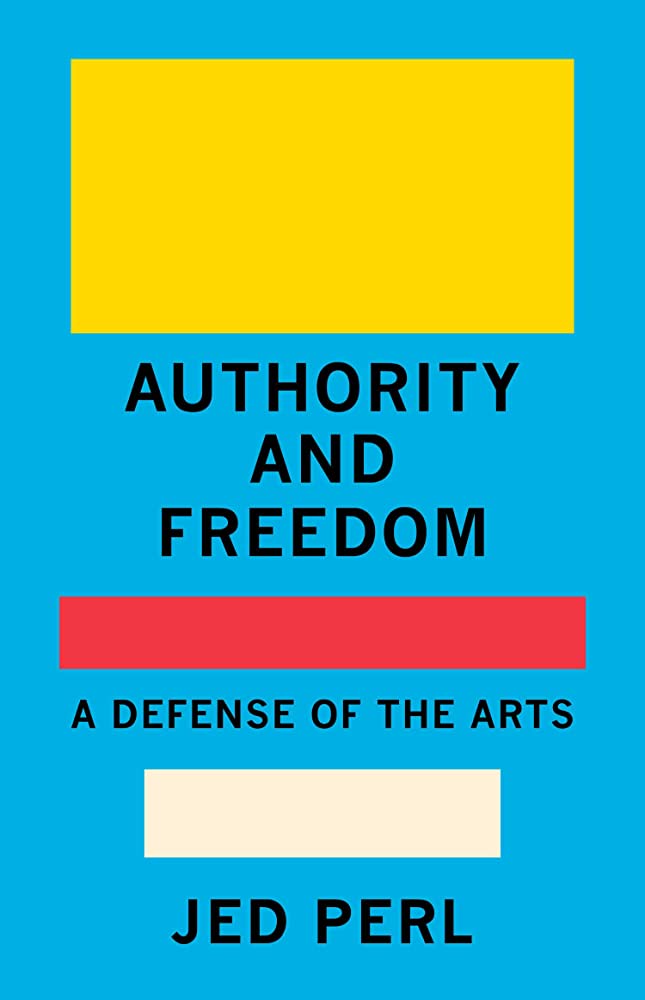
"Authority and Freedom" by Jed Perl


It’s increasingly difficult to read anything, see anything at the movie theater or on television, or visit an art museum or other cultural institution without being assaulted at some point by politics, and primarily (but not exclusively) leftist politics. It’s as if poets, novelists, artists, cinematographers, television script writers, and other culture creators have caught some kind of mass psychosis which mandates they inflict the rest of us with it. The sometimes-astonishing thing is how uniform the thinking behind it seems to be.  

Longtime art critic Jed Perl offers some resistance to this phenomenon. In Authority and Freedom: A Defense of the Arts, he argues that art transcends politics, that it has its own internal dynamic that sets it apart from whatever might be the prevailing political ideology of the moment. 


The value of art, he says, can be found in “remembering what attracted us to literature, music, and the visual arts in the first place, often when we were kids…They took us out of ourselves; they felt irresponsible, irrepressible, liberating.” Put another way, we got carried away, transported to another time and another place.


Jed Perl

He describes how artists are always caught between the poles of authority and freedom, and how the tension between the two is what leads individuals to create art. He explores the idea of vocation or calling (which has its origin in religion). He says that the arts “have a paradoxical place in our world. They’re essential because they stand apart.” And he examines what he sees as the cyclical nature of the understanding of the arts, that there have been only two brief periods in the last 150 years in the United States and Western Europe where the arts were understood as having their own significance. (And the current moment is not one of the two.)


Perl has held a number of important positions in art criticism, including being the art critic at The New Republic for 20 years and a contributing editor at Vogue for 10. He is also a regular contributor to The New York Review of Books. He has also published several books: Paris Without EndGallery GoingEyewitnessNew Art CityAntoine’s AlphabetMagicians and Charlatans, and a two-volume biography of Alexander Calder. He lives in New York City.


Authority and Freedom is a short book – 161 pages including 11 pages of footnotes – but it’s an important book. It ranges across the breadth and depth of art, and not only Western art. It considers the place of our in our civilization and our individual lives. And it says that, often despite our best conforming efforts, art stands outside ideology.

Wednesday, February 22, 2017

On Education: Experience and Ideology (Part 2)


In September 2003, a friend called and suggested I look at an ad in the newspaper. St. Louis Public Schools was looking for a director of communications.

For the three previous moths, the school district had been in about as complete upheaval as could be imagined. The reform majority on the school board hired a New York management consulting firm that specialized in massive restructurings to run the district. The day the firm arrived to take over, the school district disclosed that it had a huge budget deficit (illegal under Missouri law). By the time I saw the newspaper ad, more than 700 people in the central administration office had been dismissed (think about that number for a moment), bus and cafeteria services had been outsourced, school closings were underway, and curriculum changes were being implemented wholesale.

You can imagine the headlines. The protests. Parents up in arms. District employees up in arms. Teachers doing wildcat strikes. The non-reform minority on the board leaking school board discussions to the media. School board meetings that were borderline riots (a “good” meeting, one administrator told me, was one where fewer than five people were arrested).

My entire experience had been in corporate communications. What did I know about urban public education?

I applied for the job. I was one of 10 people selected for interviews. All 10 candidates were told to arrive at the same time. We sat in a conference, and were called out one by one about every 10 minutes. Looking around the table, I could see I was (2) the oldest, (b) one of four whites, and (c) the only male. I was called last.

Three people comprised the interview panel – the administrative vice president to whom the communications job reported, the acting superintendent (from the management firm), and one of the management firm consultants. They followed the standard behavioral interviewing script until, without warning, the acting superintendent threw the script up in the air and yelled, “Why the hell do you want this job?”

My answer must have been sufficient. An hour later I found out I was hired, and needed to be at a teacher focus group that afternoon. The job would start the next morning. When I walked in at 8 a.m., I found out that two television stations and the St. Louis Post-Dispatch were waiting for interviews – about the teacher sickout that was underway. When I asked who on the staff could give me information and a position statement, the secretary said the superintendent was at a breakfast and the other key staff people had left the building, because they were afraid I would ask them to be interviewed. “You’ll have to wing it,” she said. An hour later, I was told that there was no communications budget – it had been eliminated as a cost-saving measure (the year before it had been $1 million+).

Every day produced multiple crises. A school board member got into an argument with a high school principal than almost came to blows. Another school board member attached an administrator. A school experienced food poisoning, blamed on the outsourced contractor. And then there were the usual incidents associated with an urban school district.

I think I have some insight into what it must be like working at the Trump White House.

I visited most of the schools in the district. I was constantly talking with teachers, principals, central office staffers, parents, and news media. I attended school board meetings packed with 400 people inside and more than 2,000 outside. I saw teachers who were performing daily miracles with no resources, and teachers who were showing up simply to get a paycheck and a pension. I attended public meetings of the teachers union, because it was inevitable I’d need to respond for the district.

I learned a lot. Perhaps I learned too much. But one lesson that stuck with me was to be aware of a certain phrase. If you heard anyone say “But it’s for the children,” you knew that it wasn’t about the children at all, but about some other agenda. (I’ve also learned the same is true for the school district I live in; this may be a universal truth.)

So when I see what just happened during the Betsy DeVos confirmation hearings in Washington, I have a reaction based on the experiences in my own school district, which I described last week, and the experiences I had with St. Louis Public Schools.

When its contract expired, the management firm wasn’t rehired. The harsh things it did – school closings, layoffs, contract outsourcing – likely saved the district financially. A couple of years later, the Missouri Department of Education removed the district’s state accreditation and appointed a board to run the district. Within just the past few months, the district once again became accredited.

Charter schools (and a voluntary transfer program involving the suburban school districts) have had an impact on St. Louis Public Schools. Yes, they’ve siphoned funds away. But they’ve also forced the district to compete, consolidate, and improve academics.

Children in the inner city deserve far better school systems than they’ve been given.

Related:


Wednesday, February 15, 2017

On Education: Experience and Ideology (Part 1)


I have to admit I didn’t closely follow the recent confirmation hearings of Secretary of Education Betsy DeVos. My wife did, however, and she’d generally tell me whenever something of note happened.

Based on the lobbying onslaught on Congress, the DeVos hearings sounded like the battle of Armageddon. Even I could figure out that the two main teachers unions, the National Education Association and the American Federation of Teachers, didn’t like DeVos. At all.

A Facebook friend said this about the controversy: your views on education are shaped either by experience or ideology.

He was right. And I realized mine were shaped by experience.

We live in one of Missouri’s top-rated school districts. A big chunk of our property taxes go to that district. We had just moved to the district when our oldest started first grade. Since we were both products of public education, and we were in a well-regarded district, we really didn’t think about sending him to a private school.

The first three years met and exceeded our expectations. When he started fourth grade, however, the teacher seemed more a representative of the union than she seemed a teacher. I can’t say I can pinpoint anything specific, but parent meetings and class presentations for parents also left me with a feeling of disquiet.

When our son started middle school, we began seeing education politics. The science teacher seemed qualified, but was more interested in defending the teaching profession than in teaching science (none of the parents expected to be lectured at during parents’ night, but we were, for no discernible reason). It was the English teacher, however, that became the stumbling block.

When I was in school, I had great English teachers. I can’t remember a bad one, or even a mediocre one. My English teachers loved what they taught, including grammar. I attribute my own love for literature to the teachers I had in junior high and high school.

This was not my son’s experience. His teacher was more interested in political and social issues, including field trips that had nothing to do with English or literature. I probably could have managed that, but it was her notes home to parents that shocked me.

The notes were full of grammar errors and misspelled words. Every single one of them. I finally reached the point of no return, and began sending them back to her, with the mistakes corrected.

She thanked me. And kept on sending notes filled with grammar errors and misspellings.

I started paying attention to what was going on. Attending a presentation for parents on new curriculum changes, I learned that the district had stopped teaching penmanship, was implementing new modules on self-esteem, and was beginning to focus on what was called “critical thinking.” The examples cited made it clear that our children were being moved into something that resembled indoctrination more than critical thinking.

That did it. After his first year, we pulled our son out of the public middle school and enrolled him in the local Catholic school. As non-Catholics and non-parishioners, we paid full tuition, not subsidized by the church. It was still considerably less than the average cost of educating a child in the public system.

The Catholic school was nothing spectacular. It didn’t have the resources to do all the fancy stuff. It focused on the basics.

That year was not fun. The first thing we learned was that our son was a minimum of six months behind his classmates at the Catholic school. His first day in class, his English teacher had the students diagram sentences. He had no clue what she was talking about.

For six months, we had to do the equivalent of homeschooling in English, math, history, and science to get him to the level where his classmates were. And this was no fancy or advanced curriculum; this was basic stuff.

We had taken him out of one of the top-rated public school districts in the state, and put him in an average Catholic parish school.

I wondered what it was like in the poorer-rated districts.

About a decade later, I had the opportunity to find out. That story next week.


Top photograph by J.J. Thompson via Unsplash. Lower photo by Linnaea Mallette via Public Domain Pictures. Both used with permission.