Showing posts with label food. Show all posts

Tuesday, December 14, 2021

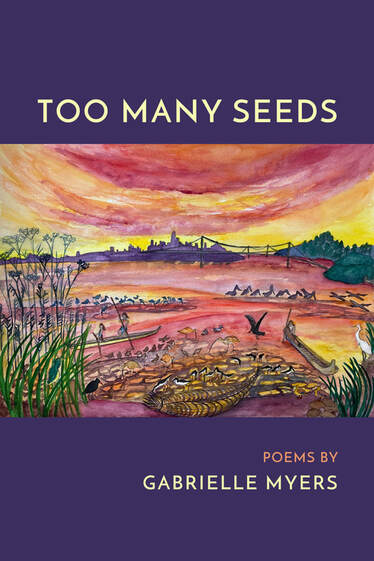
Poets and Poems: Gabrielle Myers and "Too Many Seeds"


It’s no surprise to find food, nature, and food in nature in the poetry of Gabrielle Myers. She’s an English teacher now, but she worked for years at as a chef. Food is important. The quality of food is important. Her poems are filled, like seeds, with food metaphors. Her recently published first collection, Too Many Seeds, is a veritable feast of images, ideas, questions, and answers about food, nature, and what we do in the short time we have on this planet. 

The 45 poems in the collection take us to picking heirloom tomatoes, searching for fennel pollen, picking figs, examining quality control and the processing line at a dried fruit factory, asking questions about an injured bee, what you see from your window at lunchtime, and watching a hummingbird in an orange tree. She expertly uses the language of food and nature, and food from nature, to weave a consideration of life and what it means.


To continue reading, please see my post today at Tweetspeak Poetry.

Tuesday, April 28, 2020

Pandemic Journal: Rejoicing Over Bleach at the Grocery Store


I decide to try grocery shopping at the time set aside for those 60 years old and older – 8-9 a.m. Some 60 people are waiting for the store to open. One man, wearing mask and gloves, becomes nearly hysterical when someone stands three feet too close. He moves deeper into the crowd, making himself more threatening than the person he was upset with.

The doors open. As I enter the store, I watch elderly people grab a wipe from the dispenser and break into almost a run. They are rushing to the paper aisle, where they will find – no toilet paper. This is the last time I come at the senior citizen hour. It’s too painful to watch.

***
We live in a culture that has never known want. Few people remember what Norman Borlaug called the moving geography of starvation, including the Great Depression of the 1930s. This country knew hunger, and not on a small scale. My mother, who grew up in the Ninth Ward of New Orleans, told us stories about going to bed hungry, not even a loaf of bread in the house. I’ve never had that experience, not am I interested in having that experience.

To continue reading, please see my post today at Tweetspeak Poetry.

Photograph: A pandemic grocery shopper.

Thursday, December 26, 2019

Christmas, Romance, and Food


Christmas celebrations are known for all kinds of foods – main courses, baked goods like pies and cakes, cookies (especially cookies), and more. It’s no surprise that food will often play a role in Christmas romance stories.

It may be food at big family gatherings. It may the food at Christmas dinners and lunches with work colleagues. It may the food featured at holiday time in cafes and restaurants. It may also be date meals for the hero and heroine.

In food romances and Christmas food romances, authors will also often include a recipe or two at the end, suggesting a real-world connection to a romance novel. Occasionally, the reader might be forgiven for suspecting that the story actually was inspired by the recipe. 

Here are two examples of Christmas romance novels that use food in very different ways (but both have a recipe at the end). 

The Christmas Cookie House by Jennifer Griffith

In The Christmas Cookie House by Jennifer Griffith, Leela Miller is a 20-somethig determined to keep her mother’s Christmas legacy alive. That legacy was largely based on work each Christmas on a fundraising event for the local ladies’ auxiliary – the Christmas Cookie House where thousands of homemade cookies are sold. The event is always held at the home of the auxiliary chairwoman, Una Mae Coldicott. Except this year, Una Mae plans to deep-six the event; she won’t have it at her home any longer and no one is stepping up to take charge. Leela does, even though she’s only a provisional member.

The ideal place to have the event would be the old Layton mansion, now owned by Jay Wilson, a newly minted veterinarian who is interested only in selling the mansion as fast as possible to get the funds needed to buy a veterinary partnership. Things between Jay and Leela seem to start off on a bad footing, when he discovers her trying to look into a back window of the house and instead falling into a bed of roses. Jay has to achieve one condition for the house in his uncle’s will – to sort through everything in the attic. It’s a lot to sort, and to speed access to the house for the cookie fundraiser, Leela volunteers to help.

We know where this is likely headed. But can the growing romance endure Jay’s desire to sell the house and move to another town? We’re not sure how this story will end, but Leela’s gingersnap cookies certainly won’t hurt (recipe at the end).

Keep Me at Christmas by Lucinda Whitney

Keep Me at Christmas is one of Lucinda Whitney’s novel series about the Romano family. Luciana Romano, partially to escape wedding activities for her cousins and comments about her own wed-less condition, agrees to be a last-minute substitute for a museum curation project in Hudson Springs, New York. She flies from her native Portugal to New York, to help the museum prepare for an exhibit of local 19th century textiles, and historical textiles in Luciana’s specialty. Arriving too early for her room to be ready at the local inn, she’s dropped off by the taxi driver at the Italian café and bakery operated by Jack DiLorenzo, his mother, and his grandmother. 

Two years after his fiancé broke off their engagement, on Christmas Day, no less, Jack is determined to date no one; the hurt was too great. And then Luciana walks into the café. Food becomes the initial bond; readers may gain weight simply by reading about all of the mouth-watering foods served by the café – paninis, traditional Italian dishes, desserts, and more, not to mention the hot chocolate drinks with real chocolate. (The recipe featured at the end, however, is one Jack makes for Luciana, and it’s the Portuguese dish of sweet rice, a kind of risotto pudding.)

Jack has to overcome his reluctance to take a risk on love; Luciana, no matter how strongly she’s attracted to Jack, knows that a long-distance relationship won’t likely work. She’s has only two weeks in Hudson Springs, until a snowstorm delays her return to Portugal.

Top photograph by Brooke Lark via Unsplash. Used with permission.

Tuesday, January 19, 2016

Poetic Voices: Jen Karetnick and E. Kristin Anderson


We find all kinds of things to write poems about, like food, and cheese, and the rock star Prince. At least, we write about food and Prince when we are really writing about something deeper.

Jen Karetnick is a poet and author who has written (and co-authored) books about food, like a recipe book for mangoes, entitled to no surprise, Mango. Food is an important part of our lives, for more than the obvious reasons of sustenance and survival. Food is part of culture, for good and for ill.

In Brie Season: Poems, Karetnick has assembled some 60 poems which are ostensibly about food, but go deeper into the culture that frames what we call food and the human emotions that come into play.


To continue reading, please see my post today at Tweetspeak Poetry.

Monday, October 27, 2014

Shall We Gather at the Table?


From the beginning, the tiny group of Christian believers in Jerusalem gathered together on a regular basis. Not long after the ascension of Christ, Acts 2:42 says that believers devoted themselves to the apostles’ teaching, to fellowship, to the “breaking of bread,” and to prayer. These are all communal activities, although prayer is also individual.

What this signifies, though, is that the original model of the church was people coming together and sharing among themselves. They might have shared teaching, meals, conversation prayer – but they shared it. Christianity was communal. Believers met in homes; they were not exactly welcome in synagogues or other places where Jews congregated in their religious life, although they did go to the temple for a time.

In Christian churches today, all of these activities are recognizable, including the “breaking of bread.” The food may be more plentiful and elaborate than what the early church experienced, but the idea is the same.

The difference is that we live in a (Western) culture today where food has become something of a social and political act, much like the environment was for an earlier generation (mine). There is a desire for simpler, more natural and slower (rather than fast) food. Processed and imported food is suspect; we want natural and local. Many of us also want people to know what we doing in our desire for simpler and more natural food, part of the conspicuous virtue that has replaced the conspicuous consumption of the 1950s and 1960s.

This wasn’t the point when the early church met and broke bread. Food was not an end in itself but a means to an end – the being together, even with your children running about. Christopher Smith, John Pattison and Jonathan Wilson-Hargrove, in Slow Church: Cultivating Community in the Patient Way of Jesus, ask us to imagine a common life “centered around (a) eating together at the table and (b) the slow, Eucharistic conversation that convivial feasting encourages.”

My own experience with churches eating together is something different. They have more been times associated with an event or purpose – a missions meeting, a congregational meeting, a newcomers luncheon. There is food and conversation, to be sure, but it’s often hurried and surface so we can get to the point of the group meeting. Off-building meals with Sunday School classes has been different, approaching something like what the Slow Church authors suggest.

What if the being together – the sitting, the eating and the talking – was the point? What might happen as a result?

I don’t know, but I’m willing to find out.


For the past several Mondays, I’ve been discussing Slow Church. This chapter, “Dinner Table Conversation as a Way of Being Church,” is the last chapter in the book. A short conclusion remains, and next Monday I’ll finish my own discussion with some overall thoughts about the book.

Illustration by Piotr Seidlecki via Public Domain Pictures. Used with permission.

Monday, December 9, 2013

Food and Idolatry


In 2008, I had the opportunity to hear food author Michael Pollan speak at Washington University in St. Louis. He was receiving a literary award from the English Department. The venue was packed – the room haled 600 comfortably and it was standing room only. I was clearly out of my demographic – the vast majority of people in the audience was students and under 23 years old.

In the middle of telling an entertaining story about fighting a mole in his vegetable garden, Pollan was describing how he flooded the mole’s tunnel with gasoline and set it alight, hopefully to force the animal out or kill it. “I was,” he said, “the Westmoreland of the vegetable patch.”

The room roared with laughter.

I was surprised that so many people seemed to understand the joke. I got it, and the older faculty members got it, but almost 600 people under the age of 23? (If you don’t get the joke, William Westmoreland was the army general in charge of U.S. forces in Vietnam, and the one associated with the use of napalm against the enemy.

I leaned to the laughing19-year-old next to me and whispered, “Who’s Westmoreland?”

“I don’t know,” she replied. “But isn’t Michael wonderful?”

That’s when I understood that Pollan wasn’t a journalism professor or author or food activist. He was a rock star, and what I was witnessing was popular culture at its most uncritically laudatory and undiscerning. It was cool to like Pollan. He was performing for his audience and they loved it, even if they didn’t get the jokes, allusions or examples.

In many ways, this is no different than Justin Bieber and Miley Cyrus.

Last week, in the introduction to the book discussion on Gray Matters: Navigating the Space Between Legalism and Liberty by Brett McCracken, I mentioned how Christians have adopted many if not all of the various communication forms of popular culture – movies, television, and rock music, among others. This adoption isn’t necessarily a bad thing, but we often don’t consider how the form of communication shapes the message we’re trying to communicate.

And over the past decade, one of the communication forms of popular culture has become food. Fifty years ago, sociologists talked about the phenomenon of conspicuous consumption (keeping up with the Joneses). Today, it’s conspicuous virtue, and food has become caught up within it.

So, for example, consider one of the main tenets of the food movement that Pollan is so much a part of is to eat local. When it first became popular, local was defined as no more than five miles from where you lived – you should eat only what was grown five miles or less from your home. It took no time for most people to realize that such a definition would not likely appeal to, say, a resident of New York City or Boston, Washington, D.C., Chicago, Atlanta, San Francisco (Pollan’s hometown) or Los Angeles. The definition has changed over time, and is now 400 miles, which to my mind really stretches the idea of “local.” Even then, it means that if you live in New York City or San Francisco, you shouldn’t eat bananas. And no seafood for Denver or Des Moines. And none of us in the United States can have coffee or tea.

It’s an appealing notion – you should know who grows your food. And it’s possible for some of us. But what study after study has also shown is that “eat local” is not as environmentally sustainable as “eat globally.”

But “eat local” is a conspicuous virtue. It’s not enough to pursue it. We want people to know we are doing it. And that’s where the line can be crossed, especially for Christians.

This section of McCracken’s book was disappointing. He uncritically accepts much of what passes as popular wisdom today on food. He tries to make the case for how important food was to Jesus, but it falls flat – food in the Gospels was never about the food itself but about the relationships and the people Jesus was eating it with or miraculously providing it to. And it’s difficult for me to read a rather rapturous description of a ten-course meal (even in small portions) and consider how many people, and children, in the wealthiest nation on the planet go to bed hungry every night.

McCracken does warn of the danger of food snobbery, but it’s one small part of two lengthy chapters. And while he cites the need to know about where our food comes from, he doesn’t cite the need to be discerning about all of the people, including Christians, who tell us about the spirituality of food and how we should eat.

The problem isn’t food snobbery. It’s food idolatry.


Over at The High Calling, we’re discussing Gray Matters. I didn’t mean to go on a rip, but I think I was expecting something more insightful from these two chapters than what can be found in any secular popular magazine. To see what others are saying, please visit The High Calling.

Photograph by Petr Kratochvil via Public Domain Pictures. Used with permission.