Showing posts with label early church. Show all posts

Wednesday, March 23, 2022

“Reign: The Church in the Middle Ages” by Luke H. Davis


Many of us have an image in our heads of what the Middle Ages were all about. At one time, we called the period the “Dark Ages,” the time following the end of the Roman Empire, when the civilized world was overrun by barbarians, culture collapsed, people were divided into serfs or nobles (with most becoming serfs), and life became nasty, brutish and short. Then came the Renaissance and the Enlightenment. 

Nothing is ever that simple. Many good things came from the period we call the Enlightenment, but so did the barbarism of the French Revolution. The Middle Ages were anything but a stagnant time, and that’s especially true for the church. 


Reign: The Church in the Middle Ages is the second book in the Risen Hope church history series by Luke Herron Davis. It is structured much like its immediate predecessor, Redemption: The Church in Ancient Times.  Aimed squarely at younger readers, it’s written in a lively, storytelling style that introduces the key people of the church for period that extended from the Fall of Rome to roughly the 1400s.


Included are stories about St. Benedict, St. Columba, Pope Gregory I, St. Anselm, St. Bernard, Peter Waldo, St Francis of Assisi, Stephen Langton, Thomas Aquinas, John Wycliffe, Julian of Norwich, and John Hus. David includes short vignettes of historical events that involved these people – the Crusades, the signing of the Magna Carta, the rise of the papacy and Islam, and more.

 

Luke H. Davis

While the intended audience is younger readers, even older readers can learn something from the book. I didn’t know, for example, the critical role Stephen Langton, archbishop of Canterbury, played in the writing of the Magna Carta and its signing by King John in 1215. The book is packed with “face files” like that.


Davis teaches at Westminster Christian Academy in St. Louis and chairs the Bible Department there. He’s also taught at schools in Louisiana, Florida, and Virginia. He describes himself as “Presbyterian body, Lutheran heart, Anglican blood, Orthodox spirit,” all of which have served him well in writing the Cameron Ballack mysteries. He has published three Ballack mysteries, Litany of Secrets (2013), The Broken Cross (2015), and A Shattered Peace (2017), and the first book of a new series, Joel: The Merivalkan Chronicles Book 1 (2017). He blogs at For Grace and Kingdom.


Reign is a collection of stories about key figures of the church, but it is also the history of the church from the fall of the Roman Empire to the first stirrings of reformation coming from men like John Wycliffe and John Hus. The period was an exciting time, full of upset, change, and the transformation of the church to a political powerhouse, along with the corruption that came with it.


Related


Redemption: The Church in Ancient Times by Luke H. Davis.

Wednesday, March 16, 2022

“Redemption: The Church in Ancient Times” by Luke Herron Davis


My knowledge of church history was spotty – at best – for a very long time. My grade school and undergraduate education was almost entirely secular. I took two years of catechism (Lutheran version), and in my 20s took several extension courses about the Old and New Testaments. But if you asked me what I knew about the history of the early church before my mid-30s, I would have given you a timeline that leaped from the book of Acts to St. Augustine, and from St. Augustine to the Reformation.  

That state of affairs changed, dramatically, when I pursued a liberal arts master’s degree in my mid-30s. I took course like “Athens or Jerusalem,” “History of the Early Christian Church,” and “The Image of Rome.” I read the early church fathers, like Origen, Athanasius, Clement of Alexandria, and Tertullian. I read Peter Brown’s marvelous biography of Augustine. I read the Didache. And the Desert Fathers (and a few Desert Mothers). I read Kenneth Scott Latourette’s A History of Christianity (two fat volumes) and The Rise of Christianity by W.H.C. Frend. And a whole lot more. 


And I learned that the Christian church had an unbelievably rich, complex, and often profound history. And I realized how much of that history had been erased from so many of my history courses in high school and college. And I’ve often wondered how one could introduce that history to children and young people.


Luke Herron Davis has an answer – a series on church history written especially for younger readers. The first volume in that series is Redemption: The Church in Ancient Times. And far from being a weighty tome that could be a weapon if thrown at someone, it’s short, readable, interesting, and tells engaging stories taken straight from the Gospels and the Book of Acts as well as other sources of early church history.


Davis tells the story of the church by telling the stories of some of its leading historical figures from the first through the sixth centuries A.D. Each entry is 10 to 12 pages, written in story format – enough to impart important information about each figure and whet the appetite for more.


The people included are Peter, Paul, Ignatius, Polycarp, Cyprian, Constantine, Athanasius, Ambrose, John Chrysostom, Jerome, Augustine, and Patrick. Many others are mentioned in side notes (including one of my favorite figures, Tertullian). Each chapter is written like a story, bringing a freshness and a contemporary feel. The reader feels an integral part of what’s happening. 


It's an easy, interesting read, and I suspect that even adults would enjoy it (and learn a few things).


Luke Herron Davis

Davis teaches at 
Westminster Christian Academy in St. Louis and chairs the Bible Department there. He’s also taught at schools in Louisiana, Florida, and Virginia. He describes himself as “Presbyterian body, Lutheran heart, Anglican blood, Orthodox spirit,” all of which have served him well in writing the Cameron Ballack mysteries. He has published three Ballack mysteries, Litany of Secrets (2013), The Broken Cross (2015), and A Shattered Peace (2017), and the first book of a new series, Joel: The Merivalkan Chronicles Book 1 (2017). He blogs at For Grace and Kingdom.


Redemption is not written to be a complete, encyclopedic overview of church history. What it does is, aiming at young readers, provide an introduction to some of the leading figures of early church history, the people who evangelized, taught, encouraged, and admonished, and who often had the specter of martyrdom hanging over them (like Polycarp, bishop of Smyrna, who was himself discipled by the Apostle John). These are the people who faithfully transmitted the faith to future generations, and Davis is providing a real service in introducing them in such an engaging way to contemporary readers.


Next weekReign: The Church in the Middle Ages.


Related:


Reading a Novel that Stars Your Hometown.


My review of Litany of Secrets.


My review of The Broken Cross.


My review of A Shattered Peace.


My review of Tough Issues, True Hope by Luke Davis.


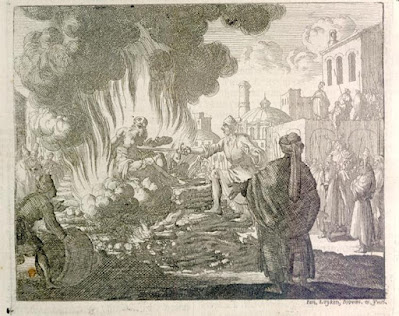
Top illustration: a representation of the burning of Polycarp of Smyrna (168 A.D.), drawn by Jan Luyken in 1685.

Sunday, April 4, 2021

The magician is schooled


After Acts 8: 14-25

The apostles hear of Samaria’s
rebirth, and two are sent to pray,
to teach, the call upon the holy wind
to descend. They lay their hands
on the people, the holy wind begins 
to blow, the holy fire begins to burn, 
and the magician sees the hands,
sees the power transferred, and 
wants that power, offering money
to buy whatever it is they have.

The magician is told the good news
is not for sale, that if he thinks it is
a commodity to be bought and sold
he doesn’t understand, he doesn’t
get it, and more, he doesn’t have it,
his heart doesn’t get it, he is still
chained by wickedness, saturated 
in gall, and your magic will do you
no good. The way is found and 
followed not by money but 
by the repentance of the heart.

The magician asks for prayer.

Photograph by Jr Korpa via Unsplash. Used with permission.

Friday, April 2, 2021

The magician is confounded


After Acts 8:9-13

A conjurer of signs, a magician
of wonders, doing far more than
pulling rabbits from hats, or so
it appeared, a celebrity who
so amazes and so dazzles that
even he calls himself great,
his magic renowned across
the city, across the region, 
hailed as the power of God.
But on the day the visitor
speaks and preaches, the day
the visitor heals the lame and
exorcises the spirits, the day
when the joy erupts across
the city, he sees a power
greater than his own, and he,
too, believes; he, too, is 
of one accord with the crowd;
he, too, is washed in the water
of forgiveness and a new birth.

Photograph by Gage Walker via Unsplash. Used with permission.

Sunday, March 28, 2021

Joy in Samaria


After Acts 8:4-8

Forced to flee, he finds himself
in that place where the one met
the woman at the well. It remains
a halfway kind of place, believing
half of this and half of that,
a hodgepodge of scrolls and idols
and superstition. Even in his fear
and his near brush with chains,
he speaks, he preaches, he performs
signs. And they listen, as if they
are one body, in one accord, and
they see the unclean spirits 
screaming in the pain of discovery
and identification, abandon 
the human habitats, and they see
the paralyzed and lame suddenly
healed, and the crowd in one accord
knows what they are seeing is
not of this earth, and the idols
and the superstitions fall and
melt away, replaced by great joy.

Photograph by Pablo Heimplatz via Unsplash. Used with permission.

Friday, March 26, 2021

The wolf takes control


After Acts 8:1-7

He hears the speech, a sermon
really, directed against the rulers,
among which he considers
himself, or at least their helpmate,
and he nods and smiles, giving
approval as the speaker is rocked
with stones, pummeled to death
with rocks. This will stop it,
this will stop the infection and
the disease. He will root it out,
infectious cell by infectious cell,
searching the city house to house,
finding them, ordering guards
to drag them away and confine
infectious cells to cells with bars,
cells with chains.

And the flock scatters to the winds,
seemingly blown without thought,
without direction, fleeing 
for safety, for life, finding
themselves in small towns and
minor cities, places of little
consequence. And still fired
by the holy wind, they do
the only thing they know to do:
they speak, they preach, they tell
the truth of what they know.

Photograph by Rajashree Patra via Unsplash. Used with permission.

Friday, March 12, 2021

A calling, a life


After Acts 6:1-7

I am Greek, not Aramaic. 
I am not one of the originals
but came later, pulled by the news,
the Spirit, the miracles, tongues
of fire. The people choose me
one of the seven, and I do 
the only thing I knew to do:
distribute food, distribute alms,
care for needs, pray, share,
encourage. When the scattering
comes, I go, quickly, to Samaria,
still the city of half-faiths,
the city of magicians and fakers.
A smaller flock to serve, I do
what I’m called to do, what I can:
preach, speak, share, encourage.
Service there becomes conflict
and confrontation, confounding
the sorcerer who seeks to buy
what he thinks is magic. Sent 
to the desert road, I speak with
the Ethiopian seated in a chariot. 
And then I baptize. I’m learning,
being taught, growing, it’s on
to the Philistines and then
Caesarea, the city of Herod
and the Romans. There I live,
with my four daughters,
prophetesses. I preach, I speak,
I serve, I encourage, I pray. 

Photograph by Felicia Buitenwerf via Unsplash. Used with permission.

Sunday, March 7, 2021

Only their names


After Acts 6:1-7

Seven appointed to serve,
the same reason for all:
seven men of good repute,
seven full of the spirit,
seven infused with wisdom,
seven who pleased the people
with service fair and impartial.
Two became famous; 
five did not. We have
their names, names implying
conversion from the Greek:
Prochorus, Nicanor, Timon,
Parmenas, Nicolas. Names
appear for a brief moment,
then submerge in the river
of time and history. While
we would hope (or flatter
ourselves) to be a Stephen 
of Philip, the truth is that
almost all of us will be
Prochorus, Nicanor, Timon,
Parmenas, Nicolas. A flash
of service, a bare mention,
but sufficient.

Photograph by Andre Ouellet via Unsplash, Used with permission.

Friday, March 5, 2021

Two become famous


After Acts 6:1-7

They are chosen almost
by acclamation, their character
and behavior known and
admired. Reputation is
the decisive factor, the men
chosen to serve the body,
officers of daily distribution
to the needy, chosen to calm
a complaint of partiality. 
Seven chosen, seven names 
noted, seven names remembered 
through all time. Seven chosen,
two explained – one a martyr,
one an evangelist. One dies
for speaking truth. The other
flees to Samaria, confronts
a sorcerer, teaches an Ethiopian,
preaches in Philistia and Caesarea,
One named Stephen.
One named Philip.

Photograph by Will Kell via Unsplash. Used with permission.

Sunday, February 28, 2021

A wise man speaks


After Acts 5:33-42

I hear your anger
and rage, I get it,
I understand, but
cool your jets,
take care what
you do here; you
know what happened
when you condemned
the Nazarene – you
got this before you now.
In your rage and anger
you want to do it again,
repeat the same mistake,
believing you’ll get
a different result. Chill,
people, and consider
all the ones who came
before, making their
claims. You know them,
you remember them,
we ignored them and
they slipped into obscurity,
remembered only
as examples of fools.

If these we see today
are likewise fools,
they will likewise slip
into obscurity. But if
they are from God,
nothing will stop them,
least of all your anger
and rage. Nothing
you do will have
any effect, because
you would oppose
the One who cannot
be stopped. 

This time, the powers
did the unexpected
and the unusual: 
they listened to and
heeded good advice.

Photograph by Susmita Saha via Unsplash. Used with permission.

Friday, February 26, 2021

Prison without prisoners


After Acts 5:21-32

Bring the prisoners here,
say the powers, the elites
posturing for effect and
self-congratulation and
not a little smug with
the condemnation 
they will deliver. 
Bring the prisoners here,
say the powers, the elites,
savoring the questioning
to come. 
They wait. They wait.
They grow restless
in their waiting, until
the soldiers come,
sheepishly and not
without a little fear, 
to report the empty cells
and the locked doors,
and the prisoners now
walking the streets,
doing exactly what
they’d been imprisoned
for:
giving hope.

Escorted to the courts,
the former prisoners
show no remorse, no fear,
and instead speak (rather
boldly for uneducated
men) the shocking
most revolutionary words
in history: we must obey
God, not men.

Photograph by Vidar Nordli-Mathieson via Unsplash. Used with permission.

Sunday, February 21, 2021

Locked away


After Acts 5:17-21

Dragged from the streets,
they are locked away,
prison cell doors locked
to prevent infection
and stop the contagion,
this pandemic of piety,
from spreading. Locked
away, they feel the fear
and uncertainty yet know
the security of what 
they have locked away 
in their hearts. They know
the powers will stop at nothing
to preserve and protect
themselves, yet they know
the power of the way
they follow. 

In deepest night, a light
appears, an angel; the doors
open. The prisoners are
freed from their prison,
their bodies, souls, and voices
liberated, and told to go
and speak and preach and teach.
They obey; they leave the cells
just as the prison doors
lock back into place.

Photograph by Damir Spanic via Unsplash. Used with permission.

Friday, February 19, 2021

Nothing angers like success


After Acts 5:17-21

The sick healed,
the demons cast out,
people coming together
to pray, to worship,
to sing, and the share, 
and the powers that be,
good elites that they are,
sense disquiet, sense danger,
sense threats to the status quo,
all of which means threats
to themselves, threats
to their positions, so
they do what any self-respecting
elites would do, and arrest
these rabble rousers and
peace disturbers, tossing them
into cells and securely locking
the threats away.
So they think.

Photograph by Andre Tan via Unsplash. Used with permission.