Showing posts with label Luke Herron Davis. Show all posts

Wednesday, March 13, 2024

“Resolve: The Church That Endures Onward” by Luke Herron Davis


Over the past two years, Luke H. Davis has been publishing a series of books on church history, written for young people. First came Redemption: The Church in Ancient Times. It was followed by Reign: The Church in the Middle AgesReform: The Church at the Birth of Protestantism; and Renewal: The Church That Expands Outward.  

The final volume, covering the period from 1890 to 2023, is Resolve: The Church That Endures Onward. It’s written in the same easily readable and accessible style as its predecessors. Davis explains history by telling stories, imagined (or re-imagined) conversations and events in the lives of key figures in the church over the modern period. While many might lament the state of in the 20th and 21st centuries, Davis has a very different story to tell. 


This history includes chapters with familiar names – Dietrich Bonhoeffer, Corrie ten Boom, Billy Graham, C.S. Lewis, Francis and Edith Schaeffer, and J.I. Packer. And it includes chapters with names well-known in their time but lesser known today, like Sammy Morris, B.B. Warfield, J.C. Ryle, Francis Grimke, Elisabeth Eliot, Eta Linnemann, and Benjamin Kwashi. Davis selects a key event in the lives of this Christians, dramatizing them to tell his stories. It’s a very effective way to introduce the subject (and people) to younger readers.


Luke H. Davis

He also includes chapters entitled "Fact Files" that highlight other well-known figures, like the great preachers and orators, persecuted Christians, and popular apologists.


Aimed as it is at younger readers, from beginning to end it also reminded me of the people and writers who have played a major or minor role in my own Christian faith, including, Billy Graham, C.S. Lewis, Francis Schaeffer, and J.I. Packer.


Resolve is a fitting conclusion to the church history series and a solid read as a standalone volume. Davis has poured some major effort into assembling these volumes, and we – young and old alike – are the beneficiaries.  


Davis teaches at Westminster Christian Academy in St. Louis and chairs the Bible Department there. He’s also taught at schools in Louisiana, Florida, and Virginia. He describes himself as “Presbyterian body, Lutheran heart, Anglican blood, Orthodox spirit,” all of which have served him well in writing the Cameron Ballack mysteries. He has published three Ballack mysteries, Litany of Secrets (2013), The Broken Cross (2015), and A Shattered Peace (2017), and the first book of a new series, Joel: The Merivalkan Chronicles Book 1 (2017). He blogs at For Grace and Kingdom.


Related


Redemption: The Church in Ancient Times by Luke H. Davis.


Reign: The Church in the Middle Ages by Luke H. Davis.


Reform: The Church at the Birth of Protestantism by Luke H. Davis.


Renewal: The Church That Expands Outward by Luke H. Davis.


Reading a Novel that Stars Your Hometown
.


My review of Litany of Secrets.


My review of The Broken Cross.


My review of A Shattered Peace.


My review of Tough Issues, True Hope by Luke Davis.


Some Wednesday Readings


‘My kid’s name resonated in that body’: Steve Nikoui’s interview after State of the Union outburst – Matthew Foldi at The Spectator.


Booknotes: Campaigns of a Non-Combatant by George Townsend – Civil War Books and Authors. 


People Hate Daylight Savings. Science Tells Us Why – Teresa Carr at Real Clear Science.


The Bull Pen at Bentonville – Bert Dunkerly at Emerging Civil War.

Monday, May 22, 2023

“Renewal: The Church That Expands Outward” by Luke H. Davis


Until now, about the only thing I associated with the famous minister Jonathan Edwards was the sermon often mentioned (and often reprinted) in American history books. The title and the substance of “Sinners in the Hands of an Angry God” gives an impression of a fiery sermon, with much shouting and a voice that was threatening and perhaps scary. The way it’s portrayed in history books certainly gives that impression. 

Then I read Renewal: The Church That Expands Outward by Luke H. Davis, and I discovered how wrong my understanding was. Edwards didn’t give fiery sermons; he spoke in a monotone and low-key voice because he believed the content didn’t need dressing up with theatrics. He faced concerns from his own church leaders. And Edwards eventually became a missionary to Native Americans in Massachusetts and president of Princeton University.


So much for the stereotype.


Renewal is the fourth in Davis’s series on church history for young people. It focuses on the years 1600 to 1900, what Davis calls the Age of Expansion. The chapters are generally organized around people; Davis writes an engaging story based on fact about each and then follows with a short factual paragraph. He also inserts “Fact File” chapters, where he provides more in-depth background on events, movements, and periods of church history. 


Luke H. Davis

The people covered include Edwards, John Bunyan. George Whitefield, William Wilberforce, Charles Spurgeon, Sojourner Truth. Hudson Taylor, Dwight Moody and several others. The structure is similar for each; I found myself particularly taken with the fictional stories based on real events.


Davis teaches at Westminster Christian Academy in St. Louis and chairs the Bible Department there. He’s also taught at schools in Louisiana, Florida, and Virginia. He describes himself as “Presbyterian body, Lutheran heart, Anglican blood, Orthodox spirit,” all of which have served him well in writing the Cameron Ballack mysteries. He has published three Ballack mysteries, Litany of Secrets (2013), The Broken Cross (2015), and A Shattered Peace (2017), and the first book of a new series, Joel: The Merivalkan Chronicles Book 1 (2017). He blogs at For Grace and Kingdom.


Renewal, like its predecessors, is aimed at young readers (roughly 10-14) but, as in my own case, even adults who think they know a lot can discovered they know – well, less that they thought. It’s an engaging way to teach church history and whet the interest for more.


Last WeekReform: The Church at the Birth of Protestantism by Luke H. Davis.


Related:


My review of Redemption: The Church in Ancient Times.


My review of Reign: The Church in the Middle Ages.


Reading a Novel that Stars Your Hometown.


My review of Litany of Secrets.


My review of The Broken Cross.


My review of A Shattered Peace.


My review of Tough Issues, True Hope by Luke Davis.

Monday, May 15, 2023

“Reform: The Church at the Birth of Protestantism” by Luke H. Davis


Luke H. Davis began his published writing career with a series of three mysteries, featuring Cameron Ballack, a county police detective who investigates and solve crimes from his wheelchair. He then published a fantasy book entitled Joël , which was followed by a book on Christian ethics, Tough Issues, True Hope. 

His most recent project has been a series on church history aimed at younger readers (roughly 10-14). In 2022, he published two in the series, Redemption: The Church in Ancient Times and Reign: The Church in the Middle Ages. And now come the next two entries in the series: Reform: The Church at the Birth of Protestantism and Renewal: The Church That Expands Outward.


You don’t have to be the targeted age group to enjoy Reform: The Church at the Birth of Protestantism. Each primary chapter focuses on a person, telling a fictionalized account of a specific event in the person’s life. A summary paragraph at the end of the chapter provides a brief biographical overview. And then periodic “fact files” provide a deeper look into a specific topic associated with the overall subject of the book.


You can see what Davis is doing here: tell an interesting story about people, provide some factual and biographical information, and inspire the reader to pursue their interest in the subject or person. It works. I thought I knew a lot about the Reformation period. And I was familiar with the major players, like Martin Luther, John Calvin, Ulrich Zwingli, and John Cranmer (I’ve seen the monument to Cranmer’s and others’ martyrdom in Oxford several times). I didn’t know the Reformation roles played by Marguerite of Navarre, Catherine Parr (Henry VIII’s last wife), and Lady Jane Grey. And I’d never heard of Martin Bucer and Patrick Hamilton.


Luke H. Davis

What I learned is that, yes, there were major movers in the Reformation, but many people played significant roles. And Davis keeps his accounts interesting by making the historical figures come to life as real and recognizable people. 


Davis teaches at Westminster Christian Academy in St. Louis and chairs the Bible Department there. He’s also taught at schools in Louisiana, Florida, and Virginia. He describes himself as “Presbyterian body, Lutheran heart, Anglican blood, Orthodox spirit,” all of which have served him well in writing the Cameron Ballack mysteries. He has published three Ballack mysteries, Litany of Secrets (2013), The Broken Cross (2015), and A Shattered Peace (2017), and the first book of a new series, Joel: The Merivalkan Chronicles Book 1 (2017). He blogs at For Grace and Kingdom.


If your children are familiar with church history and the Reformation, Reform is a good place to start. And if you think you know all about the period and the people, Reform might well help you realize that you don’t know as much as you think. 


Next Week: Renewal: The Church That Expands Outward.


Related:


My review of Redemption: The Church in Ancient Times.


My review of Reign: The Church in the Middle Ages.


Reading a Novel that Stars Your Hometown.


My review of Litany of Secrets.


My review of The Broken Cross.


My review of A Shattered Peace.


My review of Tough Issues, True Hope by Luke Davis.

Wednesday, March 23, 2022

“Reign: The Church in the Middle Ages” by Luke H. Davis


Many of us have an image in our heads of what the Middle Ages were all about. At one time, we called the period the “Dark Ages,” the time following the end of the Roman Empire, when the civilized world was overrun by barbarians, culture collapsed, people were divided into serfs or nobles (with most becoming serfs), and life became nasty, brutish and short. Then came the Renaissance and the Enlightenment. 

Nothing is ever that simple. Many good things came from the period we call the Enlightenment, but so did the barbarism of the French Revolution. The Middle Ages were anything but a stagnant time, and that’s especially true for the church. 


Reign: The Church in the Middle Ages is the second book in the Risen Hope church history series by Luke Herron Davis. It is structured much like its immediate predecessor, Redemption: The Church in Ancient Times.  Aimed squarely at younger readers, it’s written in a lively, storytelling style that introduces the key people of the church for period that extended from the Fall of Rome to roughly the 1400s.


Included are stories about St. Benedict, St. Columba, Pope Gregory I, St. Anselm, St. Bernard, Peter Waldo, St Francis of Assisi, Stephen Langton, Thomas Aquinas, John Wycliffe, Julian of Norwich, and John Hus. David includes short vignettes of historical events that involved these people – the Crusades, the signing of the Magna Carta, the rise of the papacy and Islam, and more.


Luke H. Davis

While the intended audience is younger readers, even older readers can learn something from the book. I didn’t know, for example, the critical role Stephen Langton, archbishop of Canterbury, played in the writing of the Magna Carta and its signing by King John in 1215. The book is packed with “face files” like that.


Davis teaches at Westminster Christian Academy in St. Louis and chairs the Bible Department there. He’s also taught at schools in Louisiana, Florida, and Virginia. He describes himself as “Presbyterian body, Lutheran heart, Anglican blood, Orthodox spirit,” all of which have served him well in writing the Cameron Ballack mysteries. He has published three Ballack mysteries, Litany of Secrets (2013), The Broken Cross (2015), and A Shattered Peace (2017), and the first book of a new series, Joel: The Merivalkan Chronicles Book 1 (2017). He blogs at For Grace and Kingdom.


Reign is a collection of stories about key figures of the church, but it is also the history of the church from the fall of the Roman Empire to the first stirrings of reformation coming from men like John Wycliffe and John Hus. The period was an exciting time, full of upset, change, and the transformation of the church to a political powerhouse, along with the corruption that came with it.


Related


Redemption: The Church in Ancient Times by Luke H. Davis.

Wednesday, March 16, 2022

“Redemption: The Church in Ancient Times” by Luke Herron Davis


My knowledge of church history was spotty – at best – for a very long time. My grade school and undergraduate education was almost entirely secular. I took two years of catechism (Lutheran version), and in my 20s took several extension courses about the Old and New Testaments. But if you asked me what I knew about the history of the early church before my mid-30s, I would have given you a timeline that leaped from the book of Acts to St. Augustine, and from St. Augustine to the Reformation.  

That state of affairs changed, dramatically, when I pursued a liberal arts master’s degree in my mid-30s. I took course like “Athens or Jerusalem,” “History of the Early Christian Church,” and “The Image of Rome.” I read the early church fathers, like Origen, Athanasius, Clement of Alexandria, and Tertullian. I read Peter Brown’s marvelous biography of Augustine. I read the Didache. And the Desert Fathers (and a few Desert Mothers). I read Kenneth Scott Latourette’s A History of Christianity (two fat volumes) and The Rise of Christianity by W.H.C. Frend. And a whole lot more. 


And I learned that the Christian church had an unbelievably rich, complex, and often profound history. And I realized how much of that history had been erased from so many of my history courses in high school and college. And I’ve often wondered how one could introduce that history to children and young people.


Luke Herron Davis has an answer – a series on church history written especially for younger readers. The first volume in that series is Redemption: The Church in Ancient Times. And far from being a weighty tome that could be a weapon if thrown at someone, it’s short, readable, interesting, and tells engaging stories taken straight from the Gospels and the Book of Acts as well as other sources of early church history.


Davis tells the story of the church by telling the stories of some of its leading historical figures from the first through the sixth centuries A.D. Each entry is 10 to 12 pages, written in story format – enough to impart important information about each figure and whet the appetite for more.


The people included are Peter, Paul, Ignatius, Polycarp, Cyprian, Constantine, Athanasius, Ambrose, John Chrysostom, Jerome, Augustine, and Patrick. Many others are mentioned in side notes (including one of my favorite figures, Tertullian). Each chapter is written like a story, bringing a freshness and a contemporary feel. The reader feels an integral part of what’s happening. 


It's an easy, interesting read, and I suspect that even adults would enjoy it (and learn a few things).


Luke Herron Davis

Davis teaches at 
Westminster Christian Academy in St. Louis and chairs the Bible Department there. He’s also taught at schools in Louisiana, Florida, and Virginia. He describes himself as “Presbyterian body, Lutheran heart, Anglican blood, Orthodox spirit,” all of which have served him well in writing the Cameron Ballack mysteries. He has published three Ballack mysteries, Litany of Secrets (2013), The Broken Cross (2015), and A Shattered Peace (2017), and the first book of a new series, Joel: The Merivalkan Chronicles Book 1 (2017). He blogs at For Grace and Kingdom.


Redemption is not written to be a complete, encyclopedic overview of church history. What it does is, aiming at young readers, provide an introduction to some of the leading figures of early church history, the people who evangelized, taught, encouraged, and admonished, and who often had the specter of martyrdom hanging over them (like Polycarp, bishop of Smyrna, who was himself discipled by the Apostle John). These are the people who faithfully transmitted the faith to future generations, and Davis is providing a real service in introducing them in such an engaging way to contemporary readers.


Next weekReign: The Church in the Middle Ages.


Related:


Reading a Novel that Stars Your Hometown.


My review of Litany of Secrets.


My review of The Broken Cross.


My review of A Shattered Peace.


My review of Tough Issues, True Hope by Luke Davis.


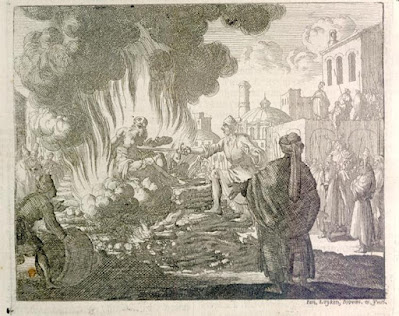
Top illustration: a representation of the burning of Polycarp of Smyrna (168 A.D.), drawn by Jan Luyken in 1685.

Wednesday, June 17, 2020

“Tough Issues, True Hope” by Luke Davis


Christians are regularly denigrated for believing Biblical teachings that were broadly accepted by the general culture less than a decade ago. The pace of change in the culture, powered by sea changes in news media, entertainment, the business world, and large parts of political and governmental authorities, seems so accelerated that it often bewilders even those who accept the changes uncritically. And this seeming rejection of Christian values has accompanied a rejection of the values of Western civilization generally. 

Multitudes of books have been written and read to understand what has happened and, equally as important, to respond and deal with the change. Luke H. Davis, as a high school teacher of Biblical ethics, has witnessed and experienced the changes. He also has to help the students he teaches to understand and deal with the issues that seem to confront them, and all Christians, at every turn. 

And he’s created a navigational aid, Tough Issues, True Hope: A Concise Journey Through Christian Ethics. In short, succinct, and conversational chapters, he’s assembled and summarized the main issues where Christians find themselves in conflict with the culture. Each issue is summarized, its Biblical position discussed, and then questions provided for further discussion. Davis uses clear, easy-to-understand language, writing a book that’s as suitable for high school and college students as it is for adults in the workplace, the home, and church. That’s no simple accomplishment.

The list of issues is staggering and begins with one that many Christians are unaware of – words and language. Words and language matter tremendously and can be used not only to illuminate but also to propagandize. (I can still remember when newspapers referred to “pro-life” and “pro-abortion,” until they evolved into “anti-abortion” and “pro-choice.”)

Luke H. Davis
The issues Davis considers includes technology and social networks; diversity and unity; abortion; murder and capital punishment; euthanasia; suicide; disabilities; bioethics; gender; marriage; divorce; pornography; same-sex marriage; and more. He even discusses the concepts of stewardship as they relate to the individual, the workplace, the environment, and immigration (legal and illegal). 

It’s a daunting list. It’s daunting even to consider how Davis researched and considered each issue. Equally impressive is the tone of the book; it’s not condemning or strident, but honest, candid, thorough, and loving. A non-Christian reading the book would likely miss how much care and love went into the discussion.

Davis teaches at Westminster Christian Academy in St. Louis and chairs the Bible Department there. He’s also taught at schools in Louisiana, Florida, and Virginia. He describes himself as “Presbyterian body, Lutheran heart, Anglican blood, Orthodox spirit,” all of which have served him well in writing the Cameron Ballack mysteries. He has published three Ballack mysteries, Litany of Secrets (2013), The Broken Cross (2015), and A Shattered Peace (2017), and the first book of a new series, Joel: The Merivalkan Chronicles Book 1 (2017).

Tough Issues, True Hope is one of the best books I’ve read on the subject of culture, issues, and Christianity. It’s comprehensive without a deluge of details. It’s highly readable. And its solidly grounded in what is pre-eminent for believing Christians – the word of God.

Related:


Tuesday, February 12, 2019

An Incredible Review of "Dancing Prophet"


Writing a novel is a hard, lonely work. You often struggle through a story, writing and rewriting and editing and deleting whole sections because, well, they're just bad and aren't going the way they need to go. And when you finish writing a novel, if there ever be such a thing, you have all the worry and anxiety and disappointment of how people will respond. 
And then you read a review, like “A Prophet Raised Up for Such a Time as This” by Luke Herron Davis.  And you tell yourself this is why you write.