Showing posts with label church history. Show all posts

Wednesday, March 13, 2024

“Resolve: The Church That Endures Onward” by Luke Herron Davis


Over the past two years, Luke H. Davis has been publishing a series of books on church history, written for young people. First came Redemption: The Church in Ancient Times. It was followed by Reign: The Church in the Middle AgesReform: The Church at the Birth of Protestantism; and Renewal: The Church That Expands Outward.  

The final volume, covering the period from 1890 to 2023, is Resolve: The Church That Endures Onward. It’s written in the same easily readable and accessible style as its predecessors. Davis explains history by telling stories, imagined (or re-imagined) conversations and events in the lives of key figures in the church over the modern period. While many might lament the state of in the 20th and 21st centuries, Davis has a very different story to tell. 


This history includes chapters with familiar names – Dietrich Bonhoeffer, Corrie ten Boom, Billy Graham, C.S. Lewis, Francis and Edith Schaeffer, and J.I. Packer. And it includes chapters with names well-known in their time but lesser known today, like Sammy Morris, B.B. Warfield, J.C. Ryle, Francis Grimke, Elisabeth Eliot, Eta Linnemann, and Benjamin Kwashi. Davis selects a key event in the lives of this Christians, dramatizing them to tell his stories. It’s a very effective way to introduce the subject (and people) to younger readers.


Luke H. Davis

He also includes chapters entitled "Fact Files" that highlight other well-known figures, like the great preachers and orators, persecuted Christians, and popular apologists.


Aimed as it is at younger readers, from beginning to end it also reminded me of the people and writers who have played a major or minor role in my own Christian faith, including, Billy Graham, C.S. Lewis, Francis Schaeffer, and J.I. Packer.


Resolve is a fitting conclusion to the church history series and a solid read as a standalone volume. Davis has poured some major effort into assembling these volumes, and we – young and old alike – are the beneficiaries.  


Davis teaches at Westminster Christian Academy in St. Louis and chairs the Bible Department there. He’s also taught at schools in Louisiana, Florida, and Virginia. He describes himself as “Presbyterian body, Lutheran heart, Anglican blood, Orthodox spirit,” all of which have served him well in writing the Cameron Ballack mysteries. He has published three Ballack mysteries, Litany of Secrets (2013), The Broken Cross (2015), and A Shattered Peace (2017), and the first book of a new series, Joel: The Merivalkan Chronicles Book 1 (2017). He blogs at For Grace and Kingdom.


Related


Redemption: The Church in Ancient Times by Luke H. Davis.


Reign: The Church in the Middle Ages by Luke H. Davis.


Reform: The Church at the Birth of Protestantism by Luke H. Davis.


Renewal: The Church That Expands Outward by Luke H. Davis.


Reading a Novel that Stars Your Hometown
.


My review of Litany of Secrets.


My review of The Broken Cross.


My review of A Shattered Peace.


My review of Tough Issues, True Hope by Luke Davis.


Some Wednesday Readings


‘My kid’s name resonated in that body’: Steve Nikoui’s interview after State of the Union outburst – Matthew Foldi at The Spectator.


Booknotes: Campaigns of a Non-Combatant by George Townsend – Civil War Books and Authors. 


People Hate Daylight Savings. Science Tells Us Why – Teresa Carr at Real Clear Science.


The Bull Pen at Bentonville – Bert Dunkerly at Emerging Civil War.

Monday, May 22, 2023

“Renewal: The Church That Expands Outward” by Luke H. Davis


Until now, about the only thing I associated with the famous minister Jonathan Edwards was the sermon often mentioned (and often reprinted) in American history books. The title and the substance of “Sinners in the Hands of an Angry God” gives an impression of a fiery sermon, with much shouting and a voice that was threatening and perhaps scary. The way it’s portrayed in history books certainly gives that impression. 

Then I read Renewal: The Church That Expands Outward by Luke H. Davis, and I discovered how wrong my understanding was. Edwards didn’t give fiery sermons; he spoke in a monotone and low-key voice because he believed the content didn’t need dressing up with theatrics. He faced concerns from his own church leaders. And Edwards eventually became a missionary to Native Americans in Massachusetts and president of Princeton University.


So much for the stereotype.


Renewal is the fourth in Davis’s series on church history for young people. It focuses on the years 1600 to 1900, what Davis calls the Age of Expansion. The chapters are generally organized around people; Davis writes an engaging story based on fact about each and then follows with a short factual paragraph. He also inserts “Fact File” chapters, where he provides more in-depth background on events, movements, and periods of church history. 


Luke H. Davis

The people covered include Edwards, John Bunyan. George Whitefield, William Wilberforce, Charles Spurgeon, Sojourner Truth. Hudson Taylor, Dwight Moody and several others. The structure is similar for each; I found myself particularly taken with the fictional stories based on real events.


Davis teaches at Westminster Christian Academy in St. Louis and chairs the Bible Department there. He’s also taught at schools in Louisiana, Florida, and Virginia. He describes himself as “Presbyterian body, Lutheran heart, Anglican blood, Orthodox spirit,” all of which have served him well in writing the Cameron Ballack mysteries. He has published three Ballack mysteries, Litany of Secrets (2013), The Broken Cross (2015), and A Shattered Peace (2017), and the first book of a new series, Joel: The Merivalkan Chronicles Book 1 (2017). He blogs at For Grace and Kingdom.


Renewal, like its predecessors, is aimed at young readers (roughly 10-14) but, as in my own case, even adults who think they know a lot can discovered they know – well, less that they thought. It’s an engaging way to teach church history and whet the interest for more.


Last WeekReform: The Church at the Birth of Protestantism by Luke H. Davis.


Related:


My review of Redemption: The Church in Ancient Times.


My review of Reign: The Church in the Middle Ages.


Reading a Novel that Stars Your Hometown.


My review of Litany of Secrets.


My review of The Broken Cross.


My review of A Shattered Peace.


My review of Tough Issues, True Hope by Luke Davis.

Wednesday, March 23, 2022

“Reign: The Church in the Middle Ages” by Luke H. Davis


Many of us have an image in our heads of what the Middle Ages were all about. At one time, we called the period the “Dark Ages,” the time following the end of the Roman Empire, when the civilized world was overrun by barbarians, culture collapsed, people were divided into serfs or nobles (with most becoming serfs), and life became nasty, brutish and short. Then came the Renaissance and the Enlightenment. 

Nothing is ever that simple. Many good things came from the period we call the Enlightenment, but so did the barbarism of the French Revolution. The Middle Ages were anything but a stagnant time, and that’s especially true for the church. 


Reign: The Church in the Middle Ages is the second book in the Risen Hope church history series by Luke Herron Davis. It is structured much like its immediate predecessor, Redemption: The Church in Ancient Times.  Aimed squarely at younger readers, it’s written in a lively, storytelling style that introduces the key people of the church for period that extended from the Fall of Rome to roughly the 1400s.


Included are stories about St. Benedict, St. Columba, Pope Gregory I, St. Anselm, St. Bernard, Peter Waldo, St Francis of Assisi, Stephen Langton, Thomas Aquinas, John Wycliffe, Julian of Norwich, and John Hus. David includes short vignettes of historical events that involved these people – the Crusades, the signing of the Magna Carta, the rise of the papacy and Islam, and more.


Luke H. Davis

While the intended audience is younger readers, even older readers can learn something from the book. I didn’t know, for example, the critical role Stephen Langton, archbishop of Canterbury, played in the writing of the Magna Carta and its signing by King John in 1215. The book is packed with “face files” like that.


Davis teaches at Westminster Christian Academy in St. Louis and chairs the Bible Department there. He’s also taught at schools in Louisiana, Florida, and Virginia. He describes himself as “Presbyterian body, Lutheran heart, Anglican blood, Orthodox spirit,” all of which have served him well in writing the Cameron Ballack mysteries. He has published three Ballack mysteries, Litany of Secrets (2013), The Broken Cross (2015), and A Shattered Peace (2017), and the first book of a new series, Joel: The Merivalkan Chronicles Book 1 (2017). He blogs at For Grace and Kingdom.


Reign is a collection of stories about key figures of the church, but it is also the history of the church from the fall of the Roman Empire to the first stirrings of reformation coming from men like John Wycliffe and John Hus. The period was an exciting time, full of upset, change, and the transformation of the church to a political powerhouse, along with the corruption that came with it.


Related


Redemption: The Church in Ancient Times by Luke H. Davis.

Wednesday, March 16, 2022

“Redemption: The Church in Ancient Times” by Luke Herron Davis


My knowledge of church history was spotty – at best – for a very long time. My grade school and undergraduate education was almost entirely secular. I took two years of catechism (Lutheran version), and in my 20s took several extension courses about the Old and New Testaments. But if you asked me what I knew about the history of the early church before my mid-30s, I would have given you a timeline that leaped from the book of Acts to St. Augustine, and from St. Augustine to the Reformation.  

That state of affairs changed, dramatically, when I pursued a liberal arts master’s degree in my mid-30s. I took course like “Athens or Jerusalem,” “History of the Early Christian Church,” and “The Image of Rome.” I read the early church fathers, like Origen, Athanasius, Clement of Alexandria, and Tertullian. I read Peter Brown’s marvelous biography of Augustine. I read the Didache. And the Desert Fathers (and a few Desert Mothers). I read Kenneth Scott Latourette’s A History of Christianity (two fat volumes) and The Rise of Christianity by W.H.C. Frend. And a whole lot more. 


And I learned that the Christian church had an unbelievably rich, complex, and often profound history. And I realized how much of that history had been erased from so many of my history courses in high school and college. And I’ve often wondered how one could introduce that history to children and young people.


Luke Herron Davis has an answer – a series on church history written especially for younger readers. The first volume in that series is Redemption: The Church in Ancient Times. And far from being a weighty tome that could be a weapon if thrown at someone, it’s short, readable, interesting, and tells engaging stories taken straight from the Gospels and the Book of Acts as well as other sources of early church history.


Davis tells the story of the church by telling the stories of some of its leading historical figures from the first through the sixth centuries A.D. Each entry is 10 to 12 pages, written in story format – enough to impart important information about each figure and whet the appetite for more.


The people included are Peter, Paul, Ignatius, Polycarp, Cyprian, Constantine, Athanasius, Ambrose, John Chrysostom, Jerome, Augustine, and Patrick. Many others are mentioned in side notes (including one of my favorite figures, Tertullian). Each chapter is written like a story, bringing a freshness and a contemporary feel. The reader feels an integral part of what’s happening. 


It's an easy, interesting read, and I suspect that even adults would enjoy it (and learn a few things).


Luke Herron Davis

Davis teaches at 
Westminster Christian Academy in St. Louis and chairs the Bible Department there. He’s also taught at schools in Louisiana, Florida, and Virginia. He describes himself as “Presbyterian body, Lutheran heart, Anglican blood, Orthodox spirit,” all of which have served him well in writing the Cameron Ballack mysteries. He has published three Ballack mysteries, Litany of Secrets (2013), The Broken Cross (2015), and A Shattered Peace (2017), and the first book of a new series, Joel: The Merivalkan Chronicles Book 1 (2017). He blogs at For Grace and Kingdom.


Redemption is not written to be a complete, encyclopedic overview of church history. What it does is, aiming at young readers, provide an introduction to some of the leading figures of early church history, the people who evangelized, taught, encouraged, and admonished, and who often had the specter of martyrdom hanging over them (like Polycarp, bishop of Smyrna, who was himself discipled by the Apostle John). These are the people who faithfully transmitted the faith to future generations, and Davis is providing a real service in introducing them in such an engaging way to contemporary readers.


Next weekReign: The Church in the Middle Ages.


Related:


Reading a Novel that Stars Your Hometown.


My review of Litany of Secrets.


My review of The Broken Cross.


My review of A Shattered Peace.


My review of Tough Issues, True Hope by Luke Davis.


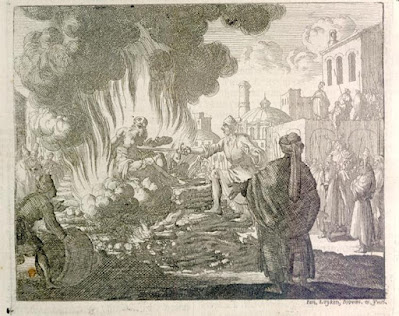
Top illustration: a representation of the burning of Polycarp of Smyrna (168 A.D.), drawn by Jan Luyken in 1685.

Monday, November 8, 2021

"Seeing Jesus" by Robert Hudson


My Baptist grandmother kept a reproduction of a painting on her bedroom wall. It was entitled “Head of Christ,” painted by Walter Sallman in 1941. If you saw it, you would know it; it was a seemingly ubiquitous painting in homes and churches for decades. It’s a Europeanized portrayal of Christ, and we can say with some certainly that it looked nothing like what the real Jesus must have looked like. But as a child, when I thought of Jesus, or when I “saw” Jesus, this was the image that came to mind. 

Few of us will claim that we’ve “seen Jesus.” We might say we’ve experienced Jesus,” but a claim to have seen him is something else again. But a number of people through history said that they had seen the real Jesus. It started with the disciples, as recorded in the gospels, who saw him before and after his death. Stephen saw him moments before he was dragged to his death by stoning. Paul was blinded by the light of Jesus on the road to Damascus. The Apostle John saw Jesus on the Isle of Patmos, in a vision that became the Book of Revelation.


And the visions continued beyond the apostolic age, right up to our own time. In Seeing Jesus: Visionary Encounters from the First Century to the PresentRobert Hudson tells the stories of people who said they saw Jesus, transforming their own lives and the world around them. 


Martin of Tours stopped an invasion of France by Islamic forces. St. Jerome translated the Bible into Latin, creating the version the church knew for a thousand years. Francis of Assisi founded a monastic order. George Fox founded the Quakers. The teenaged William Blake saw Jesus in Westminster Abbey. And add to this list Sojourner Truth, Mother Teresa, Charles Finney, Oral Roberts, Julian of Norwich, St. Anthony of Egypt. And many, many others.


Robert Hudson

Hudson isn’t trying to argue whether these people did or didn’t really see the face of Jesus. That’s not his point. As he says, the skeptic in him doubts, while the mystic in him says “How do you know it wasn’t?” Instead, Hudson tells their stories. 


And what great stories he tells. He has an insightful look at John and the Book of Revelation, suggesting it should be read as poetry. He explains how the emperor Constantine sought the blessing of the desert father St. Anthony. Simeon Antonov was a lusty, world-loving carpenter living on the steppes of Russia who became a monk on Mount Athos in Greece. Joseph Smith founded the Mormons. Sojourner Truth became a symbol of abolition. What’s clear is that something happened in these people’s lives, and the lives of others, that was both profound and transformational. 


Hudson has published 11 previous books, including The Poet and the Fly: Art, Nature, God, Mortality, and Other Elusive MysteriesKiss the Earth When You Pray: The Father Zosima PoemsThe Monk’s Record Player: Thomas Merton, Bob Dylan, and the Perilous Summer of 1966The Art of the Almost Said: A Christian Writer’s Guide to Writing PoetryBeyond Belief: What Martyrs Said to God; and Thomas Dekker’s Four Birds of Noah’s Ark: A Prayer Book from the Time of ShakespeareHis articles and poetry have been published by Christianity TodayThe Other Side, The MennoniteThe Seneca ReviewMars Hill Review, and other magazines and literary journals. He lives in Michigan.


Seeing Jesus is a gem of a book, filled with fascinating stories and equally fascinating insights. These are people who saw Jesus, or believed they saw Jesus. The vision and the belief were sufficient to help change the world.


Related:


Robert Hudson Explains the House Fly – and Poetry.

Thursday, January 23, 2014

Malcolm Johnson’s “St Martin-in-the-Fields”


One of my favorite places in London is a crypt. We had one of the best desserts we’ve ever had there – Victorian sponge cake. You can eat meals, have a snack, drink coffee or a glass of wine, and look down at the floor and read the memorial stones for the people buried there.


We’ve been to London on vacation twice in the past two years, and both times we’ve been partially anchored by St. Martin-in-the-Fields. On the northeast side of Trafalgar Square, it’s across the street from the National Gallery and National Portrait Gallery, a short two blocks to the Leicester Square ticket kiosk, a stone’s throw from Soho (if you’re so inclined), with a Charing Cross tube station entrance across from the back of the church. Covent Garden is close; a half-block walk and you’re in Whitehall or the Strand.

And it’s not just the restaurant in the crypt that’s the attraction (although the sponge cake is worth making a special trip for). We attended an evensong service there during our first trip in 2012, and a concert in 2013. And it’s magnificent building – a prototype for what we know in the United States as “the New England church.”

It’s also an institution, with a marvelously interesting history, once that includes the property now occupied by the national Gallery of Art.

Retired Anglican priest Malcolm Johnson published his history of the church, St. Martin-in-the-Fields, in 2005. It’s slightly dated, but it was on sale in the church’s gift shop and it’s hard for me to resist a book like this, particularly of a place I’m visiting.

And so I learned about the saint and the church named for him.

St. Martin was a soldier, born in 316 A.D. in what is now Hungary. He left the army when he was baptized (pacifism was strong in the church at this time). He eventually settled in what is now France, and established the first monastery, which lasted until the French Revolution. He died in 397, and was buried on Nov. 11, now marked as St. Martin’s Day.

The place occupied by the current St. Martin-in-the-Fields actually had two previous churches there, one from 1222 to 1540 and the second from 1540 to 1600. The current building was constructed from 1720 to 1723. It’s associated with Sir Christopher Wren, but it was actually one of his students, James Gibbs, who was the architect (Wren at age 90 died shortly before the building was completed). Gibbs produced something of a controversial design – a number of critics didn’t like the steeple tower sitting atop the Greek portico. Today that controversial design is rather commonplace, especially in America.

The church has been somewhat altered since 1723 – galleries added, clear glass replacing the Victorian stained glass shattered during the bombing of World War II. The area has also changed considerably – especially in 1832, when the Royal Mews (stables) across the street was abolished and replaced by the national Gallery of Art.

And the people who lived here and/or worshipped here sound almost like a Who’s Who of London history – William Hogarth, Thomas Chippendale, David Garrick, Thomas Gainsborough, and a long list of kings and queens (St. Martin’s is officially a “royal” parish).

A considerable portion of the book is devoted to the 20th century and the men who were the vicars. It was their vision and leadership that saw St. Martin’s through two world wars and significant changes in the parish and in society and culture at large. Today the church has numerous outreach programs, and continues to be a draw for tourists all over the world (including two Americans I know).

And, as my wife will testify, it has great spongecake.

Monday, March 25, 2013

Follow Me – into Persecution?


Early on in my faith, I spent a fairly considerable amount of time reading church history. I was even able to take a seminar in early church history as part of a masters degree program at Washington University in St. Louis. While it was more than 20 years ago, what I remember most about the course was two things: the professor’s deep admiration for the late 19th and early 20th century church historian Adolf von Harnack (a leading proponent of what was then called “higher criticism”) and my research project on forms of government in the early church.

You can’t read anything about church history for very long without coming into the subject of persecution. I originally understood (likely thanks to a lot of movies) was that the Romans spent 300 years avidly persecuting the church before finally throwing in the towel. In fact, it didn’t actually happen that way. Persecutions tended to be local or at most regional, with a few notable exceptions, such as the empire-wide persecution under Diocletian about 300 A.D.

The major charge against the Christians wasn’t that they believed in Christ; it was that they wouldn’t worship the emperor as a god.

Not long after receiving my degree, I was among a small group of corporate speechwriters asked by a national PR association to write a short article on a speech I deeply admired. Most of the group selected speeches like the Gettysburg Address, Lincoln’s Second Inaugural, or “Blood, Sweat and Tears” by Winston Churchill. I selected Stephen’s speech before the Sanhedrin, the one that ended in his death by stoning and the persecution of the church in Jerusalem.

My article wasn’t used. I was asked to write on something “not religious.” I declined, pointing out that the articles that would be printed actually had religious underpinnings and even direct references to God, while mine didn’t refer to God. They declined to print mine, an indication of what was already happening in American culture more than 20 years ago. I don’t consider this a form of persecution, but it was an example of anti-Christian discrimination.

Things have not gotten better since then.

What I said in my article was that Stephen’s speech and death, and the persecution of the church in Jerusalem that followed, had actually resulted in the first great wave of Christian evangelism, scattering Christians from Jerusalem to cities all over the Mideast and perhaps all the way to Rome. Paul, a leader in the persecution effort, was on his way to Damascus to extinguish the church there when he had his roadside conversion.

This became a pattern for the next three centuries. Persecute the church – and watch it grow. In fact, whenever the church has experienced persecution, it has grown. Today, in places where Christians face imprisonment and often death for their faith, the church is growing.

“We often think persecution is horrible, and certainly in many ways it is,” writes David Platt in Follow Me: A Call to Die. A Call to Live. ”But persecution is often a sign that the gospel is progressing. As long as the gospel lies dormant in a country or amid a people, and as long as no one is coming to Christ, then no one cares about Christianity. It’s only when the gospel spreads and people are converted to Christ that opposition begins to arise against Christianity.”

Persecution is a terrible thing, but for Christians, it is also a sign.


We’ve been reading David Platt’s Follow Me as part of a book discussion at TheHigh Calling. Today Marcus Goodyear concludes the discussion. Please visit the site to see his comments and the discussion.

Friday, February 22, 2013

John Pollock’s “The Apostle”


I mentioned a couple of weeks ago that I had been rediscovering an old love for early church history. A few short years after I’d become a Christian, I enrolled in extension classes at our church in Houston, and ended up taking courses in Old Testament History, New Testament History, and Bible Study Methods.

It was in the New Testament Survey course that our teacher (one of the church pastors and a full-fledged professor)  mentioned some of the 19th century scholars who had had such an influence on our understanding of church history, including the German Adolf von Harnack on the “new” or “higher” criticism side and Sir William Ramsay on the traditional side. I found Ramsey to be of interest for two reasons – he had set out to undertake field research to prove the New Testament wrong, but became a convinced Christian as a result. And several of his books had been reprinted in the early 1970s in paperback, and were accessible through Christian Book Distributors.

Reading Ramsey’s works is to take a journey to New Testament times. History came very much alive with his words and narrative style. His style is not unlike that of John Pollock, author of The Apostle: A Life of Paul.

In addition to this biography of Paul, Pollock has written biographies of Hudson Taylor, William Wilberforce, and John Wesley. He’s also the author of The Master: A Life of Christ and is Billy Graham’s official biographer.

First published in 1969, The Apostle was revised and republished in 2012. While it has the narrative style of a novel, it is not that at all. It reads like a wonderful story, or series of stories based on the Book of Acts and Paul’s letters as well as extensive research into this period of Roman and early Christian history.

What I also like is that where Pollock speculates because the sources are silent, he tells the reader that it’s speculation, even if well founded and well reasoned.

In Pollock’s hands, Paul comes alive, a man of flesh and blood who was completely overwhelmed and changed forever on the road to Damascus, a man who knew what he had been called to do, and who experienced everything from physical and emotional torment to wonderful joy. And the reader gets to join Paul as he is secretly removed from Damascus, walk the streets of Ephesus and Corinth, experienced the storm and shipwreck on Malta, and eventually find himself in Rome.

And the biography has depth, providing details on references to Paul being bowlegged (and why) to how imperial politics and the death of the Emperor Claudius affected Paul’s activities in Ephesus. The reader is also a first-hand observer of Paul writing his letters, who was there, what the immediate context was, and so much more.

Pollock tells a wonderful story, and he tells it well.

Thursday, February 7, 2013

Why Study Church History?


Thirty years ago, I felt a need to study church history. What I knew was largely confined to the New Testament and basic facts from general history courses.

My primary sources of reading (remember this was pre-internet) was the monthly catalog from Christian Book Distributors (CBD), Christian bookstores (which didn’t carry much on history), and used bookstores. In the mid-1980s, as part of a masters program at Washington University in St. Louis, I took several seminars related to church history – “Athens and Jerusalem,” “The Idea of Rome,” and even “The History of the Early Christian Church.”

That masters program brought me to the university’s library. The collection on the church and Christianity was large – and largely unused. I had virtually no competition for books.

I read some wonderful books. The works of the 19th century historian Sir William Ramsay were reprinted in the early 1970s, and CBD had them available for a steep discount. Ramsay, an atheist, traveled to New Testament lands to disprove the truth of Christianity, and became a convinced Christian. His writings include The Church in the Roman Empire, The Cities of St. Paul, and The Letters to the Seven Churches.

My course work at Washington University introduced me to the writings of the early church fathers, like Iraneus and especially Tertullian, the Roman lawyer turned Christian apologist who became a kind of heretic, although the exact nature of his heresy is not known today. Even in English translation, to read Tertullian is to read the passion of a razor-sharp mind. For one of the courses, I read Peter Brown’s Augustine of Hippo, one of my all-time favorite books.

At used bookstores, I found titles like Scenes from the Life of St. Paul by J.S. Howson (1909) and The Life and Letters of St. Paul (1928).

Other books I read along the way include The History of Christianity by Kenneth Scott Latourette, The Rise of Christianity by W.H.C. Frend, and New Testament History by F.F. Bruce (anything by F.F. Bruce is good).

Recently, I began to revisit some of the books I’ve read and find some new ones. Tomorrow I’ll be posting a review of Ben Witherington’s A Week in the Life of Corinth, and I’m currently reading a 2012 revised edition of The Apostle: A Life of St. Paul by John Pollock, first published in 1969.

Why do I read church history?

It’s interesting. I find it fascinating.

It’s important. You learn things about the church that you don’t find in general history books, like the role of the church in the anti-slavery movement (and the role of the church in trying to maintain slavery in the U.S. South), how the church likely saved Western civilization after the collapse of Rome, and (more recently) the role of the church in the collapse of communism in Eastern Europe. Not to mention that modern capitalism was one of the results of the Protestant Reformation.

Church history also provides perspective. The church didn’t leapfrog from the Book of Acts, make a brief stop at the Reformation and then appear again with the rise of mega-churches in the United States in the 1980s. For 2,000 years, Christians have struggled and fought and lost and won and prevailed and retreated. Culture wars existed before.

What studying church history also creates is a humbling and deep sense of gratitude for the Christians who walked before us and what they, with God’s grace, made possible.


Photograph by Petr Kratochvil via Public Domain Pictures. Used with permission.