Showing posts with label internet. Show all posts

Wednesday, February 16, 2022

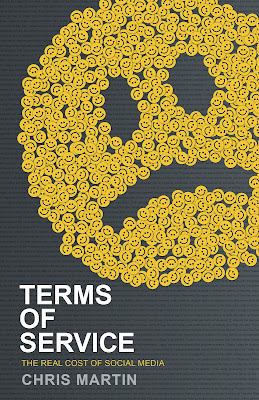
"Terms of Service" by Chris Martin


Chris Martin works at Moody Publishers as a content marketing editor and a consultant in social media, marketing, and communications. He has a deep background in social media and digital content strategy. He perhaps best known for his blog, Terms of Service, where he writes thoughtfully and with great insight about topics as diverse as the metaverse, TikTok, Wordle, and the impact of social media on society and culture. 

His new book is entitled, appropriately enough, Terms of Service: The Real Cost of Social Media. The book is a primer on social media and the internet but is also more than that – a look at how the internet shapes us and what can we do about it. And his solutions are not “let’s pass a law” type of prescriptions, but instead what individuals can do themselves.


To continue reading, please see my post day at Dancing Priest.


Friday, May 15, 2015

Impressions, Clicks, Visits and Views


A few weeks before I retired, a friend called me at work and asked what I knew about “impressions,” generally understood to mean the potential number of people who saw your ad on television, your Facebook post, your tweet on Twitter, and what-have-you.

“Why do you want to know?” I asked.

“”Well,” he said, “our outside agency says we have 140 million impressions from our ad campaign, and a 29-percent click-through rate. Is that a good thing?”

I considered my answer before I responded. “It’s a next-to-impossible thing.”

“What?”

“You might get a 29-percent click-through rate if you’re Justin Bieber or Katy Perry, but not a corporate brand. Have you looked at traffic at your web site?”

“Yeah, that’s what doesn’t make any sense. It’s only very slightly above normal, like maybe two percent.”

“If your ads were having a click-through rate of 29 percent, you would be seeing web site traffic in the tens of millions.”

Silence.

“A more typical click-through rate,” I said, “would be less than 1 percent. Some companies have done more, like the consumer products companies running contests. Coke and Pepsi, for example. But for most of us, and especially business-to-business companies, it’s much less.”

“Then what’s an impression?” he asked.

“If you ad is running on television at 8 p.m. on, say, NBC or CBS, add up the number of viewers the network reports to have at that time. Or if you’re tweeting on Twitter, add the number of followers you have and multiply by the number of tweets.”

“Are you saying this is all hocus-pocus by witch doctors?”

Well, no, I’m not. But you do have to understand what the data is before you can decide if it’s meaningful or significant. In general, if you don’t understand it, you’re mightily impressed. 140 million impressions? And a 29-percent click-through rate? Wow!

It’s possible, of course. But unlikely. My friend needed to ask what that 29 percent was clicking through to. It wasn’t his web site, the object of the ad program.

Rob Eager at Wildfire Marketing publishes a newsletter every Monday. His marketing agency specializes in books and authors. This past Monday, he had four points to make about online advertising:

First, humans account for less than half of global web traffic. The majority comes from bots, roughly evenly divided between good bots and bad bots. (I’ve seen this happen for this blog – a sudden surge in traffic coming from places like Russia and China.)

Second, the average engagement between a brand’s Facebook post and the brand’s Facebook fans is 7 in 10,000. For Twitter, it’s 3 in 10,000. Instagram ranks highest, with a 4.21% engagement rate. The corporate social media channels I managed before I retired did considerably better than the average, but that was a result of (1) a lot of hard work and (2) knowing almost exactly who it was who followed or liked our channels. And we followed a 90/10 rule – 10 percent of what we did online was about us; 90 percent was about our industry, our customers, and news important to our customers. Advertising, on the other hand, is almost invariably about you (even when it appears that it’s not.) 

Third, the average click-through rate on an ad is less than one percent.

And fourth, 54 percent of display ads by advertisers are unviewable (the link here is to the Wall Street Journal – the story is behind the paywall).

Rob has solid insight and information about the general subject of publishing and marketing of books – visit him at Start a Wildfire

The book that influenced everything I've done on social media is Trust Agents: Using the Web to Build Influence, Improve Reputation, and Earn Trust, published by Chris Brogan and Julien Smith. It's not the fast way to bulk up your author's platform and get tens of thousands of adoring fans to impress your potential publisher, and it's written in a rather breezy style, but it's full of good information and wisdom. The book doesn't include a single reference to religion, faith, or Christianity, but it does resonate with Christians because it focuses on others, not self. 

Ultimately, you're only kidding yourself if you think social media and the online world is only about impressions, clicks, visits and views.

They're about relationships. And trust.

Illustration by George Hodan via Public Domain Pictures. Used with permission.


Friday, July 10, 2009

Social Media and Me

I tweet on Twitter, mostly about social media, although I wish there was a better word for it than "tweet." I do so for a simple reason -- electronic communication has been a considerable part of my professional career for 16 years. If we go back to the introduction of the desktop for professionals, then it's more like 25 years.

Twenty-five years. It sounds like a confession that I was there at the dawn of time. I have people working for me who weren't even born 25 years ago.

I don't know why I connected so easily to electronic communication, but I did. In 1993, a colleague attended a PR conference and heard about AT&T's email newsletter for employees. We talked about it and said, why not here, too? We had just reached critical mass for the number of employees on email distribution, and we said let's do it. It took three months to try to convince IT it was a good idea. And they still said no. Then I realized I didn't need their permission. That's a story by itself and the subject of another blog post soon, but I learned that experts invariably are the people who stand in the way of innovation, including in my own organization, where Public Affairs people told me no one cared what went on in different parts of the corporation.

IT and Public affairs were both wrong.

We launched the email newsletter with a list of 100 people, covering all global regions and an extraordinary array of computers and operating systems (this was in the days before the business world was ruled from Redmond, Washington). Within a week, the list had grown to 1,500. Within two weeks, we had saturated the entire email distribution. Our little email newsletter had actually gone viral all on its own, forwarded and publicized by word-of-mouth, before anyone had even heard of the idea of "going viral." Remember, this was 1993.

For a long time, we flew under the radar of Law and Human Resources, which turned out to be a good thing. We didn't ask or seek approval for anything we published. We just did it, but checked all quotes with sources. Then employees figured out we weren't censoring letters to the editor. Before long, we were moderating internal debates and extensive discussions on business issues and getting answers for some of the inanities that pass for corporate policies. By the time we got discoverd by Law and HR, even the CEO was hooked. And he told them to leave us alone, because something extraordinary was happening -- the corporation was treating its employees like they had fully functioning brains. Like adults.

No one was more shocked by this than me, the instigator of it all. I spent the next year trying to understand what had happened, including why I of all people, the speechwriting guy, for goodness sakes, the word guy, had fallen so fast and so hard for electronic communication.

I finally understood what had happened. I was so comfortable moving across different communication media in speeechwriting (see the blog post below this one) that electronic stuff was almost a no-brainer. If you can create communication using word, mouth, eye and ear, you can do the electronic stuff. There's even a theory about it -- Walter Ong's secondary orality.

From email we moved to the web, and created the company's first web site. And there's another story -- one of the most visionary IT people I knew told me at the time to ignore the web because it was just a fad, like eight-track tapes back in the 1970s. He insisted that the future was -- drumroll, please -- Lotus Notes. And he was serious.

A whole series of corporate reorganizations intervened after that; I went off and did my own thing for a while and eventually ended up back in a corporate Public Affairs department. In the meantime, I'd stayed familiar with electronic communication, even through the great internet business implosion in 2000 and 2001. I was hired to do good old-fashioned issues management, but I brought my electronic luggage with me. And the day came when someone in a staff meeting asked, "What's a blog?"

From that question, it eventually became this. Even some of the people who don't like my company took notice, and reprinted this on their own web site.

So that's why I tweet what I tweet on Twitter. It's electronic, to be sure, but it's really about people -- connecting with them, building relationships with them, and creating something new with them.