Thursday, July 4, 2019

“His Hand in the Storm” and “Kill Me Why?” by Ritu Sethi


It’s a new police detective series, set in Canada, and featuring a brooding detective trying to keep her personal demons at bay. And wherever Chief Inspector Gray James of the Montreal police goes, things happen, and fast.

James needs things to happen. Murder investigations are like an addicting drug for the inspector. They keep his mind away from the death of the son three years earlier, a death James blames on himself. His wife apparently thought it was his fault as well; she walked out on their marriage and disappeared. It had been a sailing accident in British Columbia; James and his son had been sailing and were caught in a storm. James survived with a damaged hand and serious guilt; the boy’s body was never found.

In His Hand in the Storm by Ritu Sethi, James is called early one morning to investigate a body found hanging in an urban beach park. He’s preparing to leave when his car is blown up, inside the perimeter of the crime scene. And that can only mean that whoever placed the bomb is connected to the police department.

The case leads James and his team, including Detective Sergeant Vivienne Caron, to a medical technology startup firm that’s on the verge of being sold for hundreds of millions of dollars. The CEO will let nothing stand in the way of the sale; the developer of the technology is determined to make the sale go away. And the IT guy will get himself killed, and others could follow. And someone in the police department hierarchy would prefer to see James dead.

Ritu Sethi
In the second Gray James novel, Kill Me Why?, James has transferred to Vancouver (to explain why gives away part of the climax of the first novel). He’s spending some time in his hometown with his father, when he’s convinced by the medical examiner (also transferred from Montreal) to look into a case involving a body farm, where a Ph.D. is doing work on identifying remains of bodies in various stages of decomposition. The townspeople aren’t thrilled with the operation, no matter what the benefit may be to forensic science.

The woman scientist running the farm claims to have found a body with its mouth sutured shut. Rushing to a phone to report the body, she returns to find the body gone. The local police doubt her story, but James does not. It’s a crime eerily reminiscent of one that happened in the same area 15 years earlier.

Detective Sergeant Vivienne Caron shows up, working undercover on an art smuggling case. James has to tread warily on the missing body case; he’s not been tasked with investigating. Gradually the two cases will converge.

Author Ritu Sethi won the Colorado Gold Award for His Hand in the Storm and was also a Daphne Suspense finalist for the same book. Both novels were Amazon bestsellers. Sethi blogs at Ritu Writes.

The Gray James books are police procedurals – but they are about as unorthodox as police procedurals can get. Each ends with a dramatic development, a smart move to make the reader look forward to the next one. Kill Me Why?, with its big storm, big mansion, and a killer running loose, veered a bit to the melodramatic. And getting the police team to Vancouver from Montreal was a bit contrived. But both novels are fast-paced stories, with interesting characters, and a back story that keeps returning to haunt the hero. 

Wednesday, July 3, 2019

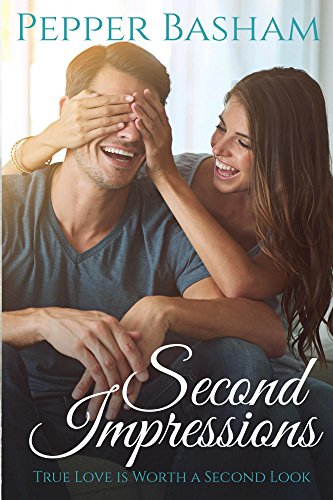
"Second Impressions" by Pepper Basham


Nora Simeon is 26 and still recovering from the accidental death of her husband. Her mother is almost a stereotype of a matchmaker, and she keeps trying to set Nora up with prospective husbands. For now, Nora is content with teaching and her passion for Jane Austen novels.

Ethan Keller works in the hotel business. His boss is his uncle, who keeps throwing attractive women in Ethan’s direction in the hopes he gets married. Ethan, however, isn’t impressed. He’s not looking for a Barbie doll-type wife, but someone who is real.

Nora and Ethan find themselves thrown together – almost literally – is a small hotel in Bath, England. Nora has been given a trip to the Jane Austen Festival as a birthday present, and Ethan’s company is buying the hotel. They find themselves forced to share a room because of overbooking – or perhaps because of plan hatched by Nora’s mother and Ethan’s uncle. 

Nora hears Ethan rudely berating a hotel clerk, and Ethan has to help a jetlagged Nora, throwing up and exhausted after her journey to Bath. Despite a bad (and justified) first impression, Nora begins to find herself attracted to Ethan, and Ethan is certainly attracted to Nora. 

It’s Bath, it’s Jane Austen, and it’s elements of Pride and Prejudice and Persuasion.
Pepper Basham

Second Impressions, a novella by Pepper Basham, is the story or Nora and Ethan, two people who find themselves unexpectedly falling in love, discovering the works of a beloved novelist, and overcoming both their first impressions of each other and attempts to sink their relationship. 

Basham is the author of numerous historical and contemporary romance novels, novellas, and stories. A Twist of Faith is the first in her Mitchell Crossroads series; the second is Charming the TroublemakerSecond Impressions is one of two novellas by Basham involving the work of Jane Austen, the second being Jane by the Book. Basham and her family live in Asheville, North Carolina. 

Second Impressions is a fun love story, an easy read, and something of a guide to Bath and Jane Austen mania.

Related:


Top photograph: Bath Abbey, by Diliff via Wikimedia Commons.

Tuesday, July 2, 2019

Poets and Poems: Incognito and “Paradox”


Paradox is the first collection of poetry by a poet who’s adopted the name “Incognito.” There is an Instagram account (@tongueslie) that explains only that “I do what I’m passionate about.” The posts include one or two of the poems and photos of the cover of the book or related to the cover. 

You finally understand this is deliberate. It’s been done with intention. Without knowing a name, a gender, an age, a place, an educational background, a list of publications, or any other identifying factors, you have to focus on the poems themselves.

To continue reading, please see my post today at Tweetspeak Poetry.

Monday, July 1, 2019

"Soldier's Heart" by Michele McKnight Baker


Webster Henderson and Junior Thompson are two young boys growing up as next-door neighbors and best friends in Carlisle, Pennsylvania, shortly before and during the Civil War. Webster is white; Junior is black. Webster comes from a prosperous family; Junior’s father has always been free, but his mother grew up in slavery, and they are steadily working their way into the middle class. The Civil War begins, and everything for these two boys and their families will change.

The story begins at a church service shortly after the war has ended. Webster’s uncle, grievously wounded during the war, walks into the church and exposes his wound. He has also donned a Confederate uniform. Churchgoers don’t know which act is worse – the exposure of the wound or the uniform. 

It would be superficially easy to describe Soldier’s Heart by Michele McKnight Baker as a coming-of-age story. It is that, but it’s also much more: the story of two families who are more intertwined than they know, who experience the challenges, deprivations, and destruction of war, and who have to find ways to come to terms with what they learn and what they experience. Told through both current narrative and flashbacks, the story is a journey through American history – very personal American history.

Carlisle as the setting is important as a critical factor in the story. It was briefly occupied and shelled by Confederate forces during the invasion of the North that ended at Gettysburg. What the novel describes as “soldier’s heart” is what we would today call post-traumatic stress disorder (PTSD).

Michele McKnight Baker
Baker is the author of a previously published novel, Sandpaper Sisters. She received a Ph.D. degree in anthropology research and organizational studies, is a former journalist, and leads her own marketing and strategic planning company. She is also the director of Advancement for the Salvation Army in York, Pennsylvania. 

Soldier’s Heart is a moving coming-of-age story, a love story, a love-unrequired story, a story of war, and a story of two families coming to understand and love each other. 

Top illustration: A drawing of the shelling of Carlisle by the Confederate army just prior to the Battle of Gettysburg.

Sunday, June 30, 2019

The servant


After Isaiah 42:1-13

So who is this servant
we’re told to behold?
We’re not told his name
or his family or position;
what matters is
who’s upholding
who’s chosen
who creates delight
who will not break
who will not cry out
who will not faint
who will not be 
   discouraged
who will establish
   justice
who will not shatter
despite the bruise.
The servant is the Lord
is the servant
is the Lord

Photograph by Gian D via Unsplash. Used with permission.

Saturday, June 29, 2019

Saturday Good Reads


“Some people got high behind the wheel, drove drunk, went too fast on curb-less country roads that seemed wide-open. They were heedless of pets and wildlife. Heedless of playing children.” Jennie Cesario at Dappled Thoughts has a recollection of a childhood tragedy.

“To return to the Church of England after floundering in the desperate waters of unbelief is akin to being rescued from drowning by clambering onto a sinking ship. It is neither a satisfactory nor permanent solution to the problem.” Joseph Pearce at The Imaginative Conservative on A.N. Wilson’s poetry anthology England: A Collection of the Poetry of Place.

Have you heard of the writers Susannah Rowson, Catharine Maria Sedgwick, Mari Sandoz, Anna Yezierska, Nella Larson, and Martha Gellhorn? I remembered Martha Gellhorn as one of the wives of Ernest Hemingway but drew a blank at the other names. David Mamet at National Review talks about great women writers who are forgotten or ignored today but shouldn’t be (they don’t fit the current academic or critical narrative). He also points out a meaning of Harriet Beecher Stowe’s Uncle Tom’s Cabinthat you never hear about.

A jury lobbed a multi-million-dollar grenade at Oberlin College in Ohio, and the story that began in 2016 reads like a contemporary American morality tale. A number of good accounts have been published; one of the best is “Ideology and Facts Collide at Oberlin College” by Daniel McGraw at Quillette. McGraw covered the story from the beginning. The college, one of its dean, and its vice president of communications didn’t exactly cover themselves with glory.

More Good Reads

Life and Culture

Why Men Can Speak on Abortion – Aaron Brake at Stand to Reason.

Wokeness and Legalism – George Yancey at Shattering Paradigms.


The Crisis in Education Theory – Rafi Eis at National Affairs.

The Coming Millennial Midlife Crisis - Tim Challies.

Writing and Literature

Building Folklore Wealth – Jesse Hake at Front Porch Republic.


Art and Photography

A once-in-a-lifetime look behind Van Gogh’s Sunflowers – Martin Bailey at The Art Newspaper.

Wheels on the Prairie – David Rupert via Facebook.

American Stuff

Four Child-Rearing Practices Ben Franklin’s Father Used to Raise a Great Man – Annie Holmquist at The Foundation for Economic Education.

Building the Transcontinental Railroad – CBS Morning Edition.

Poetry

Floss – Anna Lena Phillips Bell at Literary Matters. 

Two Days in June – Joseph Mussomeli at The Imaginative Conservative.

Miklós Radnóti – D.S. Martin at Kingdom Poets.

Faith

The value of a single soul – Andrew Roycroft at Thinking Pastorally.

In Praise of Religion’s Dark Side – Willis Renuart at Front Porch Republic.

News Media

Why Facebook Failed - Samuel D. James at Letters & Liturgy.

Down to the River to Pray – Bethel College Choir sing in a grain bin


Painting: Man Reading in an Interior, oil on canvas by Isaac Israels (1865-1934).

Friday, June 28, 2019

Behold


After Isaiah 42:1-13

An old word: behold;
more than a command
to look, to see, more
than a command to gaze
and consider. It is a word
implying the speaker knows
that the object is something
extraordinary, something
unique, something that
to consider will create
change, profound change,
deep, change everlasting.

Photograph by Rohan Makhecha via Unsplash. Used with permission.