Showing posts with label Kentucky. Show all posts

Monday, February 14, 2022

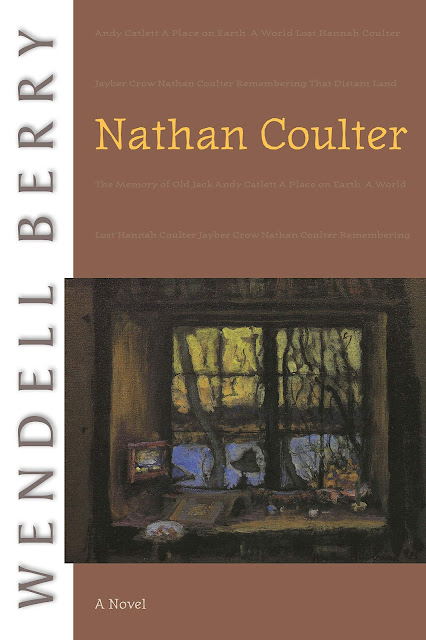
"Nathan Coulter" by Wendell Berry


Reading Nathan Coulter by Wendell Berry (born 1934) reminded me of reading A River Runs Through It by Norman Maclean (1902-1990). Two brothers, flyfishing, and a father are to Maclean what two brothers, farming, and a father are to Berry. I wondered which book might have influenced the other, until I saw the publication dates. Nathan Coulterwas published in 1960. A River Runs Through It was published in 1976. 

Nathan Coulter, Berry’s first novel, is a coming-of-age story of the title character. The story occurs in small-town and rural Kentucky from roughly 1929 to 1940. The Coulters are tobacco farmers, and Nathan’s family lives nearby his grandparents and Uncle Burley. The family is close-knit, until the death of Nathan’s mother sends the boys into the arms and the home of their grandparents. Their father is barely able to cope with his grief. 


Nathan and his older brother Thomas are inseparable, until Thomas discovers girls. And then they become more like boys living in the same house. As the brother being “left behind,” Nathan feels the loss most keenly. But it is a tobacco harvest that amplifies the loss and makes it irrevocable, a harvest that becomes a competition between Nathan’s father and his sons and then something far more between his father and his older brother. And in a brief moment, Nathan will see everything change irrevocably. 


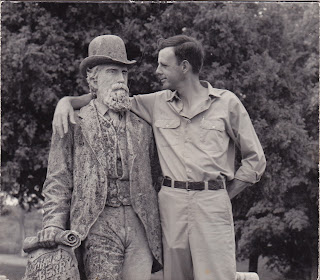
Wendell Berry about the time he wrote "Nathan Coulter"

Nathan Coulter
 is a story of family, of family farming, and especially of place. The family is rooted in place (a common theme in Berry’s stories, novels, and poems). The disruption of place will bring the disruption of family.
 

Berry is a poet, novelist, essayist, environmentalist, and social critic. His fiction, both novels and stories, are centered in the area he calls Port William, Kentucky, on the Ohio River. He’s won a rather astounding number of awards, prizes, fellowships, and recognitions. He lives on a farm in Kentucky.


With Nathan Coulter, Berry has written a beautiful novel. It tells it story, but it also tells a broader story. If you’ve grown up in the South or even the Midwest, the Coulter family is not recognizable; it’s like the family you grew up in.


Related:


My review of Berry’s That Distant Land.


Wendell Berry and the Land.


My review of Berry’s Jayber Crow.


Wendell Berry and This Day: Poems at Tweetspeak Poetry.


Wendell Berry and Terrapin: Poems at Tweetspeak Poetry.


Wendell Berry’s Our Only World.


The Art of the Commonplace by Wendell Berry.

Monday, August 15, 2016

J.D. Vance’s “Hillbilly Elegy”


It is, as the subtitle suggests, a story of a family and the culture that family has been part of – the American working class that increasingly finds itself on the losing end of globalization, economic change, the technological revolution, and government in the hands of a technocratic elite.

It is a story how a boy who had almost everything stacked against him climbed his way out of what could have been a life of destruction and despair.

And, without once mentioning the presidential election, it is a book that explains part of the appeal of candidates like Donald Trump and Bernie Sanders, and the forces that seem to be tearing the United States apart politically and socially.

By telling the story of his own family – a candid, often painful story – Vance humanizes and gives a voice to a large segment of the American population that increasingly believes itself ignored, forgotten, and marginalized. He uses the word “hillbilly” to label it, but he uses it with love, understanding, and the recognition that he is one with the family and people he’s writing about.

After World War II, his grandparents moved from rural/small town Kentucky to Middletown, Ohio; his grandfather was recruited to work for Armco Steel. It was a dislocating move for the couple; while many people like them moved from the same and similar areas, it was also a move away from the large extended family they depended upon.

They had three surviving children, the youngest of whom was Vance’s mother. And she was the one who fell into the shrinking opportunity-drug abuse-multiple marriages trap. She would be married four or five times, with numerous boyfriends in between. Vance describes himself (and his older sister Lindsay) as fortunate in that none of the boyfriends or husbands were abusive towards the children.

“It would be years before I learned,” he writes, “that no single book, or expert, or field could fully explain the problems of hillbillies in modern America. Our elegy is a sociological one, yes, but it is also about psychology and community and culture and faith.”

While it appeared that Vance as he grew older would fall into the poverty cycle, one individual would be the rock that gave him the stability he needed – his grandmother. And you may never have met a grandmother quite like this one – she set her husband on fire while he was sleeping off too much alcohol (the children saved him); she excelled at the use of colorful and vulgar language; and if she threated to use a gun people generally understood that she was serious.

J.D. Vance
His grandmother provided stability, especially during his last three years of high school, but Vance himself was learning enough about himself to know it was better to join the Marines before going off to the unstructured environment of college life. And that experience helped provide the revelation that he was ultimately responsible for his own life.

“There is a cultural movement in the white working class,” he says, “to blame problems on society or the government and that movement gains adherents by the day.” He chose not to do that. After the Marines, he attended Ohio State University and then was accepted into and graduated from Yale Law School. (And his observations about both college life and Yale also describe part of the problems with America – the upper middle class and upper classes maintaining and living the unwritten rules by which their class rules.)

Hillbilly Elegy is a book one should read during an election year like this one, and read again after the election is over. It’s a remarkable story of determination and success.

Related:

Trump: Tribune of Poor White People - Rod Dreher interviews J. D. Vance.


Top photograph by David Cooper: Middletown, Ohio, where J.D. Vance was born and raised.