Showing posts with label Port William. Show all posts

Monday, April 28, 2025

"The Memory of Old Jack" by Wendell Berry


Old Jack is what we once called “a character.” You didn’t find characters in large cities; you found them in small towns. Everyone knew them; they might be funny or odd or irascible or curmudgeonly. But they were part of the fabric of the place, part of its history and memory.  

Old Jack is 92. Born in 1860, the year before the Civil War, he has lived in the Port William area for his entire life. He’s connected to other families by kinship and relationship. He farmed for as far back as he can remember, but his farming days are behind him. He lives in what passes for Port William’s hotel, really just a boarding house with other elderly residents. But none are as old as he; he can remember some of them as children.


Old Jack can feel the end of his long life approaching. He knows this as well as he knows anything. He finds himself moving almost effortlessly between what was and what is. He recalls his childhood, his courtship of Rose and their doomed marriage, the births and the deaths, his estrangement from his only surviving child, the cost he paid for taking on the farmer who didn’t revere the land like Jack did. He remembers of deaths of friends; but he can rouse himself to engage the present, like seeing young Andy Catlett off to college, knowing it’s the last time he’ll see the boy of whom he’s especially fond.


Wendell Berry

The Memory of Old Jack
 is the second-to-last of the Port William novels by Wendell Berry. Set in 1952, it is a requiem for the kind of small-town and farming life that slowly vanished after World Wat II. It’s about the land and the people who farmed it, and the lives they lived. It’s not a rose-colored-glasses look backward; not everything was wonderful and simple. But it’s a story that only Wendell Berry could write, I think.


Berry is a poet, novelist, essayist, environmentalist, and social critic. His fiction, both novels and stories, are centered in the area he calls Port William, Kentucky, on the Ohio River. He’s won a rather astounding number of awards, prizes, fellowships, and recognitions. He lives on a farm in Kentucky.


If such a thing as purpose to a novel exists, then the purpose of The Memory of Old Jack is to remind us that this way of life existed, it was important, and when it passed, we lost something worth keeping. This may be my favorite of all the Port William novels,


Related:

My review of Berry’s That Distant Land.

Wendell Berry and the Land.

My review of Berry’s Jayber Crow.

Wendell Berry and This Day: Poems at Tweetspeak Poetry.

Wendell Berry and Terrapin: Poems at Tweetspeak Poetry.

Wendell Berry’s Our Only World.

The Art of the Commonplace by Wendell Berry.

Nathan Coulter by Wendell Berry.

Andy Catlett: Early Travels by Wendell Berry.

A World Lost by Wendell Berry.

A Place on Earth by Wendell Berry.

Some Monday Readings


The Intellectual Virtues of the Small Magazine – Jeff Reimer at Comment Magazine.


The Darktown Strutters Ball – Debra Esolen at Word & Song.


Message from Pope Francis: Read a Novel – Joel Miller at Miller’s Book Review.


The Fantastic Imagination – George Macdonald at The Imaginative Conservative.


St. James’s Square and the Growth of Stuart London – A London Inheritance.

Tuesday, July 23, 2024

“A Place on Earth” by Wendell Berry


It’s early 1945 in Port William, Kentucky. The war has been dragging on, but U.S. forces have survived the Battle of the Bulge. With a number of men involved in the fight in both the Atlantic and Pacific theaters, residents keep a close ear on the news. 

Mat and Margaret Feltner receive a telegram. Their son Virgil is missing in action. That’s all that’s known. Virgil’s pregnant wife Hannah, who lives with the Feltners, gets the news at the same time. The not knowing is a kind of limbo state, and the family somehow has to come to terms with it. It will become even harder for Mat than it does for Hannah or Margaret.


The Feltner family is at the heart of A Place on Earth, the fifth of the Port William novels by Wendell Berry. First published in 1967 (with a new, edited version issued in 1983), the novel is in turn funny, tragic, moving, and exhilarating. It contains laugh-out-loud moments, and it has moments when you’re reaching for the tissues. It’s about family, fathers and sons, the land, community, and the people who are the community.


Wendell Berry as a young man

Berry has created some memorable characters. Uncle Jack Beechum had me laughing with his stories about funerals at the church. Burley Coulter is the steadfast friend. Ernest Finley, wounded in World War I, is the carpenter who gives his heart. Mat is a man of nobility and steadfastness who begins to crack. Ida and Gideon Crop experience and struggle to overcome great tragedy. As individual as they are, they’re recognizable. They are people you know; some are you own kinfolk.


The author also shows himself capable of throwing a curve ball when you least expect it. And once it’s thrown, you realize just how right it is and how well it fits into the story.


Berry is a poet, novelist, essayist, environmentalist, and social critic. His fiction, both novels and stories, are centered in the area he calls Port William, Kentucky, on the Ohio River. He’s won a rather astounding number of awards, prizes, fellowships, and recognitions. He lives on a farm in Kentucky.


A Place on Earth is a profound story, one that changes you when you read it. It’s also one worth reading over and over again.


Related:


My review of Berry’s That Distant Land.


Wendell Berry and the Land.


My review of Berry’s Jayber Crow.


Wendell Berry and This Day: Poems at Tweetspeak Poetry.


Wendell Berry and Terrapin: Poems at Tweetspeak Poetry.


Wendell Berry’s Our Only World.


The Art of the Commonplace by Wendell Berry.


Nathan Coulter by Wendell Berry.


Andy Catlett: Early Travels by Wendell Berry.


A World Lost by Wendell Berry.


Some Tuesday Readings


Slow to Grow – poem by Andrew Stevenson at Creative Ramblings. 


The Vision of George Washington – poem by Monika Cooper at Society of Classical Poets.


The Greek City of Rome Before the Romans – Caleb Howells at Greek Reporter.


Sestina of Human Longing – poem by Katharine Whitcomb at Every Day Poems.

Monday, February 5, 2024

"A World Lost" by Wendell Berry


I can’t read the Port William stories and novels of Wendell Berry without thinking of my own father’s family. There’s a resonance between my relatives from north Louisiana and Berry’s characters in his fictional town in Kentucky that I times I think he’s repeating my family history. 

A World Lost is no different. Published in 1996, the now adult Andy Catlett is looking back at his childhood, and specifically the years of World War II. In his reminiscences, he’s trying to understand how his Uncle Andrew Catlett, his namesake and boyhood hero, came to be murdered. 


In their 40s, both his uncle and his father were too old to be drafted in the war. For this story, the war is mostly far away, never intruding upon the narrative. Except for rationing, life seems unchanged. His father, whose heart is farming, works as a lawyer. Uncle Andrew, whose heart is not farming, is charged with helping their parents with the family farmstead. Uncle Andrew, married without children, much prefers to be roughhousing with his friends, dancing, and entertaining the ladies. But the uncle adores his nephew, who often accompanies him on his escapades. 


The murder happens will Uncle Andrew and several other men are working at an abandoned lead mine, scavenging wood for reuse. A man not working with him shoots and kills the uncle. The man is caught, charged, and tried, but serves only a few years in prison.


Wendell Berry

The adults never talk about the death and trial around the child Andy. But the boy new at the time and still knows how his uncle’s death changed everything for his grandparents, his father, and Andy himself. It’s only much later that it becomes important for Andy to know and try to understand what happened. 


He researches court archives and old newspaper articles, and he mines the memories of the few people who are left who remember and will still talk about it. He eventually comes to a kind of answer, but he knows it’s a limited one. How well can we know the past and the people who inhabited it, even if we ourselves were once part of it?


Berry is a poet, novelist, essayist, environmentalist, and social critic. His fiction, both novels and stories, are centered in the area he calls Port William, Kentucky, on the Ohio River. He’s won a rather astounding number of awards, prizes, fellowships, and recognitions. He lives on a farm in Kentucky.


A World Lost is a relatively short novel, about 100 pages, but it’s a powerful one. It evokes a memory at every turn. It speaks to what we know and what we don’t, and to what about our own family history that has vanished, never to be remembered.


Related:


My review of Berry’s That Distant Land.


Wendell Berry and the Land.


My review of Berry’s Jayber Crow.


Wendell Berry and This Day: Poems at Tweetspeak Poetry.


Wendell Berry and Terrapin: Poems at Tweetspeak Poetry.


Wendell Berry’s Our Only World.


The Art of the Commonplace by Wendell Berry.


Nathan Coulter by Wendell Berry.


Andy Catlett: Early Travels by Wendell Berry.


Some Monday Readings


Authentic Humanity – Eric Miller at Current Magazine.


Lauded Writer and Emeritus Professor Fred Chappell Remembered – University of North Carolina.


Writing the Character-Driven Story: Chapter 1 – Harvey Stanbrough. 

Monday, February 14, 2022

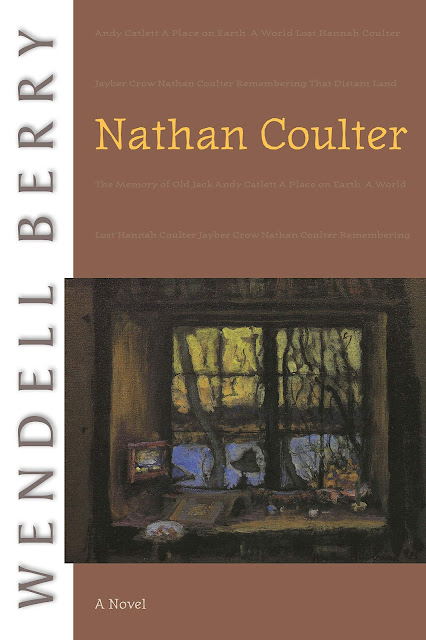
"Nathan Coulter" by Wendell Berry


Reading Nathan Coulter by Wendell Berry (born 1934) reminded me of reading A River Runs Through It by Norman Maclean (1902-1990). Two brothers, flyfishing, and a father are to Maclean what two brothers, farming, and a father are to Berry. I wondered which book might have influenced the other, until I saw the publication dates. Nathan Coulterwas published in 1960. A River Runs Through It was published in 1976. 

Nathan Coulter, Berry’s first novel, is a coming-of-age story of the title character. The story occurs in small-town and rural Kentucky from roughly 1929 to 1940. The Coulters are tobacco farmers, and Nathan’s family lives nearby his grandparents and Uncle Burley. The family is close-knit, until the death of Nathan’s mother sends the boys into the arms and the home of their grandparents. Their father is barely able to cope with his grief. 


Nathan and his older brother Thomas are inseparable, until Thomas discovers girls. And then they become more like boys living in the same house. As the brother being “left behind,” Nathan feels the loss most keenly. But it is a tobacco harvest that amplifies the loss and makes it irrevocable, a harvest that becomes a competition between Nathan’s father and his sons and then something far more between his father and his older brother. And in a brief moment, Nathan will see everything change irrevocably. 


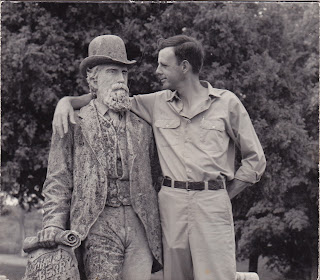
Wendell Berry about the time he wrote "Nathan Coulter"

Nathan Coulter
 is a story of family, of family farming, and especially of place. The family is rooted in place (a common theme in Berry’s stories, novels, and poems). The disruption of place will bring the disruption of family.


Berry is a poet, novelist, essayist, environmentalist, and social critic. His fiction, both novels and stories, are centered in the area he calls Port William, Kentucky, on the Ohio River. He’s won a rather astounding number of awards, prizes, fellowships, and recognitions. He lives on a farm in Kentucky.


With Nathan Coulter, Berry has written a beautiful novel. It tells it story, but it also tells a broader story. If you’ve grown up in the South or even the Midwest, the Coulter family is not recognizable; it’s like the family you grew up in.


Related:


My review of Berry’s That Distant Land.


Wendell Berry and the Land.


My review of Berry’s Jayber Crow.


Wendell Berry and This Day: Poems at Tweetspeak Poetry.


Wendell Berry and Terrapin: Poems at Tweetspeak Poetry.


Wendell Berry’s Our Only World.


The Art of the Commonplace by Wendell Berry.