Showing posts with label Wyatt North. Show all posts

Wednesday, January 17, 2018

"The Life and Prayers of St. Michael"


The Bible has a small scattering of references to him – two in the Book of Daniel, the Book of Revelation, and the epistle of Jude. He is the only archangel mentioned by name (Gabriel, who appeared to Zechariah and Mary, is described as an angel, not a prince of angels). But for all of the few Biblical references, Michael the Archangel plays a critical role in the accounts of the end times.

Wyatt North Books has published an account of the angel, The Life and Prayers of St. Michael, that combines what is known from the Bible, how he’s been considered in church history, and how he’s revered in the Catholic Church today. While the book reflects a Catholic perspective, its potential appeal is broader, including to anyone interested in Bible characters, eschatology (the study of end-times), or Bible study.

Most of the short book is divided into two parts – a biographical section and a section listing the various Catholic prayers to the saint.

The biographical section considers who the archangel is, the difference between angels and archangels, St. Michael in the apocryphal Book of Enoch, the various references in the Bible, his offices and how he’s venerated in the church, visions and understandings of St. Michael through the centuries, and how he’s depicted in Christian art.

The prayer section includes 10 prayers specifically to St. Michael.

What is clear from both the Bible and church history is that Michael plays an important role – the defender of the people (Christians) and a defender of the church, and especially but not only in the end times described in Daniel and Revelation. He is a “warrior of God, invincible and insurmountable,” reads the foreword of St. Michael (there’s no author listed, a common practice with Wyatt North books).

St. Michael is a concise summary of what is known about the archangel, how he’s been considered in church history, and how he’s regarded today.

RelatedSt. Michael the Archangel, the second movement in “Church Windows” by Ottorino Resphigi, composed in 1925-26.


Top photograph: a statue of Michael the Archangel.

Wednesday, May 3, 2017

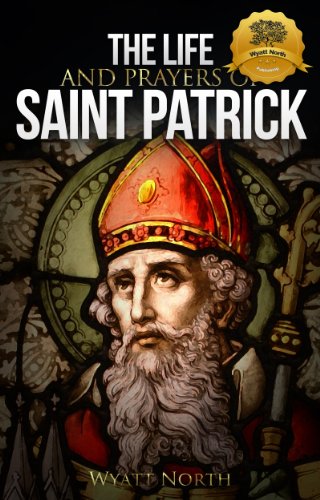
“St. Patrick: His Life and Prayers” by Wyatt North


The man we know today as St. Patrick was born in Britain in the late 300s, about the time that the Roman Empire was constricting and Britain was being abandoned. He was born into a landowning if not noble or upper class family living in northwestern Britain, not far from Hadrian’s Wall. We know he had a sister. And we know that when he was 16, raiders swooped in and carried him and others off, eventually selling him into slavery in what is now Ireland.

Only two of his writings have survived. One is the Epistle to Coroticus, written to a British chieftain and his subjects, seeking the release of Christians they had captured. The other is his Confessions, which explain, in his own words, how God favored him and used him to accomplish God’s work. We have a biography said to be written by one of Patrick’s converts, but created some 200 years after Patrick. Other than those documents, we have a wealth of myth and legend about the saint, some of which may be true and some not (Patrick himself makes no mention of driving the makes out of Ireland).

Wyatt North Publishing prints a whole series of short works on both Catholic and Protestant subjects, including Mother Teresa, St. Anthony, Pope Francis, C.S. Lewis, the life and times of Jesus, and other subjects. In a succinct publication, St. Patrick: His Life and Prayers separates what we know and what we don’t know about the saint. But it’s not necessarily “scientific” to dismiss the myths and legends; some of them are likely to founded in some fact or facts, while others are likely to have been derived from an oral storytelling tradition.

This volume by Wyatt North also includes three of St. Patrick’s prayers, “The Prayer for the Faithful,” “The Prayer for God’s Protection and Christ’s Presence,” and the “Lorica of St. Patrick,” a kind of adoration to begin each day.

St. Patrick is an easy-to-read, short summary introducing us to the saint, his life, and what he accomplished.


Top photograph: A stained glass panel of St. Patrick at Christ the Light Cathedral, Oakland, California.

Wednesday, April 19, 2017

“Thomas Merton: An Inspired Life” by Wyatt North


Thomas Merton (1915-1968) is likely the most famous American monk. His autobiography, The Seven-Storey Mountain, is still in print 70 years after it was published. He was a prolific writer, poet, essayist, speaker, and even a Vietnam War protestor. He was a member of the Trappist Monks at the Abbey of Gethsemani in Kentucky – and was likely the man who put the American Trappists on the awareness map.

But he also had a family, and a history. He had a path to faith that was uneven, broken, and confusing (this may be truth of faith in general). While it’s not an exhaustive biography, Thomas Merton: A Life Inspired, published by Wyatt North, is a succinct summary of the facts of Merton’s life and journey to faith.

Merton was born in 1915 in Prades, France, to an American mother and a New Zealand father.
Because of the war, they went to the United States, and after the armistice in 1918 returned to Europe, Living in France and then England. His mother died of stomach cancer when he was still a young child; years later his artist father would succumb to brain cancer.

He studied first at Cambridge (which he hated) and then transferred to Columbia University in New York City. He studied poetry and philosophy, but found himself drawn again and again to faith, and especially the Catholic Faith. He converted to Catholicism, and explored various religious traditions and groups until finally settling on the Trappists.

The Wyatt North biography also covers the life he led before Catholicism (somewhat dissolute but likely not out of the ordinary for a college student) and even the relationship he had with a nurse in Kentucky. What emerges from the account is not a stereotyped saint but a man of faith who struggled and strove. In other words, a real person. He died in 1968 during a trip to Thailand.

Wyatt North Publishing publishes a series of short works on both Catholic and Protestant subjects, including Mother Teresa, St. Anthony, Pope Francis, St. Patrick, C.S. Lewis, the life and times of Jesus, and other subjects.

Thomas Merton is a good summary of the facts of Merton’s life, how he came to faith, and how he both was inspired and proved inspirational to others.

Related: