Showing posts with label commentary. Show all posts

Wednesday, December 8, 2021

"The Gospel of Luke" by J.C. Ryle


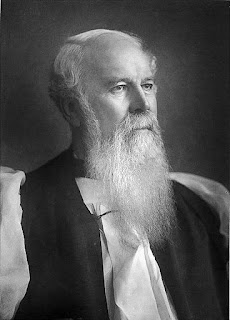
John Charles Ryle (1816-1900) was a British theologian, pastor, preacher, and writer. He worked as a minister in rural England for 38 years, until he became the first Anglican bishop of Liverpool in 1880. He worked steadily until he retired in 1900, the same year he died at age 84. 

He was born into a wealthy family; he father was a banker. As the oldest son, he was expected to inherit his father’s state and pursue a career in Parliament. He attended Eton and Oxford. In 1837, he became a Christian. He continued to follow the path chosen for him by his family, including the study of law after graduation from Oxford. But in 1841, his father’s bank crashed, and the family was financially ruined. Needing a job, he turned to the Anglican Church; his Oxford degree qualified him for the clergy.


Ryle was a prolific writer. His works include studies of prophecy and end times, holiness, preaching, parenting, and Bible studies. Perhaps his best-known works, still published today, are his “expository thoughts” on the four gospels of the New Testament. 


J.C. Ryle

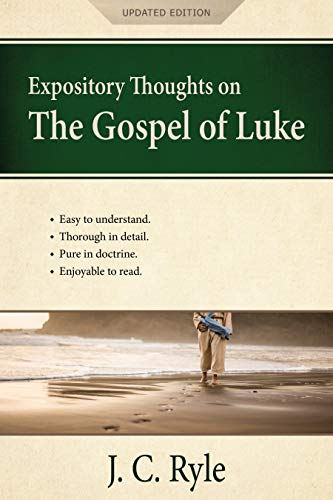
Expository Thoughts on the Gospel of Luke
 is one of those four. The Gospel of Luke is considered the “research version” of the life of Jesus, because Luke was not an eyewitness. He arrived on the scene during the ministry of Paul, and at some point he wrote an account of Jesus’s ministry with his gospel and followed it with an account of what happened after (Acts of the Apostles), describing the period of the very early church and Paul’s ministry.
 

Ryle’s expository thoughts are exactly that. He moves through the entire gospel, section by section, and provides insights into what is happening. The insights, written in highly accessible language, read like sermons, and it wouldn’t be surprising to learn that they first started out life as sermons and sermon notes.


His section on Luke 4:23-32 is an example, the “prophet is without honor in his own country” passage. Ryle cites three great lessons from the account. “We learn, for one thing, how apt men are to despise the highest privileges when they are familiar with them…We learn, for another thing, how bitterly human nature dislikes the sovereignty of God…We learn, lastly from this passage, how diligently we ought to persevere in well doing, notwithstanding discouragements.” The structure of his discussion is familiar, even today, as that of a classic sermon. 


Expository Thoughts on the Gospel of Luke was published more than a century ago, but its insights and wisdom are timeless, and they still have application to us today.

Friday, June 26, 2015

“Paul’s Letter to the Philippians” – Dan King et al


When I became a Christian, I was given a verse as “my verse,” and it has stuck inside my head for more than 40 years. It’s from the Apostle Paul’s letter to the Philippians: “Being confident of this, that he who began a good work in you will carry it on to completion until the day of Christ Jesus” (1:6). Every time I read it or have cause to remember it, I think back to a cool night in January in the basement of one of the main classroom buildings at LSU.

A few decades later, I returned to the classroom where it all happened. That’s the photo above, taken in 2010.

When I saw that a group of people, many of whom I knew in person or online, had created a Bible study for Philippians, I had to see what it was about.

I was not disappointed.

Paul’s Letter to the Philippians is designed as a guide for a group Bible study. To punch that point home, it’s a guide designed by a group for groups. In fact, the individual chapters were not so much edited as curated by Dan King and Crystal Rowe.

In the foreword, King explains how the study and guide were developed: “this community commentary was compiled through an online group study on the epistle, in which we worked through the entire book one passage at a time. Bloggers and writers from various backgrounds led us through the discussion as if we were sitting in someone’s living room together talking through this amazing piece of Scripture.”

The guide includes the historical context for the letter, and then 11 discussions, covering the letter’s major sections. Each section follows a similar format: discussion of the passage, a Greek word study, and an English word study. The word studies focus on a particular word in the passage, providing definitions, synonyms and word origins. Word studies, including their origins, are not superfluous – they provide depth of understanding and often open a study or discussion into a new direction.

As King says, this is a Bible study by “real people,” trying to work out what the epistle teaches and how it applies to life. The writers involved in the discussion and the guide include King, Rowe, Marty Duane Scott, Mark Lafler, Rachel Slough, Lyla Lindquist, Dave Moser, Ryan Tate, Diana Trautwein, Joshua Gillies, Ayomide Akinkugbe, Eric Swalberg, Sheila Lagrand, Asjlet Pichea and Evan Dawson. (I’ve actually met Dan King and Sheila Lagrand in person, both at Laity Lodge near Kerrville, Texas. Online, I’ve “met” Marty Duane Scott, Lyla Lindquist, Ryan Tate, Diana Trautwein and Eric Swalberg.)

The writers represent different Christian faith traditions, from evangelical to Episcopal. They bring their faith traditions to this discussion, and it enriches and deepens our understanding.