Showing posts with label historical romance. Show all posts

Tuesday, December 17, 2024

The Paperback Arrived!


The paperback edition of Brookhaven just arrived. I downloaded the Kindle version last Thursday, but it is something else to hold the physical book in my hands. Behind it are a few of the books (but only a few) I used for research.

Wednesday, March 24, 2021

“Paris Time Capsule” by Ella Carey


In 2010, an apartment in Paris was unlocked for the first time since 1966. It was included in the will of the granddaughter of the woman, Marthe de Florian, who originally owned it. The apartment included two surprises – an original painting of de Florian by Giovanni Boldini, and the furnishings, which were largely unchanged from the early 1900s.  

The apartment and what it contained were almost a perfect time capsule of the Belle Epoque, the 15 to 20 years before the start of World War I.  De Florian was a demimondaine who famous lovers included Georges Clemenceau, a prime minister of France. While she had been largely forgotten by history, the discovery of the apartment brought a spotlight to her life and times. 


Author Ella Carey was inspired by the story to write Paris Time Capsule, using the De Florian discovery as the basis for her story but changing some key facts. 


Catherine, or Cat, Jordan receives a letter from an attorney in Paris. Included with the letter is a key. The young New York City photographer discovers she has been left a legacy in a will of a woman she’s never met. The legacy is a Paris apartment. 


Once she arrives in Paris, Cat discovers the apartment has not been opened in more than 70 years. She explores the musty, cobwebby apartment, accompanied by Loic Archer, the grandson of the woman whose will left the apartment to Cat. 


Several mysteries need to be solved. Why did the apartment remained locked for 70 years? Why did Loic’s grandmother, the daughter of Marthe de Florian, make Cat the heir to the apartment? And why was the apartment abandoned intact in the first place? The answers take Cat and Loic to southern France and back to Paris. And along the way, Cat, engaged to a young establishment merchant banker in New York, finds she’s losing her heart to Loic.


Ella Carey

Ella Carey is the author of several historical novels. Paris Time Capsule is the first of three books in the Secrets of Paris trilogy, followed by The House by the Lake and From a Paris Balcony. She’s also the author of Secret ShoresBeyond the HorizonThe Things We Don’t Say, and the recently published A New York Secret. She lives with her family in Melbourne, Australia.


Paris Time Capsule is a mystery, a historical romance, and a contemporary love story, all wrapped into one hard-to-put-down novel.


Top photograph: Marthe de Florian, oil on canvas by Giovanni Boldini, via Wikimedia Commons. This was the painting discovered when the Paris apartment was unlocked in 2010.

Wednesday, August 26, 2020

“Uniquely Common” and "Silent Harmony" by Caryl McAdoo

I
t’s not unusual to see a group of authors get together and write a series of related books built around a theme. I’ve seen this particularly in two genres – romance and mystery. In some cases, each of the authors takes a different character and builds a separate but related story.

One example is the Lockets & Lace series, a group of Christian historical romances generally set in the 19th century and featuring a story that involves a locket. The series is currently going strong with 26 entries, each about 200 pages long. Caryl McAdoo has written three of them.

Uniquely Common tells the story of Christina Adams in the early 1850s. She lives with her brother and his two daughters in a New York City brownstone. Big changes are underway for the family – they’re planning to move to the Napa Valley in California to create a vineyard and winery business.

A surprise happens when Christina’s brother Asher brings home a good friend – and his business partner, a man named Ethan Cord. Christina is still reeling from a recent broken engagement, and she slowly realizes that Asher sees Ethan as a potential husband for her. Christina is not interested, thank you very much, but can’t object to the man coming with them as they leave New York.

The group travels by train to New Orleans and then by steamboat to St. Louis and Hannibal. In Hannibal they will purchase their mules, oxen, and “prairie schooners,” and then head to St. Joseph near Kansas City. Ethan and Christina keep finding themselves entangled in different situations. They also start finding themselves becoming romantically involved. It’s a story filled with the history of mid-19th century transportation and especially trains and steamboats. (And yes, there’s a locket involved.)

Silent Harmony is the story of three sisters, Lucy, Servilia, and Melody. It’s 1867, and the three live in the Red River Valley of Texas, trying to keep their cotton farm alive. Their father and Lucy’s husband were both killed in the Civil War, and Lucy has assumed headship of the family. She also has a four-year-old daughter, Harmony, who is both deaf and mute. 

A new teacher has arrived in town, a man named Zeke Sheffield. He stutters, and his stuttering often so bad that he has learned sign language. And it’s sign language that he will be teaching, along with other subjects. For Melody, the youngest sister, it’s love at first sight. But It’s Lucy who needs a husband and father for Harmony. 

Zeke is complicated. He has visions of things that will happen, and they turn out to be true. He stutters, yes, but not with Melody. And Sevilia is about as mean to her younger sister as she can get away with. 

The story is filled with color of post-Civil War Texas and how people have to start making a life for themselves again. 

Top photograph: A steamboat in the 1850s.

Wednesday, July 1, 2020

Finding Romance in Alaska, Part 2


It’s late 1918. The Great War is approaching its end, but for Geoff Chambers, going on 21, the war may never end. He’s home in Juneau, Alaska, from the trenches in Europe, missing most of both legs. He’s bitter, angry, and suffering from Post-Traumatic Stress Disorder. His family needs to get him away from Juneau. Reports of the Spanish flu epidemic are everywhere, and they need to isolate him from it so his physical recovery can continue.

Josephine Nimetz is 17. She works as a seamstress to help support her struggling family, but she also has experience nursing an ailing man. She’s on her way to deliver gloves to Mrs. Chambers when she’s accosted by her drunken stepfather, who’s demanding money for alcohol. He knocks her unconscious, and the Chambers find her and bring her to a room in their home. During the night, she hears a voice calling for water and discovers Geoff, who looks the very shell of a man.

His father makes an offer to Josephine and her mother. If she will care for Geoff at the family lodge on a nearby island for several months, until the threat of the epidemic passes, she’ll be well paid. Josephine and her mother agree, even though the girl knows she faces nine months caring for a young man who wants to die. In fact, the doctor gives him no more than two years unless something drastic changes in his attitude. Complicating Josephine’s work is that Geoff is already addicted to morphine.

Barbara Britton
Until June by Barbara Britton is the story of what happens on that island between Josephine and Geoff. It’s a romance novel, but it’s a bit unusual in not being a straight-line romance. There’s Geoff’s health, the deadline of when the job will end, family complications, and a friend of Geoff’s who is something less than kind to Josephine. There’s also the occasional bear, and a lurking dog that looks more like a wolf. 

Britton is the author of three romance novels in the Tribes of Israel series and three in the Daughters of Zelophehad series, aimed at teens in both the Christian and general markets. She’s a member of the American Christian Fiction Writers, Society of Children’s Book Writers and Ullustrators,, Romance Writers of America, and Society of Wisconsin Romance Writers. A native of San Francisco, she lives with her family in Wisconsin.

Until June is solid, well-written historical fiction, with a well-researched geographic setting and background of World War I. It’s also a simply good story; I was so taken that I read it almost in one sitting.

Related

Monday, May 13, 2019

“Trouble the Water” by Jacqueline Friedland


Seventeen-year-old Abigail Milton arrives in Charleston, South Carolina, from England in 1845. Her father has sent her for a year to stay with his close friend Douglas Elling. The Milton family had hit something of a financial disaster; Mounting debts from losses during a flood had forced them from comfortable middle class to poverty. Abby had been working at a mill and as a servant to her uncle, while fending off the uncle’s lecherous advances. 

She’s determined never to marry; she intends to become a teacher. And what she first sees of 26-year-old Douglas Elling confirms her resolution. He’s remote, rude, and distracted; he dresses without care and his beard makes him look disheveled. Three years before, he lost his wife and young daughter to a fire – a fire deliberately set because people of Elling’s class are not supposed to hold abolitionist views and, it’s rumored, help fugitive slaves escape.

Abby and Douglas seem content with staying out of each other’s way. She’s assigned a governess to give her lessons and teach her how to act in Charleston society. Douglas has little to do with her until he accidentally spooks a horse who rears and almost tramples Abby. And everything begins to change.
Jacqueline Friedland

Trouble the Water by Jacqueline Friedland is the story of Abby and Douglas, and how two people overcome past tragedy and brokenness as they reach toward each other. It’s also the story of slavery, abolition, the Underground Railroad, and the risks people would take to help slaves reach freedom. 

Friedland received a B.A. degree from the University of Pennsylvania and a law degree from New York University Law School, graduating Magna Cum Laude at both schools. She also received a M.F.A. degree from Sarah Lawrence College. She worked as an attorney for New York law firms and switched to teaching legal skills and writing at the Benjamin Cardozo School of Law in New York City. She lives with her family in New York. This is her first novel. 

Trouble the Water pulls you fully into the story of Abby and Douglas. Friedland has done her research; she’s captured the sense of Charleston and the slavery system on which the South was constructed extremely well. The novel is a historical romance, but it is also about overcoming the past and listening to one’s conscience.

Wednesday, May 8, 2019

"A Rose Blooms Twice" by Vikki Kestell


Rose Brownlee is 32, happily married, and the mother of three children. In an instant, everything is snatched from her – the family’s carriage overturns on an icy bridge, Rose is thrown clear to the rocks below, and the carriage is swept into the wintry river. She loses her husband and the children.

Weeks later, recovering from her own injuries, Rose decides to head west toward the new lands opening up on the vast American prairie. Her husband has left her extremely well off financially, and she decides to travel by train however long she decides to travel. She finally stops in the small farming town of Riverbend, a town settled by Americans and immigrants from Norway, Ireland, and other countries. 

She decides to stay, for however long she wants to stay. She buys a house, she makes friends, and she begins attending the town’s one church. And it’s in Riverbend that Rose will find the true meaning of faith, the embrace of community, and the beginning of a return from her personal tragedy. She’ll also find love.

Vikki Kestell
A Rose Blooms Twice by Vikki Kestell is the first of eight books in “A Prairie Heritage” series. First published in 2012, it is a historical novel that falls in the “faith-filled, inspirational” genre. It is also an addicting read.

Before beginning her writing career, Kestell worked in government, academia, and corporate arenas, holding a Ph.D. degree in Organizational Learning and Instruction. She has also written four books in the “Nanostealth” series, three in “Girls from the Mountain” series, and several in the “Laynie Portland Spy” series, as well as a Bible study entitled “Growing Up in God.”

A Rose Blooms Twice is not all an “everything turns out wonderful” story. Rose faces personal danger, snakes, locusts, and several blizzards, and manages to find the faith and inner strength to live through all. It’s a heartwarming, inspiring story.

Wednesday, April 10, 2019

“Bending Toward the Sun” by Mona Hodgson


It’s September 1865. The Civil War had ended but its effects linger. Some men have come home from the war; others have not. For Emilie Heinrich, the war presented no personal impact. She had been 14 when it started; her father had not enlisted. The two of them operate a general store in Saint Charles, Missouri, on the Missouri River not far from St. Louis. 

Quaid McFarland was one of the more fortunate soldiers. He had enlisted with the Union forces and he came home, much to his mother’s delight. He hasn’t seen Emilie since she was 14 and in pigtails, but when he does see her now, he unexpectedly discovers a love interest, and interest that Emilie reciprocates.

But there’s a problem. Emilie’s German father does not see Quaid as a suitable husband for his daughter. For one thing, he’s a teamster, driving a delivery wagon, definitely a class below where Emilie is. For another, he’s Irish.

Bending toward the Sun is the second of three “Quilted Heart” novellas by Mona Hodgson (the first being Dandelions on the Wind and the third is Ripples Along the Shore). It’s a historical romance, hinged upon a single question – will Emilie and Quaid overcome her father’s objections to their relationship? 

Hodgson has published some 42 books, including historical novels and children’s books. Her series books include Sinclair Sisters of Cripple Creek, Bedtime in the Southwest, Real Girls of the Bible, and the Princess Twins books. What initially attracted me to Bending Toward the Sun was its post-Civil War timing and the physical setting of Saint Charles, which is about 10 miles from where I live.

Bending Toward the Sun is a romantic story of overcoming class and ethnic prejudice, steeped in solid period research. 

Monday, February 19, 2018

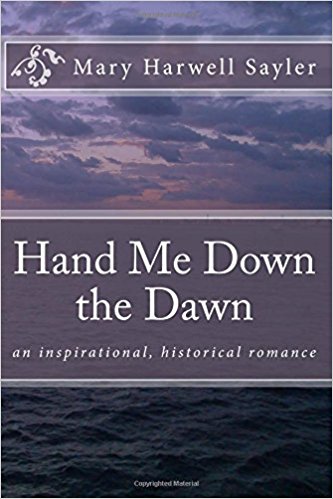
"Hand Me Down the Dawn" by Mary Harwell Sayler


It’s 1895. Catherine Caldwell, known as “Cat,” is 19 years old. She’s digging her father’s grave; her mother died some years before. She hasn’t had much education. The people of the town she lives near think of her as rather odd. With no other family, she decides to fulfill a kind of promise to her mother and heath south to Florida, specifically to Siloam Springs on the St. John’s River, a place she’s never visited but which holds the promise of a better life.

She disguises herself as a boy, wearing her father’s dungarees and boots. She hops a freight train headed south, and after she’s discovered and rather painfully thrown off the train, she meets Raff Jordan. Jordan is clearly a man of the gentleman class, and he is piloting his raft of goods to Siloam Springs with the help of a young local man named Wyatt Tate. For several weeks, the three make their way together on the St. John’s River from Jacksonville. Cat discovers that Jordan is a preservationist – someone deeply concerned by the destruction of Florida’s natural habitats by phosphate ore miners and others.

Cat discovers herself liking Jordan, a liking that grows stronger. But their relationship often seems like oil and water. Once they reach Siloam Springs and the big steamboat docked there, Jordan deposits Cat with the Tate family and takes off. Ma Tate isn’t fooled for a moment – she knows Cat is no young boy. And she helps her get a job working as kitchen help at the local hotel and establishing a double life – kitchen boy cleaning pots and pans and beautiful singer at the hotel.

Mary Harwell Sayler
Cat’s story is told in Hand Me Down the Dawn by Mary Harwell Sayler, first published in 1985 and now updated and republished. Sayler is a poet, editor, and writer whose published books include Living in the Nature Poem, Faces in a Crowd, Outside Eden, Beach Songs & Wood Chimes: Poems for Children, Christian Writer’s Guide, Praise: Poems, and What the Bible Says About Love, among many others. She lives in Florida.

Hand Me Down the Dawn is a historical romance, and Sayler has done her historical and environmental homework in telling Cat’s story. And it is a sweet, winsome story, including enough twists and turns to keep the reader guessing if Cat will find the life and the love she’s looking for.

Related:


Top photograph: Lucas New Lines operated steamboats on the Ocklawaha and St. John’s rivers in Florida in the 1890s.