Friday, September 23, 2022

Certain prophets


After Matthew 7:13-14
 

False prophets are

a dime a dozen.

They speak at TED

conferences, they

write books, they

have large followings

in Instagram and

twitter, people

sharing, liking, 

retweeting everything

they hear, everything

they see. Too often,

false prophets occupy

a pulpit, speaking

words of gold and

silver, words like

gilded thorns, thistles,

rotting fruit, words 

that appeal like

the siren’s call,

the call of telling

you what you want

to hear. Consider

what they create, 

what they produce:

weakness, rottenness,

destruction.


Photograph by Hennie Stander via Unsplash. Used with permission.

Thursday, September 22, 2022

"Death at Whitewater Church" by Andrea Carter


The Inishowen Peninsula of County Donegal seems a cold, almost desolate place in the depths of winter. The northernmost extension of the Republic of Ireland, it’s most rural with some small towns. When they want a major shopping trip, residents head to the city of Derry. Dublin is a four-hour drive. 

Benedicta O’Keeffe, known as “Ben,” is an attorney. Her practice encompasses the northern part of the peninsula, and it usually involves land sales, probate, court filings, and the basic kinds of law practice. Ben is fine with that; she’s moved here to escape Dublin and the guilt she’s placed on herself for the death of her younger sister. She hasn’t seen her parents in two years. 
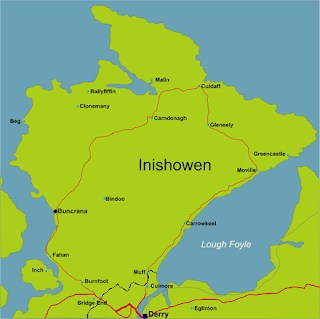
 

Inishowen Peninsula

She likes the people she works and lives with, especially the chief policeman, Sgt. Tom Molloy. She and Molloy seems to circle each other, trying to make up their minds if there’s something more to their relationship or not.


Ben accompanies a property surveyor to check a deconsecrated church property. An English couple wants to buy it and refurbish it as a holiday home. It’s known as the Whitewater Church; it served the community of Whitewater that all but disappeared in the mid-1980s with the death of the local shipping business. They’re about finished the surgery when the discover the church has a crypt. What remains there might have been were removed with the deconsecration. At the bottom of the stairs, however, they find a skeleton wrapped in a blanket. And it doesn’t belong in the crypt.


It might be the body of Conor DeVitt, who disappeared on his wedding day six years before, leaving a hole in his family and the community. What the discovery leads to is a decades-old story of an IRA terrorist bombing, family secrets, and the upending of other crimes both related and unrelated. And Ben finds herself at the center of all of it.


Andrea Carter

Death at Whitewater Church
 is the first of five Inishowen mysteries by Irish writer Andrea Carter. It’s so well written and so intricately plotted that at time I had to remind myself I was reading a crime novel, not a literary story. It requires  close reading to keep track of all the characters, a close reading that will be rewarded. And it’s such a good story that, immediately upon finishing it, I ordered the next four. Death at Whitewater Church is that good.


Carter studied law at Trinity College Dublin and managed the most northerly solicitor’s practice in the Republic of Ireland. In 2006, she moved to Dublin to work as a barrister and then turned to writing crime novels. She’s published five Inishowen mysteries featuring solicitor Benedicta “Ben” O’Keeffe: Death at Whitewater ChurchTreacherous StrandThe Well of IceMurder at Greysbridge, and The Body Falls.

Wednesday, September 21, 2022

"Christmas in Venice" by Meadow Taylor


It’s Christmastime. Canadian Olivia Moretti has just landed at the airport in Venice. She’s excited to be starting a new job with an art gallery in Venice. She speaks flawless Italian; her late father was a native before emigrating to Canada. 

Still at the airport, tired and jetlagged Olivia first runs into Alessandro Rossi of the Venice police. He wants to see identification, and he wants to know where her suitcase is. The elderly woman she had left it with momentarily is gone; the suitcase remains, but something inside is ticking. And the President of Italy is due to land at the airport.


Christmas in Venice
 by Meadow Taylor is a short story and prequel to the romantic suspense novel Midnight in Venice. It’s designed to introduce the reader both to Olivia and the policeman, both of whom as major characters in the novel. The story blends the right amount of humor, suspense, and the possibility of romance to keep interest moving forward toward the novel. 


Meadow Taylor is the pen name of two (unnamed) Ontario authors of historical fiction. In addition to Midnight in Venice, Taylor has also published the novels The Billionaire’s Secrets and Falling for Rain and the short story Christmas in Bruges


Prequels, and especially prequel short stories and novellas, are an increasingly popular and effective way for an author to introduce full-length novels. Reasonably priced and sometimes free, they give the reader a taste of what the longer story is about. They’re also often used as a promotional giveaway to encourage readers to sign up for an author’s newsletter. Christmas in Venice is an example of the effective use of a prequel.


Top photograph by Federico Beccari via Unsplash. Used with permission

Tuesday, September 20, 2022

Classic Biography: "Edgar Lee Masters" by Herbert Russell


The year 1915 was momentous in the history and development of American poetry and poetry in general. Poetry Magazine published The Love Song of J. Alfred Prufrock by T.S. Eliot, launching the era of modernism in poetry. And a number of poems which had been published off and on by William Reedy of Reedy’s Mirror in St. Louis were collected and published under the title of Spoon River Anthology.  

The collection by Edgar Lee Masters (1868-1950), a Chicago attorney, rocked the poetry world, the literary world, and even popular culture. The book went through seven printings in seven months. By 1916 (and 19 printings), an augmented edition was published. It was the top-selling poetry book for the next five or six years. 


The more than 200 poems written as tombstone epigraphs struck a deep, responsive chord in American culture and among the broad general public. People recognized the characters who emerged from the poems. They weren’t so much types as they were cleverly drawn and succinct summaries of your family members, friends, and neighbors. 


To continue reading, please see my post today at Tweetspeak Poetry.


Photograph: Edgar Lee Masters (1868-1950).

Monday, September 19, 2022

"Ends of War" by Caroline Janney


I have an image in my head, likely based on what I remember from American history in college, that when Robert E. Lee and Ulysses S. Grant agreed to surrender terms at Appomattox in April 1865, Lee’s Army of Northern Virginia went home. Two weeks later, William Johnston surrendered to William Sherman at Greensboro, North Carolina, and Johnstone’s Army of Tennessee went home. And that was end of the Civil War. 

Well, not quite.


As Lee’s army fled west from Richmond and then Petersburg, what had been about 60,000 men was losing strength. Some were captured, some took off for points west, and some disappeared into the woods and valleys. By the time Lee and Grant met, Lee’s army was likely between 30,000 and 40,000, and more men were leaving every day.


Grant’s purpose, to which he stuck ferociously through the negotiations and through the coming months, was to bring peace. Lee’s men could go home. They would be issued rations and paroles. A parole was good to obtain rations from Union provosts and to obtain transportation on ships and trains to go home. There would also be no reprisals for having served in Lee’s army. 


To continue reading, please see my post today at Tweetspeak Poetry


Sunday, September 18, 2022

Two gates


After Matthew 7:13-14
 

It’s a narrow gate

by which you enter.

It’s a wide gate

by which you’re

swept along

with the crowd,

jostling, yelling,

swelling, angry,

believing the wide

gate is the entrance

to what the crowd 

wants. It is the entrance

to what the crowd

earns. The narrow gate,

requiring movement

in almost single file,

is a hard, difficult

path but also the true

entrance. 

Few choose it.


Photograph by Neil Martin via Unsplash. Used with permission.

Saturday, September 17, 2022

Saturday Good Reads - Sept. 17, 2022


How long before the news media has to stop falling for hoaxes before it recognizes the need for basic journalism? The answer, in this day and age, is probably never. The Covington kids, Jussie Smollett, etc., etc., keep happening with nauseating frequency, and the news media wonders why trust is at its lowest level ever. Jessie Singal at Common Sense
 takes a look at the latest example, and how a small college newspaper, practicing basic journalism, upended the likes of The New York Times, Washington Post, NPR, CNN, and ESPN, to mention only a few. 

One might think that after a century of intense ready, study, research, and a multitude of articles and books, a poem might finally be understood. One might think that, and one would be wrong. T.S. Eliot’s The Waste Land turned 100 years old this year. Alexander Larman at The Critic Magazine says the poem still defies easy categorization


What is it with politicians and laptops? We’ve had Eliot Weiner, Hillary Clinton’s emails, and now Hunter Biden. When it surfaced in 2020, the FBI, CIA, former intelligence officials, and the news media all singing the now well-known hymn, “It’s Just Russian Disinformation.” As it turns out, our vaunted intelligence services notwithstanding, the Hunter Biden laptop was, and is, all too real. Andrew Rice and Olivia Nuzzi at New York Magazine’s Intelligencer (not exactly a conservative publication) tell the story of the now infamous laptop. And it’s, as they say, a story without heroes and a sordid one from start to whatever will be its ultimate finish.


More Good Reads


American Stuff


A Congregation on the Pennsylvania Frontier – Mark Wilcox at Emerging Revolutionary War Era.


Reading the Founding – Bradley Birzer at The Imaginative Conservative.


Poetry


The Poem as Shared Emotional Experience – Wendy Pratt at Wendy Pratt Writing.


The Silence of Thomas Aquinas – Benjamin Myers at Ekstasis Magazine.


Cast – Jerry Barrett at Gerald the Writer.


Life and Culture


How Weed Became the New OxyContin – Leighton Woodhouse at Tablet Magazine.


The return of the sacred: The British monarchy is defying secular modernity – Sebastian Milbank at The Critic Magazine.


Why Progressives Undermine Civilization – Michael Shellenberger.


Do Parents Have Rights That Protect Against Transgender Ideology? – Joe Carter at The Gospel Coalition.


Faith


Just War and Our Cultural Conflict – Kevin DeYoung.


Following Christ in the Machine Age: A Conversation with Paul Kingsnorth – Tessa Carman at Mere Orthodoxy.


British Stuff


The wars of the Windsors – Dominic Green at New Criterion


The Death of the Queen and a Christian Understanding of Sovereignty – Alastair Roberts at The Theopolis Institute. 


Cruikshank at the Tower of London – Spitalfields Life.


News Media


Google’s Revolution in Historical Research – Philip Johnson at Anxious Bench.


Writing and Literature


For Percy Bysshe Shelley, Literature Was the Spark of Revolution – Jared Marcel Pollen at Jacobin.


Let the Violent Bear It Away – Dwight Longenecker at The Imaginative Conservative.


Translation as Transgression: Bringing the Uyghur Novel 'The Backstreets' into English – Darren Byler at Words Without Borders.


Art


The Industrial Visions of Precisionist Artists – Bill Morris at The Millions.


“The Civil War” Soundtrack: Ashokan Farewell


Painting: Lady with a Book, oil on canvas (ca. 1860) by Arthur Boyd Houghton (1836-1875).