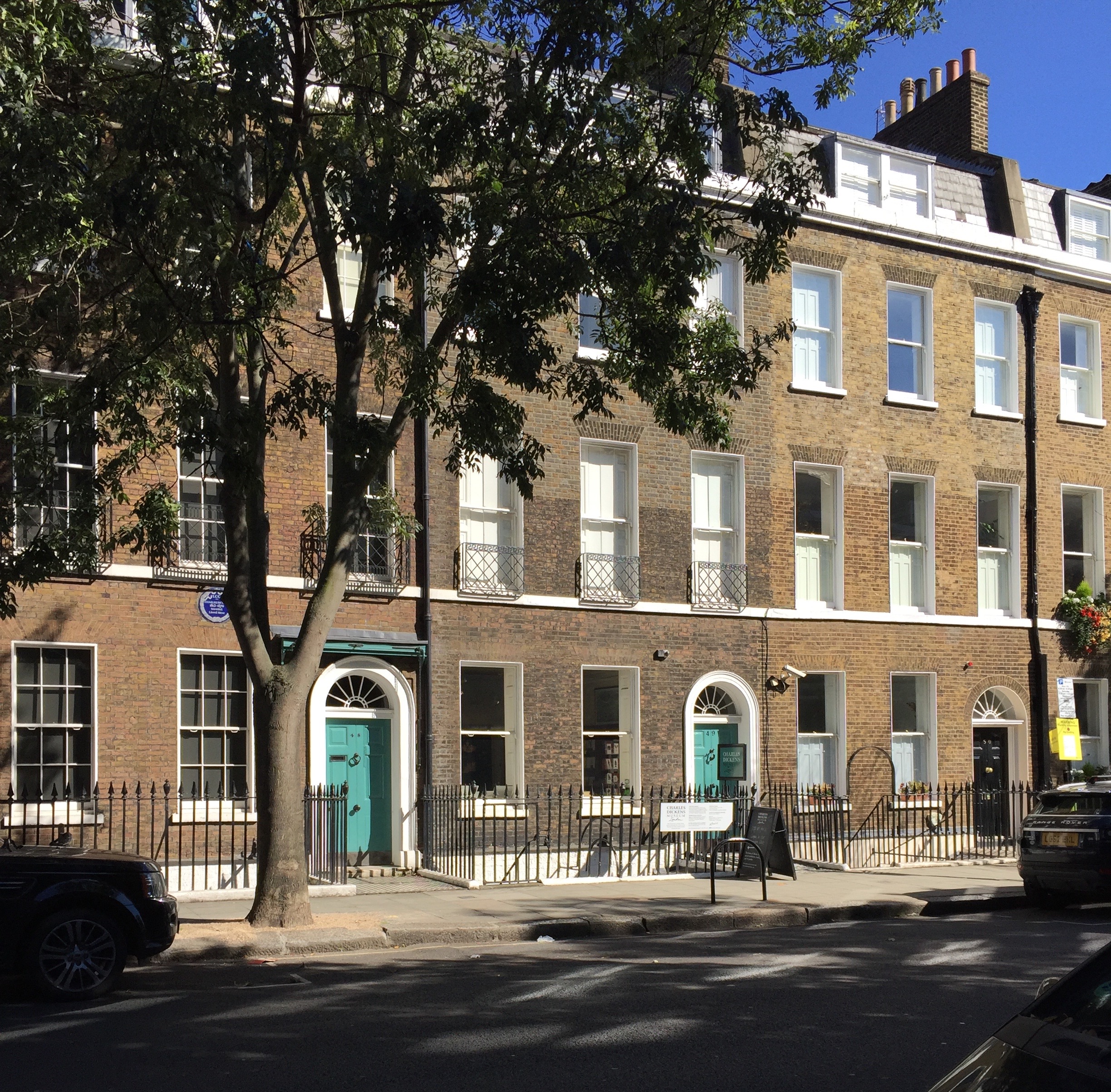
It’s Libraries & Museums Month at Tweetspeak Poetry, and we’re looking at a whole world of art, books, buildings and architecture, artifacts, and the things we populate our cultural institutions with.
My wife and I traveled to England five times in the 2010s. We’d been once before, back in 1983. Much had changed; for one thing, the food had vastly improved. And we did all the sights that you do – the Tower, Buckingham Palace, St. Paul’s Cathedral, Westminster Abbey, the British Museum, the Imperial War Museum, the Royal Academy of Arts, Windsor Castle, and all the other places you must visit if you’ve never seen them before.
But a city like London is also filled with small museums, and they tend to be the ones most tourists overlook. Admission is reasonably priced, and guides or docents are quite knowledgeable about the site and the idea or person it’s built around. I have three particular favorites, and I’ve returned to them again and again on succeeding trips.
Detective Chief Inspector John Shadow and his sergeant Jimmy Chang are asked to visit a museum in York dedicated to Roman antiquities. Someone seems to have stolen valuable Roman coins and replaced them with fakes. The museum staff isn’t sure when this might have happened; it could have been anytime during the previous eight months.
Sgt. Chang also seems to be acting weirdly, and Shadow is half afraid he’s getting ready to dump his girlfriend, the coroner the police prefer over the chief coroner. Added to the mix is a missing Chinese tourist, a young girl who had joined a tour of Britain late and who now seems to have disappeared. And this is in top of a previously reported missing Chinese girl. What’s even stranger is that both girls have the same passport name.
Shadow suspects that all these crimes – the theft of the coins, the missing girls – may be linked. A reseller of chocolates may be involved. Someone at the museum may be involved. But everyone, including Shadow, thinks Shadow is off on this suspicion.
H L Marsay
A Roman Shadow is the fourth mystery novel in the DCI John Shadow series by British author H L Marsay. It has all the hallmarks of its predecessors, a well-written mystery, a curmudgeonly chief detective, plenty of references to restaurants in York (Shadow, who lives on a boat, dines out for most meals), an overly enthusiastic detective sergeant, and a way of tying a number of disparate narrative streams together.
Marsay is the author of six mystery novels in the DCI John Shadow series. Set in York, the characteristic features of each of the stories are a curmudgeonly DCI, his irrepressibly cheerful sergeant, a culinary tour of the city restaurants, café, and pubs (some of which actually exist), and an introduction to York’s colorful history and present. A member of the Crime Writers Association, she lives with her family in the city of York in England.
It may be a new syndrome. Recently, the Centers for Disease Control reported the findings of a study that said an epidemic of depression was sweeping younger adults and teens, and especially young women. An earlier study, not cited by the CDC, looked at a similar phenomenon, but through the lens of politics, finding considerable differences between progressives and conservatives. Conservative writer Rod Dreher discusses what he calls “Borderline Progressive Disorder.”
The news media has been grappling with a significant loss of trust in the United States, worse than any other Western country. All kinds of programs and initiatives are being tried. But nothing’s going to work, argues Chris Hedges at Scheerost, until the news media confront one of their largest failings in the last six years. See “The Trump-Russia Saga and the Death Spiral of American Journalism.”
Nicola Sturgeon, first minister of Scotland, recently announced she was stepping down from her position. Speculation abounded, but at least one factor playing a role was her running afoul of gender politics. Her most likely successor was a young woman named Kay Forbes, that is, until it was discovered she had a personal belief in traditional marriage. Carl Trueman at First Things Magazine calls for prayer for her, noting that it’s reaching a point where anyone with a traditional view of marriage, no matter how muted, is considered ineligible for public office.
There’s a lot of unease going round the Kidlington Police Headquarters of the Thames Valley Police, as well as police offices across England. A sniper is on the loose, and several policemen have been killed. Everyone’s looking over their shoulders. No more smoking in the parking lot. No loitering outside. Officers are jumpy, and with good reason.
DI Hillary Greene is looking over her shoulder, too, but she’s determined not to let a sniper control her life. And now she and her team have a new murder case – a wealthy woman in the midst of a divorce has been stabbed to death just inside the entryway of her home.
The leads are few, and they go nowhere. The woman’s husband has a solid alibi. So does his current crush. The neighbors noticed nothing. No one saw a car parked nearby. Someone did see a woman riding a bicycle about the right time, but it was a considerable distance away and no identification was possible.
Through slow, exhaustive and exhausting, and often plodding police work, Greene and her officers find a few clues. A possible lover. A sister the victim hasn’t spoken with in years. Threatening letters.
Faith Martin
And, all the time, the sniper is lurking, and we watch in riveting horror as he gets closer and closer to Kidlington.
Murder in the Mansion is the eighth in the DI Hillary Green series by British author Faith Martin, and it’s nailbiter of a story. Martin won’t leave the reader hanging, but you’ll be on the edge of your chair through the last page. This may be the best entry in the series yet.
In addition to the DI Hillary Greene novels, Martin (a pen name for Jacquie Walton) has also published the Ryder and Loveday novels as well as the Jenny Sterling mysteries. Under the name Joyce Cato, she has published several non-series detective stories. Both Cato and Martin are also pen names for Walton. (Walton has another pen name as well – Maxine Barry, under which she wrote 14 romance novels.) A native of Oxford, she lives in a village in Oxfordshire.
I like maps. In fact, I can’t remember a time when I didn’t like maps. While they were (and are) abstract in their own way, they also make what they depict manageable and understandable. They also help you find your way to places you’ve never been. When I use a map, I study it, commit major roads and streets to memory, and then go.
And then there’s history.
I may be one of the few people who get excited to receive a Civil War atlas as a Christmas present. But I did, and I was.
And it wasn’t only an atlas.
The Atlas of the Civil War is, as its name implies, a collection of maps. But it’s also a National Geographic publication, which means your get far more than the maps and chunks of text about them. It’s written by author Stephen Hyslop, who’s published among other historical works, National Geographic’s Eyewitness to the Civil War. It’s edited by Neil Kagan, whose firm specializes in illustrated books. And it includes an introduction by Civil War historian Harris Andrews.
To continue reading, please see my post today at Dancing Priest.