Thursday, November 19, 2015

Daniel Tyler’s “A Guide to Dickens’ London”


In the novels, stories and articles by Charles Dickens, London often assumed the role of character all on its own. Its streets and buildings, its neighborhoods and squares, its slums and courts and prisons, and, most of all, its people were both a giant canvas on which he drew his works and a well of inspiration.

Dickens knew London in person. He walked its streets; in fact, he was rather famous for walking its streets, thinking nothing of a good 25- or 30-mile hike (he was also reported to be a fast walker).

Daniel Tyler, a lecturer at the University of Oxford, has published several books related to Dickens, including Dickens’s Style (2013), and he recently edited The Uncommercial Traveller, published this past October by Oxford University Press. The Uncommercial Traveler has numerous references to London, and Tyler put some of that research to good use in a volume entitled A Guide to Dickens’ London.

This isn’t a guide to a walking tour, like Lee Jackson’s Walking Dickens’ London or the “Magic Lantern” brochure you can obtain at the Tourist Information Centre across from St. Paul’s Cathedral that helps you find key locations in Dickens’ life and writings. Instead, A Guide to Dickens’ London is the book you should read before you do a walking tour, because it connects in detail various neighborhoods, buildings, locales, streets and even the bridges across the Thames to Dickens’ works, and especially the novels.

Daniel Tyler
Tyler walks the reader through the areas that contained the slums, the affluent areas (most of which are still affluent), the coach houses and hotels, the homes, the precincts of the law around the Temple, the river and bridges, the prisons and the churches that provided Dickens with the background and often the foreground for a considerable portion of the action in his novels. Here was a key scene in Bleak House and one in Little Dorrit; there was where Pip walked and was embarrassed to see Estella riding by. And over there is the prison Pip visited in Great Expectations.

It’s a relatively slender volume of 152 pages (including the index) but there is considerable research packed into it. A Guide to Dickens’ London is a highly readable text, telling both the story of one of the greatest novelists and the city he loved, even as he railed against its squalor and injustice.


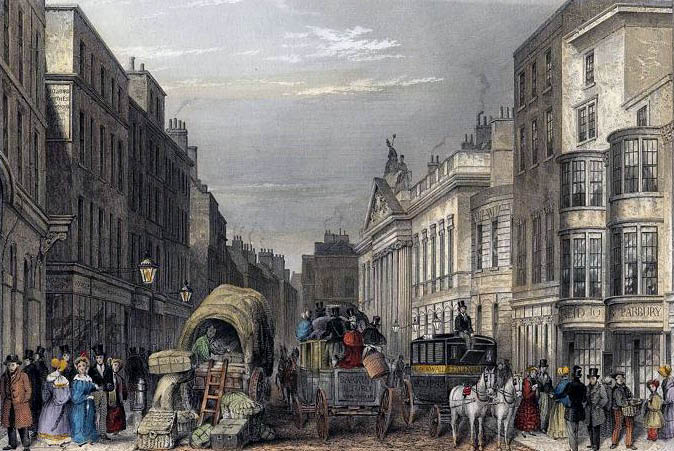
Illustration: Leadenhall Street in London in Dickens’ times, via Wikimedia Commons.

Wednesday, November 18, 2015

‘Nobody’ by Creston Mapes


Hudson Ambrose is a reporter for a Las Vegas newspaper. He’s headed home in the wee hours of the morning when he sees a man slumped over in a bus shelter. He calls 911 and waits, but no police show up. Observation tells him that this is one of the city’s many homeless people. And then he does what no reporter should do – he checks the body for identification. He finds a safety deposit box key and a bank book.

A homeless man with almost $700,000 in his savings account.

Ambrose leaves, still holding the key and the bank book. And he knows he at least has the makings of a story – a homeless bum murdered, with hundreds of thousands in the bank. And Ambrose also knows he may have both a story and the money.

Thus begins Nobody by Creston Mapes. It’s one nail-biting thriller of a mystery.

As Ambrose begins to pursue the identity of the murdered man and the story, he discovers a few problems. First, there’s no body – something of play on words here, with a double meaning – literally a missing body, and the body of a homeless man, and for many of us, the homeless are indeed nobodies. Second, the man has a story that stretches back to a legalistic church in Atlanta.
And third, someone clearly doesn’t want Ambrose doing what he’s doing, and is going out of his way, stopping at nothing, to make sure Ambrose is stopped.

There’s a fourth problem as well: Ambrose is being chased by God. The murder victim turns out to be a man beloved among the homeless and beloved by his church, which includes a young woman Ambrose finds himself becoming interested in.

Creston Mapes
Mapes is the author of several novels that fall into the “Christian fiction” category. These includes two books in the “Rock Star Chronicles” – Dark Star and Full Tilt – and three in “The Crittenden Files” series – Fear Has a Name, Poison Town, and Sky Zone. Nobody was first published in 2007, between the two series; an ebook version of the novel arrived in 2014.

I say these stories fall in to the Christian fiction genre, and they do, but there’s a considerable amount of realistic violence and themes one doesn’t find in Amish romances. Part of what Nobody is also about is to put a face and a name on society’s nobodies – the homeless. Interestingly enough, while the story is set in Las Vegas, it’s not about gambling.

Nobody is a story of finding out what happened to a murdered homeless man, and what happens when a reporter discovers he’s being dragged kicking and screaming into faith. And did I mention it’s a nail-biting thriller of a tale?


Photo of Las Vegas by Alex Grichenko via Public Domain Pictures. Used with permission.

Tuesday, November 17, 2015

A Month of Keats: Keats and Hampstead Heath


Our Keats Walk in Hampstead in north London, led by guide Anita Miller, has brought us to Hampstead Heath. Our first time on the Heath was a week before, when we visited Kenwood House. Kenwood is on the north side of the Heath, the place occupied by the various earls of Mansfield (and the setting for the 2013 movie “Belle,” which is well worth seeing). The house includes an incredibly fine art collection, including a Rembrandt, a Vermeer, some Constables, a Gainsborough or two, a Van Dyck, and many others.

John Keats by Joseph Severn, 1819
Today we’re on the south side of the Heath (and it’s a big heath). We have just crossed the street from Well Walk and entered what is a forested part of the area.

This is a place John Keats knew well. He would often walk from where he lived on Well Walk across part of the heath to Wentworth House, where his good friend Charles Armitage Brown lived. Brown was the companion who spent 48 days hiking Scotland with Keats, and the friend who would offer Keats a place to live after his brother Tom died in late 1818.

To continue reading, please see my post today at Tweetspeak Poetry.


Photograph: A forested part of Hampstead Heath.

Monday, November 16, 2015

'Classic Crime Stories'


Sherlock Holmes, as it turns out, had peers. Or at least he had contemporaries who also happened to be in the detecting business.

Classic Crime Stories, edited by author David Stuart Davies, is a collection of crime mysteries written in the late 19th and early 20 centuries. In some cases, the reader knows who did it; the focus becomes how the detective ferrets out the truth. Others are more traditional mystery, with the reader accompanying the detective as the crime is eventually solved. In a few, there is no detective at all, but rather a victim or would-be victim seeking to evade their doom.

All of the authors represented in the collection of 20 stories were well known in their day, and several of them are still well known – Arthur Conan Doyle, Robert Louis Stevenson, G.K. Chesterton, John Dickson Carr, and Guy de Maupassant. But all of the stories are gems.

In R. Austin Freeman’s “The Echo of a Mutiny,” a murder happens in a lighthouse – with no witnesses except the killer. In Chesterton’s “The Hammer of God,” a Catholic priest (not Father Brown) puzzles over why a small hammer was used to kill instead of a larger one. In “The Ripening Rubies” by Max Pemberton, a jeweler discovers who is stealing jewelry from London society ladies at balls and parties. William LeQueux’s “The Purple Death” concerns three bodies found in an abandoned fishing boat, each with a purple face. John Dickson Carr’s Dr. Gideon Fell solves a murder, or two, involving a summerhouse on an island – which no one seemed to have been able to reach without being noticed. Sheridan Le Fanu tells a wonderful Gothic story in “The Murdered Cousin,” and how the intended victim saves herself.

David Stuart Davies
Editor Davies has written several Sherlock Holmes novels and edited new collections of vintage detective stories, fairy tales, ghost stories, G.K. Chesterton’s Father Brown mysteries, a World War II detective series, and Starring Sherlock Holmes: A Century of the Master Detective on Screen, among other works.

The stories he’s selected for Classic Crime Stories provide a window on a period where crime writing and mystery writing were reaching the first crest in a major wave of popularity, the start of the Golden Age of mystery writing. The quality of the stories here helps explain that popularity.


Photograph by George Hodan via Public Domain Pictures. Used with permission.

Sunday, November 15, 2015

Why go


After Acts 21

Pleas, entreaties, warnings,
tears fall on blocked ears
and open mind. I will listen to
but not heed the words breaking
my heart; I know their source,
their origin, their why. But I will
set theses precious stones aside;
I have no choice. I will go on
to what is feared:
inevitable arrest,
inevitable trial,
by the same minds and sentiments
that condemned and executed
the innocence of the word,
I will go on, risking
the likely repetition.


Illustration: 19th century woodcut.

Saturday, November 14, 2015

Saturday Good Reads


We live in crazy times.

An innocuous email from Yale offends students who need safe space, and the university found itself caught between irate students and an irate reaction on social media. At the University of Missouri, a protest about racism evolved into a bully of a professor being outed – and she may have singlehandedly diverted national attention away. The positive thing about both of these situations is that people are beginning to take a close look at what passes for a university education these days. (Did you know you could major in English Literature at UCLA, with no requirement to take a course in Shakespeare? Details in the video below.)

And still, beautiful photography. And poetry. And reflections on faith. And the story of a Muslim refugee in Amish country.

Photography

What lies within the seed – Susan Jones.

Mist on the Prairie – Tim Good at Arts by Tiwago.

Husbandry in Harvest – Jack Baumgartner at The School of the Transfer of Energy.

Delta Blues – Ari Gabel at Oxford American.

Poetry

Aye of the Beholder – Brendan MacOdrum at Oran’s Well.

Bernard of Clairvaux – D.S. Martin at Kingdom Poets.

Encounter – Loren Paulssen at World Narratives.

Law of Averages – Maureen Doallas at Writing Without Paper.

Writing

10 Secrets from the Weird World of Writers – Leslie Leyland Fields.

Why are our favorite detectives so fatally flawed? – Janet Brons at Strand Magazine.

Stuck in the Middle – Ann Kroeker.


Life and Culture

A Thin-Skinned Minority is Ruining This Nation – Mike Adams at the University of North Carolina – Wilmington.

The Tyranny of Social Justice Warriors and The Establishment’s ‘Pain’ – Rod Dreher at The American Conservative.


Supporting My Mizzou Students – Thom Lambert, University of Missouri Law School.

Faith

The Place in the Woods – Winn Collier.


Bible Out Loud – Monica Sharman at Know-Love-Obey God.

Let Love Prevail over Religion – Amanda Hill and Hill + Pen.

The Labyrinth – Doug Spurling at Spurling Silver.

Who Killed the Liberal Arts?


Photograph: Bridge of Sighs at Cambridge University by Anna Langova via Public Domain Pictures. Used with permission.

Friday, November 13, 2015

"Barbara Hepworth: Sculpture for a Modern World"


It was in June, I believe, when I saw an item posted by Maureen Doallas on her blog, Writing Without Paper. If you know Maureen, she know she is all things art, and this item had to do with an exhibition  at the Tate Britain on the work of sculptor Barbara Hepworth. I checked the link and made a note of it, since we were planning a vacation in London and would be there while the exhibition was still on (it closed on Oct. 25).

I was not familiar with Barbara Hepworth’s work. I wasn’t familiar with 20th century sculpture. And I wasn’t sure what I thought about the modernist / international style of sculpture. But these are actually good reasons to see an exhibition, and I did add it to the list of “possibles” to see.

Early one morning during the first week we were there, I was power-walking in Pimlico and went right by the Tate Britain. I saw the banner for the Hepworth exhibition, and decided I would try to make time for it. A few days later, I did. (Instead of walking, I took the tube from St. James’s Park to Victoria Station, and from Victoria Station to Pimlico.) Three blocks later, I was at the Tate, paid my admission for Hepworth, and went in.

Barbara Hepworth in 1934 with ‘Mother and Child’ (Getty Images)
Born in 1903 in Yorkshire, Hepworth was interested in art from a young age. By 17, she was studying at the Leeds School of Art, and moved to London shortly after, to study at the Royal College of Art. She fell in love with and eventually lived with sculptor John Skeaping, with whom she had a son. They shared studio space. The relationship lasted until she met and fell in love with Ben Nicholson, with whom she had triplets. In the years leading up to World War II, Hepworth was making a name for herself (along with sculptors like Henry Moore), and working in Modernism and what was called the International Style.

After the war, her reputation grew. She and Nicholson were divorced in 1951. She established her studio in St. Ives in Cornwall, and executed a number of commissions for the United Nations, art centers, sculpture parks and other organizations. She died in a fire in her studio in 1975.

Large and Small Form, 1934; the Piers Art Centre, Orkney.
The show was arranged in six largish rooms, and mostly (but not entirely) in chronological order. The first room was mostly smaller, table-top pieces, carvings in wood and stone. The larger pieces came at the end, but the exhibition was mostly organized by themes – carving, studio, international modernism, equilibrium, staging sculpture, and pavilion. Hepworth also worked in brass, especially for outdoor installations.

Walking from room to room, one could how she developed concepts of form, including the human form. Some of the wooden pieces suggested an African influence, but the spherical shapes she developed were captivating. I couldn’t tell you what they represented, but I was nonetheless captivated by several of the pieces, particularly in the international modernism and equilibrium rooms. And I was struck by the sheer beauty of many of the sculptures she produced. (For an extra cost, which I paid, the Tate had a very helpful audio guide.)

I bought a book about Hepworth, British Artists: Barbara Hepworth by Penelope Curtis, and I wish I had been able to read it before seeing the show. Curtis provides an overview of Hepworth-s life and work, a critical history, and the influence she’s had, all in less than 100 pages but filled with photographs of her sculptures. It’s an excellent introduction to the artist and international modernism.

I’m glad I went. I learned something about a period and its sculpture that I knew precious little about. And the Tate knows how to do an exhibition.

Barbara Hepworth at the Tate Britain


Top photograph: Sculpture with Colour (Deep Blue and Red) by Barbara Hepworth, 1940; Tate Britain.