Showing posts with label Texas. Show all posts

Tuesday, April 18, 2023

Art and Poetry Come Together in Fredericksburg, Texas


It’s one of the many places settled by German immigrants in pre-Civil War America. Fredericksburg, Texas, is some 75 miles west of Austin in the Texas hill country. And, yes, everything they say and sing about bluebonnets in the spring is true. Years ago, when I lived in Houston, I drove my wife to Austin for a series of medical procedures. And the bluebonnets dazzled. 

A number of other things dazzle in Fredericksburg. The birthplace of Chester Nimitz, the admiral who commanded the U.S. Navy in the Pacific in World War II (the town has an impressive museum devoted to the War in the Pacific). The nearby Lyndon Baines Johnson Ranch, a historical park operated by the National Park Service. The Pioneer Memorial Library and Pioneer Museum. The Texas Rangers Heritage Center at Fort Martin Scott. Don’t forget the beer and food at Oktoberfest. And close by is Luckenbach, Texas, made famous in songs by Waylon Jennings, Johnny Cash, Willie Nelson, and Kristofferson. 


Fredericksburg has another boast. Actually two: art, and poetry. And they’ve come together in a poetry and art exhibition at the Fredericksburg Art Guild through the month of April. Featured are artist Nan Henke and poet Megan Willome.


To continue reading, please see my post today at Tweetspeak Poetry.


Photograph: the eastern end of downtown Federicksburg by Chris Litherland via Wikimedia.

Tuesday, October 19, 2021

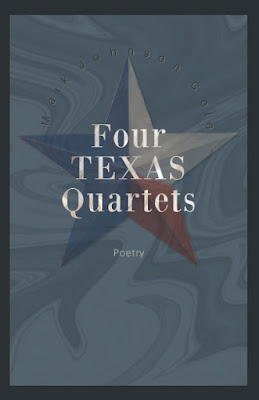
Poets and Poems: Mark Johnson Cole and “Four Texas Quartets”


Mark Johnson Cole loves the poetry of T.S. Eliot. And he loves his state of Texas. And while undoubtedly many Texas share a love of Eliot’s poetry, Cole may have done something unique. He married Eliot’s Four Quartets and Texas history and current events to create Four Texas Quartets. In a time when poetry is being revitalized on Instagram, when novels are being written in poetic form, and collections and even Poetry Magazine often mash up poetry with art and photographs, Four Texas Quartets is a creative standout. 

A native Oklahoman but reared in Texas and currently living near Houston, Cole holds seven degrees. He’s been a working attorney and a local government official. He studied German and then philosophy in graduate school. He studied law and theology in New England, Germany, Liechtenstein, London, and the Midwest. 


Over time, he says, he discovered that philosophy was becoming less personally important and poetry becoming more so. He discovered the poetry and prose of Eliot and the importance of “his thought in the history of the culture of the West.” And from there he began to study writers like John Graves, Wendell Berry, J. Frank Dobie, and Larry McMurtry.


To continue reading, please see me post today at Tweetspeak Poetry.

Wednesday, August 7, 2019

"Adam" by Chris Keniston


I bought this novel thinking it was a Christian romance. By the second sentence of the first chapter, I had figured out that it was indeed a romance novel, but not likely Christian. I continued reading and discovered a mostly clean good story.

Veterinarian Adam Farraday has had a long night with an ailing horse. He’s on his way home in the dark of the morning when he sees a fancy red sports car on the side of the West Texas road, with a flat tire and some additional damage. And the person getting out from the car is wearing a white wedding gown.

Margaret Colleen O’Brien, known as Meg, is spitting nails. She discovered her imminent husband-to-be is a fraud and a crook, fled her wedding right before the ceremony, drove like mad out of Dallas and ended up with a flat tire on a back-country road. Her credit card was maxed out by the fiancée, she’s tossed her cell phone out of the window of the card, and she has exactly one pair of jeans and a blouse in a bag. She needs to lie low for a while, and what better place than this small town in West Texas, whatever its name is.

Meg gets a job as a waitress in the town’s one café, Adam discovers he is strongly attracted to this redheaded stranger, and the town wonders what her back story might be. Meg discovers she’s falling for Adam, one of the six Farraday brothers, but she wants nothing to do with men after what almost had happened to her with that crook.
Chris Keniston

One of the Farraday brothers is the town sheriff. He gets a visit from the FBI. They’re looking for Meg.

Adam by novelist Chris Keniston is the first in the multi-volume Farraday Country romance series. It’s a rather fun story, with vivid secondary characters (Adam’s Aunt Eileen is a classic), an interesting plot line, and, as noted before, mostly (but not entirely) clean romantic scenes.

Keniston is the author of numerous romance novels and stories. She has nine books in the Hart Land series; eleven in the Farraday Country series; nine in the Aloha Closed Door Series; six in the Surf’s Up series (episodes); nine in the original Aloha Series; six in the Family Secrets series; two in the Honeymoon Series; and one in the Main Street Romance Flirts Series. She and her family live in suburban Dallas.

The ending of Adam can be guessed; this is a romance novel, after all. But Keniston keeps some mystery until the end – what will the FBI do? What happens to Meg’s almost-husband? Will she return to Dallas? Or will she throw everything over for the handsome veterinarian? 

Monday, January 30, 2017

“News of the World” by Paulette Jiles


Having spent some time in the Texas Hill Country west of San Antonio, I’ve heard a few of the stories about the battles between bands of the Comanches and Kiowas and the Spanish, Anglo and immigrant settlers in the 1860s and 1870s. The stories are gruesome and harrowing, and neither side had a lock on viciousness and terror.

In some cases, the Indians would take kidnapped women and children back to their tribes. (If you’ve seen the 1990 Kevin Costner movie “Dances with Wolves,” actress Mary McDonnell plays a woman who was kidnapped as a child and raised as a member of the Indian tribe.) Some of those women and children were rescued or traded to U.S. authorities, and returned (if possible) to their families. But the children and adults who came back were often fundamentally changed from those who had been kidnapped.

The novel The News of the World by Paulette Jiles tells the story of one of these returns.

It is Texas in 1870, a post-Civil War society that has both Union troops still in occupation over former Confederates and attempting to deal with frontier Indian attacks.

Captain Jefferson Kyle Kidd is 72 years old. He’s experienced three wars – the War of 1812, the Mexican-American War, and the Civil War. A former newspaper publisher in San Antonio but bankrupted by the collapse of the Confederacy, he ekes out a living by traveling from small town to small town in Texas, and reading newspapers – the news of the world – in meeting hall performances.

He is in Wichita Falls on the Oklahoma border when he’s asked to return a 10-year-old child who has been captive with the Kiowas. She had been taken when she was six, with her parents and sister murdered by a Comanche raiding party, and then swapped or given to a Kiowa tribe. She speaks no English, considers herself a Kiowa, and is terrified to find herself in an Anglo society. Kidd is asked to return her to an aunt and uncle who live near San Antonio. It will be a long and likely dangerous trip, especially when they reach the Hill Country.

Paulette Jiles
As they travel, we learn more of Kidd’s history, and his hope that his two daughters and their families, living in Georgia, will eventually join him in Texas. He’s a widower who still mourns his wife. We learn more of the girl, Johanna Leonberger, but what we learn is her Kiowa understanding of the world. The two must learn to talk with each other, trust each other, and depend upon each other for their very lives.

Jiles is a writer and poet who’s published numerous works, including the novels Enemy Women, The Color of Lightning, Stormy Weather, and Lighthouse Island; a memoir, Cousins; Blackwater; and Song to the Rising Sun. She graduated from the University of Missouri-Kansas City with a degree in Romance Languages and received the Canada Governor General’s Award for Poetry. She lives near San Antonio.

The News of the World is a relatively short novel (209 pages) but a big story. While it is a tale right out of Texas history, it is also a moving account of two people who couldn’t be more different having to cross cultures, ages, and personal histories to survive together.


Top photograph: A scene in San Antonio circa 1870.

Friday, January 16, 2015

A Tale of Two Romances


Two novels. Two romance novels. Both offered for free as promotions of newer books in the series. Both published in the same year. Both with the same high rating on Amazon. Both set in Texas. Both set in rural Texas. Both involving recent widows. Both have a handsome man return to town.

And by about page 4, you know both are completely different.

I’ve said (admitted) (confessed) that I read the occasional romance novel. And I see a lot of promotions for free ebooks on Amazon (including my own on Fridays during January; that means today). I downloaded two novels, thinking that both of them were Christian romance novels. One of them was. One of them was not.

But it had been some time since I downloaded, and so over my long Christmas vacation I perused my Kindle. And found Cathy Bryant’s A Path Less Traveled, the second novel in her Miller Creek series. It falls into a sub-sub-genre – Contemporary Christian Western Romance (it’s set in Texas and the heroine lives on a ranch, so that makes it western, I suppose). It’s a simple, straightforward story.

Published in 2010, it wasn’t considered for the Pulitzer Prize or the National Book Award. But that wasn’t the author’s intention. Bryant wanted to tell a romantic story, and she succeeds admirably. Great literature, no. A good entertaining story, yes.

A young widow still grieving for her dead husband is trying to make a go of a design business in a small town. She’s not succeeding. Financially, she’s in over her head. She has a young son that she’s trying to be both mother and father to. Each day gets a little more desperate, but she stubbornly refuses to share her problems with family and friends. And then a lawyer comes to town for a wedding, a lawyer with his own personal baggage. He connects with the young boy. He wants to connect with the boy’s mother. She, however, is as stubborn as a Texas mule.

About the worst thing I could think of to say is that the reader sometimes wants to slap the heroine’s face and say “Girl, get with it!” But the story is a family-friendly type of read. It has 141 reviews on Amazon.

Then there was the other romance novel (if you want to know the title, email me; I don’t voluntarily publicize bad writing). I mistakenly thought that it, too, was a Christian romance. By page four, I hit the first “damn!” in the narrative. And I thought, well, I knew some Christian publishers are getting more edgy. By page seven I knew that no Christian publisher I had ever heard of was getting this edgy.

For the first four chapters, unconsummated lust – lust and nothing but lust – dripped off the pages. The writing was stilted. The writing, in fact, was superfluous.

I stopped reading. And then I looked to see how many reviews it had on Amazon.

More than 500.

I thought about what the editor H.L. Mencken once said: “You’ll never go broke underestimating the intelligence of the American public.” Or underestimating bad taste, I would add. Or our appetite for coarseness.

That’s an old-fashioned word, coarseness. But it’s a good word to describe our culture. Our public rhetoric. The language we commonly use. The language even we Christians are commonly using. I once sat in a training seminar at my own church and heard a visiting pastor use language that he apparently thought made him cool, relevant and millennial. It didn’t. It was offensive.

If you want a nice, entertaining romance novel about rural Texas, read Cathy Bryant. Forget the coarse thing. We all be better off.


Photograph of the Texas state flag by Summer Woods via Public Domain Pictures. Used with permission.

Saturday, November 22, 2014

Christian Wiman’s “Once in the West”


I’ve read a lot of poetry over my lifetime, and likely more in the last 10 years than the rest combined. Rarely have I been as taken with a collection as I have with Christian Wiman’s Once in the West: Poems.

The poems originate in Wiman’s childhood and coming of age in Texas. They extend beyond that, into the reader’s mind and own experience, a collection of sharp, piercing stones with cutting edges that leave blood on the floor – the blood of life and of a life lived.

Some may mind the occasional profanity. I didn’t, and it surprised me that I didn’t.

I’ll have more to say later, but here is one example of a poem from the collection.
 
Calculus

A soul
extrapolated

from the body’s
need

needs a body
of loss

is that, then,
what we were

given
in that back-

seat, sweat-
soaked, skin-

habited heaven
of days

when rapture
was pure

beginning
and sinning

praise?

Related:


Photograph by Silviu Firulete via Public Domain Pictures. Used with permission.

Sunday, March 3, 2013

The silence is deeper here


The silence is deeper
here, encased in canyon
walls, air filtered
dry of remaining
vestiges of noise, enclosing
the life moving within.

The silence is deeper
here, embroidered by sacred
songs rising, words distilled
pure of extraneous and
unnecessary matter, encircling
the silence pulsating within.

The silence is deeper
here.

Photograph: View from the balcony, Laity Lodge, looking down the Frio River.

Thursday, November 15, 2012

An Element of the Sacred


What strikes any visitor to Laity Lodge is first, the remoteness, and second, the beauty of the landscape.

How remote? Cell phones don’t work. How beautiful? The photograph above was taken while I was standing on the balcony of the main lodge building, early on Sunday morning. For three mornings straight, I got up at five, showered and dressed, walked to lodge and scrounged for coffee.

And then I inhaled the quiet, and the solitude. I’d write some. I’d watch the sun rise over the bluff – a magnificent thing to see.

I was there for the online staff retreat for The High Calling. We came from all over the United States and even from Australia. We arrived on Thursday in San Antonio, congregated in Kerrville (about an hour or so west of San Antonio), had dinner in Hunt, Texas, a few miles out of Kerrville, and then went on to Laity Lodge.

And it’s still reachable only by driving through a river for about four blocks. Like I said, it’s remote.

It’s also something else. The word, I believe, is sacred, but not because of anything spiritual that attaches to the landscape but rather what happens within that landscape.

Worship. Reflection. Teaching. Writing. Art. Music.

And for us with The High Calling, meetings and discussions and planning. Those, too, had an element of the sacred about them.

For most of the weekend, we joined with a group from Westlake Presbyterian Church in Austin, Texas, there for their retreat. Together we heard a series of four messages from Robert Mulholland, a retired professor from Asbury Theological Seminary, and music from Jeff Johnson. And on behalf of The High Calling, I livetweeted Mulholland’s talks, except for the Eucharist service on Sunday.

I’ve already written a little bit about what I heard from Mulholland. There’s more, much more. His words prompted me to ask a question that I’m still answering: how many of my own career conflicts have been part of God conforming me to Christlikeness?

All of them, I suspect.

On Saturday afternoon, a group of us hiked the Circle Bluff Trail, which ends atop the bluff with a vista stretching for miles. I had hiked this trail two years ago. Once we reached the top, Marcus Goodyear, our tour guide and editor of The High Calling, asked who wanted to continue on. Two the group returned; four of us went on with Marcus. “Continuing on” included wading the Frio River, making our way to the Fencepost Trail, and then a descent into Box Canyon.

The descent included the use of ropes. But it was relatively short and not very strenuous.

If you were a mountain goat.

I survived just fine.

So we listened and talked, presented and pondered. We learned. We shared and encouraged. We sat quietly and we laughed. We walked and hiked and waded.

We spent some time at Laity Lodge. Good time.

Sacred time.

The stone of canyon walls
rests in stacks, layers in color:
tan, gray, blue-gray; limed
with the waters, living waters
pouring in their trickles, flowing
down to the river,
down to the sea,
to launch a thousand ships.


Wednesday, November 18, 2009

Shoe Polish, A Velvet Cape and Mile-High Hair

Before I graduated from college, I’d been to Texas three times: a family vacation to see Six Flags in Dallas/Ft. Worth; a journalism conference at the University of Texas in Austin; and my interview for a copy editor position at the Beaumont Enterprise. I got the job, graduated from LSU, and drove the next day to Beaumont.

I was not prepared for Texas, Beaumont or working for a newspaper…

(Today, I’m honored to be guest posting at Hey Look, A Chicken!, aka @katdish’s place. To read the rest of the post, take a look here. But watch out -- @katdish is known for her well deserved and fully justified rants.)