Showing posts with label pilgrimage. Show all posts

Wednesday, August 31, 2022

"The Way is Made by Walking" by Arthur Paul Boers


Sometime about 2005, Arthur Paul Boers went on a hike. Not just any hike, but the 500-mile-long Camino de Santiago in northern Spain. Already an experienced hiker, he made the journey in 31 days. And he wrote about his experience. 

But he didn’t simply write a travel diary of what he saw and where he stayed. Instead, The Way is Made by Walking: A Pilgrimage Along the Camino de Santiago is about the experience of pilgrimage itself, what it means and signifies, and what the idea of pilgrimage suggests for the Christian life. It isn’t a primer on pilgrimage, or even a step-by-step guide to the Camino de Santiago. This is the Christian life as a pilgrimage.


Boers explains why he was drawn to pilgrimage, its Christian roots, and its lessons for spirituality. Like the pack he carried on his back, a pilgrimage is always about the need to simplify, carrying with us only what’s vital and necessary. (He became such a stickler on this point that he tore out sections of the book he read along the way as soon as he finished reading them. The book was Don Quixote.) 


He goes on to consider the challenges of faithful pilgrimage, the opportunities for hospitality, what happens even to secular seekers along the way, and how to put pilgrimage into daily practice. And he sees walking as a spiritual practice.


Arthur Paul Boers

Just so you know, Boers also wrote about the blisters on his feet, the good and bad food, and some nice places to sleep along with those he’d rather forget about. And four appendices discuss recovering and reclaiming Christian pilgrimage, planning a pilgrimage, some well-known pilgrimage destinations, and resources specific to the Camino itself. 


The book, first published in 2007, so impressed the late Eugene Peterson that he wrote the foreword. 


Boers is an ordained minister and Benedictine oblate, and he served for many years as a pastor in rural, urban, and church-planting settings.  He served for six years he held the R.J. Bernardo Family Chair of Leadership at Tyndale Seminary in Toronto, Canada, and taught pastoral theology at Associated Mennonite Biblical Seminary in Elkhart, Indiana. He’s also published Our Work, God’s WorldLiving into Focus: Choosing What Matters in an Age of Distraction; and Servants and Fools: A Biblical Theology of Leadership.  He received his D. Min, degree with distinction from Northern Baptist Theological Seminary, and he also holds degrees in pastoral counseling and peace studies.


You don’t have to travel to Spain and walk the Camino de Santiago to appreciate The Way is Made by Walking. You can practice the idea of pilgrimage in your own neighborhood or town. And while the 500-mile Camino might be too challenging, I’m thinking about the 120-mile path from Winchester to Canterbury. 

Wednesday, January 19, 2022

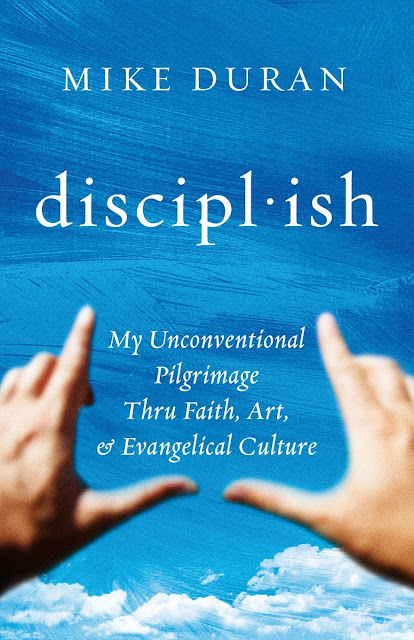
"Discipl-ish" by Mike Duran


Mike Duran took an unconventional path to Christian faith and ministry, but it was “unconventional” only in the sense that it wasn’t the usual coming-to-faith “cartoon” that’s presented as common to all believing Christians, as in, “I was a sinner, and I was saved one night.” 

What Duran’s memoir, Discipl-ish: My Unconventional Pilgrimage thru Faith, Art, & Evangelical Culture, conveys more than anything else is how coming to faith lasts a lifetime. It includes breakthroughs, setbacks, problems, upheavals, victories, discouragement, and growth. Faith is life, and it’s messy and hard and sometimes painful, but it is also unbelievably rewarding.


Duran was raised in the Catholic Church, including attendance in Catholic schools and serving as an altar boy. But he always had a rebellious steak, a streak that took him at a relatively young age into drugs, the occult, and delinquency. What he didn’t know then was that he was on a pilgrimage to Christian faith.


He describes how he first experienced the call to faith; how he discovered gifts he didn’t know he had, like teaching and preaching; the churches he attended, including a heavy metal church; how he became and served as a pastor and how he left the pastoral ministry; and how he rediscovered ministry through working at a painting company, construction work; and becoming a maintenance painter at the local public school district.


Mike Duran

He casts an honest eye on himself and the people who influenced his pilgrimage, for good and for bad. And he comes to recognize that “for good and for bad” is a misleading description of what happens to him and his faith over a lifetime.


Duran is a novelist, writer, former pastor, and speaker. His novels and stories occupy an unusual spot in Christian fiction – that of Christian horror and speculative fiction. He’s known for his penetrating insights into Christianity and its critics, both inside and outside the church, and he blogs regularly about issues and events (I’ve included his blog posts more than 50 times over the years on Saturday Good Reads). He’s also an artist, known for his wall crosses and other works. He lives with his family in Southern California. 


Discipl-ish is honest, and often painfully honest. In telling his story, Duran doesn’t spare himself and his own actions. And this is what makes this story real and familiar: we ultimately see the reflection of ourselves and our own faith pilgrimages.


Related:


My review of Mike Duran’s Subterranea


My review of Mike Duran’s Christian Horror: on the Compatibility of a Biblical Worldview and the Horror Genre.


My review of Mike Duran’s The Resurrection.

Sunday, October 3, 2021

Pilgrimage III


After Isaiah 9:6 and Psalm 121

The journey goes on,

often interminably,

as we toil upward

to the hills.

And as we walk

this road together,

we sing the sing

that’s always new.  


My help is from the Lord,

he who does not sleep,

he who holds us in his hand,

he who prevents our slips and falls,

he who protects against 

the dangers of night,

the dangers of day,

he who shields us from evil,

he who protects our lives,

and he did it then,

he does it now, and

he does it forever.


Photograph by Iva Rajović via Unsplash. Used with permission.

Friday, October 1, 2021

Pilgrimage II


After Isaiah 9:6 and Psalm 121

A pilgrim’s question:

on my journey up

to the hills, my journey on

this dusty road with its twists

and turns, potholes,

roadblocks, obstructions,

eroding roadbed, cracks

and gaps,

I ask, I am asked,

by myself, 

by my fellow travelers,

what is the source,

the fount, the origin 

of my help? What is 

its birth, its start,

its creation?

My first response,

to myself,

to my fellow travelers,

is to look to the hills,

the hills where

the answer resides,

where the answer

always resides.


Photograph by Raimond Klavins via Unsplash. Used with permission.

Sunday, September 26, 2021

Pilgrimage I


After Isaiah 9:6 and Psalm 121

When I say I lift

my eyes up

to the hills,

I speak on the road

to the city,

the city on a hill,

the city in these hills,

the home of where

we worship.

I am on the road,

on the pilgrimage,

because the sound 

in my heart requests,

in my heart requires, 

this journey

to the hills. 

When I lift 

my eyes up

to the hills,

I see the source

of what sustains,

of what sustains me.


Photograph by Damien DUFOUR Photographie via Unsplash. Used with permission

Monday, October 9, 2017

“What is Due the Other” by Kent Russell


Your mother has been the family breadwinner. Your father has been something of a non-starter. Your mother looks at your writing career, including the book you’ve published, and doesn’t think you have a real job. You and your two older sisters have been raised Catholic, but you’ve wandered. And you don’t feel especially close to your mother. 

Then she calls, and asks you to come with her and one of your sisters on a pilgrimage to the Holy Land. And you go, accepting the request almost without thinking.  

Writer Kent Russell describes what happened in What is Due the Other: The Diary of a Family Pilgrimage. Part memoir, part travel diary, and part prayer journal, the work describes an 18-day pilgrimage to Jerusalem, Bethlehem, and Galilee, with a group of generally older people led by a Catholic priest originally from India. Kent and his sister Karen are the youngest members of the tour. 

The trip, while it has its humorous moments, is not a comedy. This isn’t a satire. But it is also not a traditional account of a spiritual journey. Perhaps the best way to describe is a journalistic account of what happens on a trip to the Holy Land, one in which the journalist will find himself changed. And the change comes not only in spiritual renewal but also in his relationship with his mother. 

Kent Russell
Russell discovers the reality of the geography of Jesus and Christianity, and it is different from what he understood from the faith he was reared in. He rides in a boat on the Sea of Galilee. He visits Bethlehem, and understands that the manger of Jesus’s birth was more likely a cave. He walks with the group through the Via Dolorosa, Jesus’s last journey that ends in the cross. And the reality of the geography and faith brings Russell to a spiritual place he has not been before, and a place with his mother he has not been before. 

The author of I Am Sorry to Think I Have Raised a Timid Son (2015), Russell has written for Harper’s Magazine, GQ Magazine, The New Republic, and The Believer, among other publications.  

What is Due the Other is the story of a young man looking to understand his mother better and surprising himself by deepening his faith in the process.  

Photograph: Sunset on the Sea of Galilee by Fina Dittmer via Public Domain Photos. Used with permission.

Thursday, March 9, 2017

Poets and Poems: Angela Alaimo O’Donnell and “Still Pilgrim”


Still Pilgrim by poet Angela Alaimo O’Donnell unintentionally poses a question from the outset, and that question is the title, specifically the word “still.” Does it mean “continuing to be” a pilgrim, or does it mean still in the sense of quiet or motionless? Or perhaps both? Or can one imagine a comma and read it as a command, as in “Be still, pilgrim”?

Angela Alaimo O'Donnell
The word “pilgrim” doesn’t help answer the question. Americans still associate the word with settlers from England who settled in Massachusetts (and not the same as the Puritans). But a pilgrim can be anyone who takes a journey for reasons of reflection, escape from an unpleasant or dangerous environment, and spiritual experience and renewal like the Way of St. James de Compostela.

But once you begin reading the 57 poems of Still Pilgrim, the answer becomes clearer. This is the story of a life, a life understood as a pilgrimage, and a life in which even the smallest of events and experiences are grasped as part of the journey.


To continue reading, please see my post today at Tweetspeak Poetry.