Showing posts with label Mike Duran. Show all posts

Wednesday, January 19, 2022

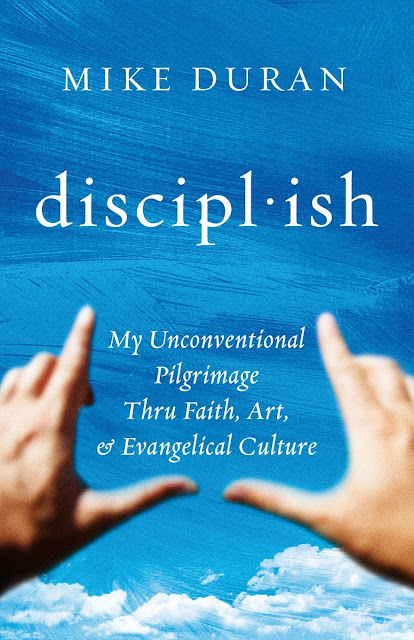
"Discipl-ish" by Mike Duran


Mike Duran took an unconventional path to Christian faith and ministry, but it was “unconventional” only in the sense that it wasn’t the usual coming-to-faith “cartoon” that’s presented as common to all believing Christians, as in, “I was a sinner, and I was saved one night.” 

What Duran’s memoir, Discipl-ish: My Unconventional Pilgrimage thru Faith, Art, & Evangelical Culture, conveys more than anything else is how coming to faith lasts a lifetime. It includes breakthroughs, setbacks, problems, upheavals, victories, discouragement, and growth. Faith is life, and it’s messy and hard and sometimes painful, but it is also unbelievably rewarding.


Duran was raised in the Catholic Church, including attendance in Catholic schools and serving as an altar boy. But he always had a rebellious steak, a streak that took him at a relatively young age into drugs, the occult, and delinquency. What he didn’t know then was that he was on a pilgrimage to Christian faith.


He describes how he first experienced the call to faith; how he discovered gifts he didn’t know he had, like teaching and preaching; the churches he attended, including a heavy metal church; how he became and served as a pastor and how he left the pastoral ministry; and how he rediscovered ministry through working at a painting company, construction work; and becoming a maintenance painter at the local public school district.


Mike Duran

He casts an honest eye on himself and the people who influenced his pilgrimage, for good and for bad. And he comes to recognize that “for good and for bad” is a misleading description of what happens to him and his faith over a lifetime.

 

Duran is a novelist, writer, former pastor, and speaker. His novels and stories occupy an unusual spot in Christian fiction – that of Christian horror and speculative fiction. He’s known for his penetrating insights into Christianity and its critics, both inside and outside the church, and he blogs regularly about issues and events (I’ve included his blog posts more than 50 times over the years on Saturday Good Reads). He’s also an artist, known for his wall crosses and other works. He lives with his family in Southern California. 


Discipl-ish is honest, and often painfully honest. In telling his story, Duran doesn’t spare himself and his own actions. And this is what makes this story real and familiar: we ultimately see the reflection of ourselves and our own faith pilgrimages.


Related:


My review of Mike Duran’s Subterranea


My review of Mike Duran’s Christian Horror: on the Compatibility of a Biblical Worldview and the Horror Genre.


My review of Mike Duran’s The Resurrection.

Thursday, May 21, 2015

Mike Duran’s “Christian Horror”


Christian publishing is uncomfortable with certain fiction genres, what’s generally called “speculative” but includes science fiction, paranormal, and horror. And yet some of the most successful speculative writers, like Stephen King, acknowledge the presence of Biblical imagery throughout many of their works.

For a number of years, Mike Duran, author of a number of Christian horror story collections and novels, has written about Christian publisher’s reluctance to embrace anything in speculative fiction. Publishers know their audiences, however, and is to the audiences that Duran now turns his attention. Christian Horror: On the Compatibility of a Biblical Worldview and the Horror Genre makes a solid case why Christian readers’ attitudes toward the horror genre is misguided and possibly dangerous.

Duran has written an apologetic for the horror genre in Christian fiction, and it’s an impressive piece of work. And he lays claim for horror some of the most famous works in Western literature.

“Many have suggested,” he writes, “that the epic poem Beowulf is one of the earliest horror stories ever written. Possibly the oldest surviving long form in Old English, Beowulf is often cited as one of the most important works of Old English literature. Though the story is in essence a pagan myth, most believe it was originally written down by a Christian monk who incorporated Christian elements into the text.”

He doesn’t stop with Beowulf. He also makes a convincing case for Christian elements being incorporated into Mary Shelley’s Frankenstein, Robert Louis Stevenson’s Dr. Jekyll and Mr. Hyde,  H.G. Wells’ The Invisible Man and especially Bram Stoker’s Dracula, a work in which there is nothing subtle about Christian influence. And then there is the Bible itself, filled with any number of horrific stories.

Mike Duran
Duran examines religious themes in horror and horror themes in religion; how the evangelical culture has in general responded to the horror genre; what he terms “toward an apologetic” for Christian horror; and the main objections Christians voice against horror and similar genres.

I don’t ready much in the horror genre, but I’ve read books by Duran, Mike Dellosso, and T.L. Hines, among others, and I have found the quality of the writing and stories to be at least equivalent to if not considerably better than much of what’s published in mainstream Christian fiction.

And Duran is right: it doesn’t always have to be an Amish romance.

Related:

My reviews of Duran’s Subterranea and The Resurrection.


Photograph by George Hodan via Public Domain Pictures. Used with permission.

Friday, February 27, 2015

Mike Duran’s “Subterranea”


I read the nine stories that comprise Mike Duran’s Subterranea and I stepped into the Twilight Zone. Nine times.

Duran blogs at deCompose, and is a regular contributor to Novel Rocket, a site for fiction writers (of all genres, but mostly Christian). He also regularly challenges the sacred cattle of the Christian writing and publishing world.

He writes what’s called speculative fiction. His writing reminds me of T.L. Hines, who wrote in a genre dubbed “noir bizarre.” (Hines published five remarkable novels between 2007 and 2010 and nothing since then.) Duran isn’t “noir bizarre,” but he’s occasionally noir with a dash of bizarre (or perhaps vice versa).

Nine gripping stories, all dealing with underground themes.

A man is interrogated about what happened during a subway dig, during which several men were killed in an explosion. Without explanation, a man leaves his front porch and is later found floating in a pool. A group of college students set out to Mexico to disprove the existence of a mythological story. A bar scene that seems straight out the intergalactic Cantina in the first Star Wars movie (1977). Six men die because of a woman. A man recovers, or maybe not, from a horrific automobile accident. Demons chase muses to stop the creative impulse. An overweight man has to be removed from an apartment building. A priest projects compatibility of couples seeking to get married, usually ending with the couples deciding to go their separate ways.

Mike Duran
What Duran plumbs here is the “subterranea” of the human mind and heart. He’s using a speculative, almost Twilight Zone approach in much the same way the old Rod Serling television program did. The stories force you, through odd and unexpected circumstances, to consider motives and actions. The people see familiar; their surroundings do not. And it’s that juxtaposition of familiar and strange that provide glimpses into the human soul.

It’s not a pretty sight. But it’s a true one.

That’s what strikes me most about these stories – they read true. Duran knows his subject, and knows it well.

Related:

My review of Mike Duran’s The Resurrection.


Photograph by Marina Shemesh via Public Domain Pictures. Used with permission.

Monday, November 12, 2012

Does It Always Have to Be an Amish Romance?


I recently read Robin Parrish’s novel Offworld, the story of a group of astronauts returning from Mars who discover that the world’s 10 billion people, or almost all of them, have disappeared. The novel was published by Bethany House, a well known and well respected Christian publisher. The author is a Christian. And the novel is, well, the novel is not an Amish romance.

It’s not even overtly Christian. No big gospel message. No struggles with faith. And an incredibly riveting and well-written story.

I didn’t think this was a big deal, until a few weeks later, someone commented on a blog about the novel: “I didn’t like it. Offworld didn’t edify me.”

I have all kinds of problems with that statement, not the least of which was the assumption that the novel’s purpose was to “edify me,” both an arrogance and a self-centeredness that the commenter likely didn’t intend.

A debate rages off and on about what is, and isn’t, “Christian” fiction. Some have offered these qualifications: written by a Christian author; published by a Christian publishing house; absence of cursing, sex, raw violence; some moral lesson; explicit goaspel message; good always wins in the end. Some go much farther than this. Novelist Ted Dekker ripped on the content guidelines of Christian romance publisher Steeple Hill; some pointed out that under those guidelines, even the Bible wouldn’t be published. Dekker eventually apologized, and everyone agreed to “move on,” a euphemism for acknowledging that the parties don’t, and probably won’t, agree. Another way to look at it, though, is to say Mr. Dekker knows his art and Steeple Hill knows its market. Publishing is a business, after all.

Suspense writer Mike Dellosso and writer Mike Duran have both written in the past about “Christian fiction,” to raise questions and invite discussion. Both go beyond the “defining guidelines” kind of controversy, and ask more pointed questions. What is “Christian” fiction? Is there such a thing? Can there be? For those who say that some write from a “Christian worldview,” what does that mean? And the audience question: what is the purpose of “Christian” fiction – to evangelize or build up the church? Who do Christians write for? Who should we write for? If we’re writing only for other Christians, are we keeping ourselves not of this world and out of it?

The discussion, even with the occasional outrage, is healthy. And it’s important. It begins to get at the purpose of writing and fiction, of creation and art. It leads us to this “separate but equal” life and lifestyle we Christians often live in today’s world.

And it can point us in a different direction. Switchfoot singer Jon Foreman, writing in The Huffington Post, called the artist “the bridge between hope and despair” (read the whole article). I think Foreman is right.

I’d add that this bridge, this essential function, happens most effectively when we Christian writers understand we are that bridge.

This article was originally published by The Christian Manifesto, but the site was redesigned and the archive (with all of my posts) disappeared. So I’m occasionally reposting some of the articles I wrote for the publication.

Friday, April 1, 2011

Mike Duran's "The Resurrection"

Armando Amaya has died too soon, too young. Family and friends gather to mourn. One family friend, Ruby Case, is so moved that she touches the dead boy’s hand as she view his body in the casket.

Armando sits up in his coffin.

Ruby’s pastor, the Rev. Ian Clark, has almost reached the point of no return in his crisis of faith. As the minister for Canyon Springs Community Church in Stonetree, California, Clark is walking away from his faith, his resignation letter ready to deliver to the elders – in spite of the occasional visits of Mr. Cellophane.

Mr. Cellophane is a rather frightening apparition showing up in the Clark’s church office about once a week.

Ruby Case and Ian Clark will learn that the resurrection of Armando and the appearance of Mr. Cellophane are not unrelated. Something is happening in Stonetree, something evil.

In The Resurrection, his first novel, Mike Duran assembles the contemporary fascination with the occult, a crisis in faith, an unlikely heroine, a professor too tolerant for his (and others’) own good, secrets buried in the distant past, and a prayer group ready to wage war to produce The Resurrection, a supernatural mystery and thriller that forced me to read it to the end late one night when I should have gone to sleep.

The story is fast-paced, with Duran moving the reader from key event to key event in the narrative, artfully controlling the story line to keep us guessing and wanting more. In the process, he examines the role of academia and seminaries, the current yen to tolerate just about everything and anything, those innocent little occult shops with the funny smells, the hollowing out of the church, and the unseen spiritual realm. He even manages to ease the tension at one point with an errant iguana. And there is that stone tree, the one the town is named for, the scene of an old suicide, or murder.

The Resurrection is a well-written, well-constructed and riveting story, full of flawed human beings who are recognizable because they are flawed. Duran’s people do stupid, foolish and courageous things, and find themselves on the front lines of a war they hadn’t even dreamed of.

Related:

Mike Duran blogs at deCompose.

Saturday, March 13, 2010

Saturday Good Reads

My list of “good reads” today is shorter than last Saturday’s, and they were all posted before Tuesday evening. Then came the almost simultaneous labor for my daughter-in-law and head injury requiring surgery for my son, the father-to-be. Life is slowly returning to normal, or becoming a “new normal.” And I’m already becoming a bore on the subject of my new grandson.

Poetry

Phoenix-Karenee’s poem, “Wordless Vision.”

Maureen Doallas’ beautiful poem "Anne," about Anne Frank.

Laura Boggess’ poem in her Sunday Sermon Notes.

The End of Innocence by Justinian at Discount Verbiage.

Shadow, Jezamama’s walk along a lake, a story and a poem.

Prose

It is Home,” by Marty Duane at Coffee with Marty.

A Gun, for Goodness Sake,” by Jeff Jordan at To My Children, If They Are Listening.

Should the Message be Hidden?” A guest post by author Randy Ingermanson at Brandilyn Collins’ blog.

Engagers of Separatists?” by Mike Duran at deompose

Columbia Journalism Review: “Who Says? Narrative Authority in a Fragmented World.”

Author Travis Thrasher on criticism: “Everybody’s a Critic.”

And finally…

While this isn’t a post about me, I do want to call attention to an article I wrote for the High Calling Blogs, which was published Friday. It’s about a business called Transformational Threads, owned by my friend Maureen Doallas (yes, the poet) that is all about a passion for art.

Sunday, August 16, 2009

Discipleship, Evangelism and “Return Policy”

Mike Duran over at deCompose had a lively discussion going last week about the purpose of Christian fiction. He posed a question – is the purpose discipleship or evangelism or both? -- and then answered it by saying that most of the Christian fiction published today is decidedly aimed at its targeted market – readers who are Christians. (For a non-Christian, “discipleship or evangelism” means writing for Christians to help them broaden or deepen their faith as opposed to writing to people who don’t share the Christian faith.)

I think Mike’s right. Stroll through a Christian bookstore, or the Christian fiction section at Barnes & Noble, and it’s pretty obvious who Christian fiction is published for (not to mention that a non-Christian would not likely be wandering around a Christian bookstore or the Christian fiction shelves at B&N). So Mike asks an additional, more provocative question – who should Christian fiction be aimed at?

It’s easy to end the discussion with “well, both, of course.” But for a Christian writer, the answer isn’t so simple, especially in the culture we live in today. If a lot of people don’t have the foggiest as to whom Noah was, or what a “road to Damascus” experience actually refers to, then you have to write very different kinds of stories than you might have even as recently as 20 or 30 years ago, if you're trying to reach a broader readership.

I had this discussion in mind as I read Michael Snyder’s novel Return Policy (I posted my review at Amazon earlier today). He’s published by a Christian publishing house (although one with a secular corporate parent) but his readers are likely to be Christians and non-Christians alike. The gospel message is there, but it’s not overt. Instead, Snyder achieves something more difficult. He doesn’t “tell” the gospel message; rather, he lets the story play out the gospel message so that the reader sees it.

Here’s my character description from the Amazon review: “Willy is a writer and college teacher, who can't deal with his wife's abandonment from years before and spends time trying to destroy what belonged to her, like the espresso maker, while he desperately misses her. Ozeena, a customer representative at the espresso maker manufacturer, was abandoned years earlier by her husband after he allowed their child to almost drown in the bathtub; she struggles to raise her brain-damaged son and competes for a promotion at work. And Shaq, a homeless man with large gaps in his memory (large as in almost total), is searching for his wife Patrice and searching for what is missing from his mind while almost fearing he's going to find it.”

Through the lives of these three characters, and a few of the minor ones, the reader experiences the healing of brokenness, faith, hope and love. Each character is struggling with the realities of life. Each reaches a decision point where it’s either take a leap of faith or accept being permanently broken. Each receives and gives grace. The novel isn’t the stereotyped sermon at a tent revival; it is the telling of the stories of people’s lives where we can see what faith actually means.

There were elements of “Return Policy” that reminded me of the oddball humor of John Kennedy Toole’s A Confederacy of Dunces and the stories of Flannery O’Connor. But Michael Snyder is an original, with an original voice and a decidedly original perspective. Return Policy does what good fiction, Christian or otherwise, should always do – broaden and deepen our understanding while forcing us to confront an old truth in a new way.

Monday, August 10, 2009

Findings on Today's Web

Mike Duran over at deCompose has a good post today about the aim of Christian fiction. Is it discipleship, evangelism or both? His argument, and I think a good one, is that it's supposed to be both but skews heavily towards discipleship, i.e., the Christian market. Interesting discussion.

L.L. Barkat, who has three blogs and posts on several others, has a short, sweet post today at Seedlings in Stone called "Nothing in Return" and one at Love Notes to Yahweh about coming into wild roses. (OK, so I'm a fan. I like her writing and her art, and her children are no pikers in the art department either.) (I have a real rube's definition of art -- if I can draw it or paint it, it's not art. I can't do what L.L. does. And I can't do what her children do, either.) And in only the way that the internet can, I tweeted a reply to an question from Intervarsity Press about a favorite IVP book (Stone Crossings), L.L. retweeted it, IVP retweeted my blog post about it, and my blog got a rush of visitors. Crazy but fun.

I'm still reading Michael Snyder's Return Policy. I'm deliberately reading it slowly, catching the rhythm and the pace. I don't think I've read anything quite like it before. It reminds me, in a way, of John Kennedy Toole's A Confederacy of Dunces, but Snyder has his own distinct voice.

I spent part of the weekend working on two articles about blogging about layoffs. The editor who commissioned them saw my posts here and asked if I could write one or two articles about them. (He was editorially nonchalant, and I was editorially gaga, at the request.) We'll see how the editing and rewriting process goes.