Showing posts with label Vikings. Show all posts

Monday, July 13, 2026

The Viking Christians: The Day Valhalla Died


Six years ago, I published the last novel in the Dancing Priest series, Dancing Prince. A good deal of it is set on a fictitious island named Broughby in the Orkneys, off the northern coast of Scotland. One of the characters, Erica Larsson, becomes the romantic interest of Thomas Kent-Hughes, the reclusive son of King Michael who has gone his own way and avoided the royal limelight. 

Thomas, or Tommy, leads an archaeological team that discovers what looks like a Viking tomb, except that it is carved with a cross, a very Christian cross. And Erica writes a story, of novella length, entitled “Island,” which imagines how such an anomaly could have happened. Vikings destroyed churches and abbeys; they didn’t get buried as Christians. Or did they?


I read a lot about the Vikings as research for Dancing Prince. If I’d included everything I learned, it would have made another book. But I did write the story that Erica would tell, and the publisher agreed to include it as an addendum with the novel. And I explained the story and how it came to be in a post entitled “The Story of the Novella ‘Island’”. Dancing Price, like it four predecessors, is classified as “alternative contemporary history.” Island is historical fiction, and it was the first time I attempted anything in the genre.


As it turns out, considerable information exists about the Viking Christians, or how the Vikings turned to Christianity. This past weekend, I stumbled across this short video, which describes what happened rather succinctly. It’s a fascinating story.


Top illustration: “Ansgar Preaches the Christian Doctrine in Sweden” by Hugo Hamilton (1830).


Some Monday Readings


Best Way to See the Renaissance? Get the Panoramic View – Joel Miller at Miller’s Book Review.


The Quiet Theology of “All Creatures Great and Small” – Beth Ferguson at GC Discipleship.


Rare Miscalculation: The Gamble That Backfired on Conservatives (aka, how we got the income tax) – Jason Clark at This Is the Day.

Tuesday, September 12, 2023

“The Battle of Maldon” by J.R.R Tolkien, Edited by Peter Grybauskas


In 991, Vikings attacked Anglo-Saxons in eastern Essex, not far from the current city of Chelmsford northeast of London. A large stream connected by a bridge separated the two forces. The Anglo-Saxons could have likely held off the Vikings for a considerable period. But the Vikings asked permission to cross the bridge to fight, and it was granted by the Anglo-Saxon leader Beorhtnoth. It’s not known why, except perhaps that Beorhtnoth thought he might find glory in battle. 

And that he did, except it wasn’t what he expected. The hand-to-hand combat was vicious and intense. When the Battle of Maldon ended, Beorhtnoth was dead, along with several members of his family, and the Vikings were victorious.


What detail we have of the battle is contained in the fragment of an epic poem probably written shortly after the battle. It’s one of the oldest British historical manuscripts, older than even Beowulf. And J.R.R. Tolkien spent considerable time, particularly in the earlier part of his academic career, studying and translating the poem and researching the period.  He also wrote a verse play himself, a fictional attempt to file in some of the missing texts.


To continue reading, please see my post today at Tweetspeak Poetry.


Some Tuesday Readings


Blackberry Memories – poem by Janice Canerdy at Society of Classical Poets.


A Hobbit’s Journey Home: Dreaming of the Shire – Joseph Pearce at The Imaginative Conservative. 


A list of things lost – poem by Kathleen at The Course of Our Seasons.

Monday, December 13, 2021

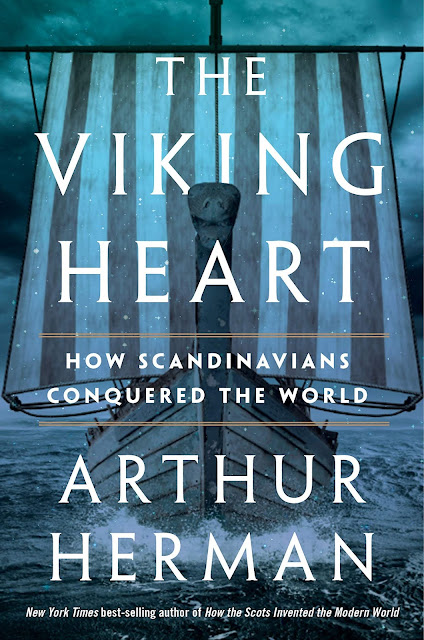
"The Viking Heart" by Arthur Herman


They pillaged and plundered Britain. They threatened Constantinople. They father the Germanic tribes that threatened and eventually sacked Rome. They showed up on the steppes of Russia. They became the Normans who landed in England in 1066. They founded Iceland and established settlements in Greenland. And they landed in North America 400 years before Columbus. 

“They” are the people who came to be known as the Vikings, the people who lived in what is now Denmark, Sweden, and Norway. And they transformed the world.


In his highly readable The Viking Heart: How Scandinavians Conquered the World, historian Arthur Herman tells their story. And what an enthralling, thrilling story it is.


It’s an eye-opening account. We’re familiar with the story of the Viking attacks on Britain and Ireland, and how they founded settlements there. Less well known their connection to the Germanic tribes that confronted (and often defeated) Roman armies. The Vikings were called the Rus and gave that name to Russia. They sacked the suburbs of Constantinople. 


Arthur Herman

And their influence didn’t stop with the end of their marauding ways. Herman describes the role of the Swedes in the European land wars of the 1600s, and the peaceful “invasion” of the United States via immigration in the 19th and early 20th centuries.


And throughout his well-written account, he asks and answers the question: what was it that propelled these people to wander, fight, sack, plunder, dominate, control, and influence so many countries, empires, and regions? And he gives a solid account of how they often fought each other.


Herman is a popular historian who’s published Freedom’s ForgeHow the Scots Invented the Modern WorldThe Idea of Decline in Western HistoryTo Rule the Waves, and Gandhi & Churchill. He/s taught at the Western Heritage Program at the Smithsonian’s Campus on the Mall, and he’s been a professor of history at Georgetown University, The Catholic University of America, George Mason University, and The University of the South at Sewanee. Gandhi & Churchill was a finalist for the Pulitzer Prize.


The Viking Heart is a fascinating account of a people who have played a major role in European, Asian, and North American history.

Tuesday, September 29, 2020

Dancing Prince: Anticipating a DNA Study of Vikings?


Some strange things have occasionally happened with the Dancing Priest stories. Strange, as in they anticipated some real news events. Each of the novels has an example of this, to the point where it spooked my wife and even my publisher.

And now comes Dancing Prince, published in July of this year. 

In mid-September, scientists in Denmark and Armenia published a study in Nature that reported on the largest DNA study of Vikings ever done. The Vikings, as it turns out, were a far mar diverse lot that anyone had previously known. Yes, a preponderance of the DNA was associated with the Nordic countries like Sweden and Denmark, but the researchers also found that the Vikings were not a homogenous group. The DNA included connections to southern Europe and Asia.

To continue reading, please see my post today at Dancing Priest

Photograph by Steinar Engeland via Unsplash. Used with permission.

Monday, July 8, 2019

“To Be a Queen” by Annie Whitehead


Any writer of historical fiction will emphasize the importance of research – a lot of research. Once the research is done, assuming it’s ever really “done,” the temptation becomes trying to pack too much of the research into the story. Even in historical fiction, the story is paramount.
In To Be a Queen, the historical account of Aethelflaed or the “Lady of the Mercians,” author Annie Whitehead gets the balance of research and story exactly right. And what a story she tells!

Aethelflaed (ca. 870 to 918A.D.) was the daughter of Alfred the Great, King of the English based in Wessex. The most significant fact of this entire period was the repeated invasions by and battles with the Vikings. The Viking threat framed Aethelflaed’s life, as it did the lives of her father, her brother Edward, her husband Aethelred, and the entire people of the British Isles.

Aethelred, lord of the Mercians, becomes allied with Alfred to fight the Vikings. They’re successful, and to cement the alliance between Wessex and Mercia, Alfred gives his daughter Aethelflaed in marriage to Aethelred. Whitehead creates a love interest for Aethelflaed, one closer to her age, but the young girl knows what her royal duty is. Her considerably older husband is aware of her love for another man, but wisely bides his time. 

In the story, Aethelflaed eventually comes to love her husband deeply and earns the respect of the Mercian people, to the degree that they accept her as their ruler when Aethelred is struck down by illness and later dies. She holds the distinction of being the only woman ever to ruled an Anglo-Saxon kingdom.

The heart of the story is in its details – the accounts of day-to-day activities (royal women worked, often just like non-royal women), the love stories Whitehead builds, Aethelflaed’s many miscarriages, and the personalities of the characters themselves, including the heroines, heroes, and villains. What makes this historical novel even more interesting is that what is known of the Mercians is what was written down by their enemies and allies; no first-hand, Mercian accounts of their rulers and history exist. 

Annie Whitehead
Whitehead, a member of the Royal Historical Society and the Historical Writers Association. She has published three novels set in Mercia: To Be a Queen (2013); Alvar the Kingmaker (2016); and Cometh the Hour (2017). She has also published the non-fiction work Mercia: The Rise and Fall of a Kingdom (2018). Her books have won a number of prizes and recognitions, and she is a frequent contributor to anthologies on English history and a lecturer. She blogs at Casting Light upon the Shadow and Time Traveler.

To Be a Queen is a rousing story, well researched and expertly told, of a woman who served and ruled in a perilous time. 

Related:


Top illustration: a 13th century representation of Aethelflaed, found in The Cartulary and Customs of Abingdom Abbey (1220 A.D.)

Monday, August 13, 2018

"Dragon Lords" by Eleanor Parker


If there is a general understanding of who the Vikings were and what they did, it would be something like this: that warriors sailed westward from Scandinavia, finding place like Lindisfarne Abbey and towns and cities in the British Isles. That they warred, plundered, pillaged, raped and destroyed their way across England, Scotland, and Ireland. And then they – did what?

There’s some truth to that picture, but the reality is far more complex. The British Isles experienced repeated waves of Viking invasions and attempted invasions, as did many other parts of Europe. And while the Vikings brought considerable destruction, they also brought the instincts and plans of settlers. In 1016, a new wave arrived, in the forms of the Danes. Fifty years later, descendants of the Norseman who settled in Northern France and became Normans invaded Britain – a story of Viking descendants fighting Viking Descendants, and not only the descendants of the Angles and the Saxons. 

In Dragon Lords: The History and Legends of Viking EnglandEleanor Parker takes a look at the Vikings, why they came, and what they did, and fins a far richer story than the received wisdom. Analyzing the myths, legends, and poetry of the period, she finds a complex and fascinating story. 

Some came for plunder, yes. But others came to settle down and raise families and even raise up new dynasties. Some came to avenge deaths. They came for land and territory and to create kingdoms. 

Parker examines a diverse array of legends, stories, and myths. She considers the stories and histories (many with an ax to grind against the Viking invaders) of warriors, kings, and even saints (yes, Vikings converted to Christianity, with some joining the clergy and a few becoming beatified). She looks at the numerous stories (often widely differing) about Ragnar Lothbrok and his sons, Siward of Northumbria, Havelok the Dane, and other figures historical and legendary.

Eleanor Parker
Parker is a lecturer in medieval English literature at Brasenose College. Oxford. She received her B.A., M. Philosophy, and D. Philosophy degrees from Oxford. She teaches Old and Middle English literature, English language, and Old Norse literature. Her research focus is the literature in England between 1000 and 1400 A.D., with a special interest in the Danes who came to Britain. She publishes a highly regarded blog, A Clerk of Oxford, and writes a regular column for History Today.

In Dragon Lords, she tells an interesting and compelling story. Parker reminds us that literature and history can be closely related, and that literature can be used to understand historical events and eras. 

(Note: The American edition of Dragon Lordsis not available until Sept. 30. Before then, it can be ordered, with free shipping worldwide, from Book Depository in the U.K.) 

Top photograph: an illustration of a Viking longship.

Sunday, June 2, 2013

The Viking Raid


Under a cloudless sky she sat
staring out at the sea shimmering
silver in the morning sun,
searching for the promised glimpse
of a sail upon the horizon, a glimpse
unlike the first, when sails appeared
and surrounded them, their tiny isle,
and bearded men in horned helmets
rained terror and destruction, except
for the blond man with a young beard
who claimed her with hands gentle
in their  pillaging roughness.
And now, the sleeping child next to her,
she stares out at the sea shimmering
and feels the terror of not seeing
a sail upon the horizon.