Showing posts with label discipline. Show all posts

Friday, June 21, 2024

Discipline has a purpose


After Hebrews 12:1-17
 

We are children, learning;

we are children inevitably

wayward, choosing the wrong,

ignoring the right. Because

we are loved, we are

disciplined.


It is sons who are disciplined,

sons and daughters, heirs,

disciplined to be trained

to endure the race,

the discipline running

with us in the race, keeping

in our lanes, propelling

us forward, training

us all the way, training

us because he loves

us.


Photograph by Candra Winata via Unsplash. Used with permission.


Some Friday Readings


Entropy of the Modern Mind – Greg Doles at Chasing Light.


From The Finding of the True Cross – hymn by Yared at Kingdom Poets (D.S. Martin). 


Fisher of Men – poem by Chris Slaten at Rabbit Room Poetry.


The Uselessness of Prayer – Trevin Wax at The Gospel Coalition.


Sacred Heart – artwork by Jack Baumgartner at The School for the Transfer of Energy. 


A Taste of Honey, Poetry & Love: An Interview with Laura Boggess - T.S. Poetry.

Wednesday, August 17, 2016

I didn’t do it my way


Search for the topic of “self-discipline” in books at Amazon, and you will discover more than 100 pages of results. Self-discipline is a subset – a rather large subset – of the general book genre of self-help. For the physical bookstores still left, self-help also was and remains one of the largest selections.

Consider that many business and leadership books are essentially self-help and self-discipline books. Throw in “time management” and you could probably open your own bookstore devoted to these related topics alone.

Self-help and self-discipline are significant topics of interest to our culture.

If we look at the search results on Amazon for Christian self-help and self-discipline, we find another hundred pages of listings. Some of these are undoubtedly meant to encourage and inform, but I have to say the titles suggest there’s little difference between Christian books and secular books on self-help.

And yet it’s right in this area of discipline that we find Christian teaching is countercultural.

What we know, what we have been taught, what we have heard in the pulpit and Sunday School classes and seminars and retreats is this: Faith is not a question of self-discipline, because there are a lot of things the “self” just can’t do.

In fact, the self is the problem. Disciplining the problem is treating the symptoms, not the illness. Some self-discipline is involved, but the story of our journey in faith is not “I did it my way.”

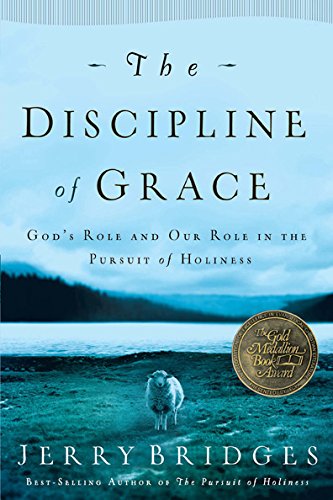
“Discipline is not necessarily a reliance on human effort, or as it is called, ‘a work of the flesh,’” says Jerry Bridges in The Discipline of Grace: God’s Role and Our Role in the Pursuit of Holiness. What he says next is profound.

“We are enabled to do the work.”

It is one of the great mysteries of the Christian faith – how exactly does the Holy Spirit operate. We know Jesus promised a “helper” or a gift (Acts 1:4-5), a gift he called the Holy Spirit. And he told the disciples to wait for the gift.

They didn’t have to wait long – about 50 days (the length of time between the resurrection and Pentecost). But it must have at times seemed like an eternity. In the interim, they chose a disciple to replace Judas, they met together, and they likely shared meals, prayed, encouraged, and taught each other.

But they waited. And when the promised help arrived, there was no mistaking what was going on – a sound like a violent wind; tongues of flame appearing over their heads; suddenly speaking in languages they didn’t know but others in Jerusalem could hear and understand; and a boldness in speaking out to the crowds.

The signs of enablement don’t have to be a loud noise and tongues of fire. But the critical fact is this:

We are enabled to do the work.


Led by Jason Stasyszen and Sarah Salter, we’ve been reading The Discipline of Grace by Jerry Bridges. To see what others had to say on this chapter, “Dependent Discipline,” please visit Sarah at LivingBetween the Lines.


Photograph by Peter Griffin via Public Domain Pictures. Used with permission.

Wednesday, August 10, 2016

Something less than cruise control


In The Discipline of Grace: God’s Role and Our Role in the Pursuit of Holiness, author Jerry Bridges compares two types of spiritual obedience – cruise-control obedience and racing-car obedience.

“…We press the accelerator pedal of obedience until we have brought our behavior up to a certain level or ‘speed.’ The level of obedience is most often determined by the behavior standard of the Christians around us. …We want to just comfortably blend in with the level of obedience of those around us.” And then we hit cruise control.

I know what it’s like to be on cruise control.

Been there, done that.

And often it’s less than cruise control. Call it “cruising just enough to get by. Barely.”

I know what happened, when it happened, and why it happened. You serve in a church for 15 years – children’s ministry, adult Sunday School, small church, prayer commission, occasional teaching on Sunday night, greetings ministry, short term missions trip. And then you watch the ground shift from underneath you, as a handful of congregational and staff leaders decide they want the church to become the next Willowcreek.

It didn’t work. It nearly destroyed the church. We left for another church home, and I dragged the decision out because I kept hoping something would change. It didn’t. We stayed too long.

A new church, with all the difficulties of finding new ministries to plug into, new people to meet, new Sunday School class. It wasn’t easy, but we kept at it and had begun to establish new friends, new networks, new ways to serve. I even became a deacon.

And then – déjà vu all over again. The change for “growth and relevance.” Our Sunday School class was eliminated, and the one we switched to was eliminated. New programs implemented. Big media emphasis. I raised a voice and was reprimanded.

I didn’t have it in me to fight again. All the change eventually ended the same way as before – upheaval, staff changes, people leaving. We stayed put. I didn’t have the energy to change churches yet again. But something else happened. We stayed put, but I withdrew.

My focus turned away from the local church toward a para-church ministry. I got serious about writing, and published two novels and a non-fiction book. We still attend church regularly. The upheaval has calmed down. The teaching is good. Support for missions is strong.

But I stayed on cruise control. Or something less.

It’s not a good place to be.

Of course, no one ever said that faith was easy.


Led by Jason Stasyszen and Sarah Salter, we’ve been reading The Discipline of Grace by Jerry Bridges. To see what others had to say on this chapter, “Obeying the Great Commandment,” please visit Jason at Connectingto Impact.


Photograph by George Hodan via Public Domain Pictures. Used with permission.

Wednesday, July 27, 2016

The discipline became a joy


When I became a Christian during my last semester at college, the state of my Biblical understanding left a great deal to be desired. I had attended two years of catechism when I was 12 and 13; the Lutheran Church required it and even if it hadn’t my mother would have. So every Tuesday and Thursday during the school year I was at our church with the other students, studying Lutheran teachings and general Christian doctrine from 4 to 5 p.m.

I have to say it was not a self-imposed discipline. I can remember days of hoping the taxi wouldn’t show up in time, an extremely rare occurrence.

When I became a Christian in 1973, and fully understood what that meant, things changed. Up to that time I understood myself as a cultural Christian; after that I was a Christian by belief, and trying desperately to understand what that meant and entailed.

For two to three years afterward, I drifted. Our working hours at the newspaper in Texas generally precluded church attendance. Once we were in Houston, we joined a large Methodist church. On the surface it was healthy. Below the surface it was beginning to be wracked by theological change. We eventually left, and found a smaller non-denominational church.

We got involved in a Young Couples class, we made friends, we found an older couple who was related to one of my college roommates. But my Biblical understanding was still lacking. I knew some the basic stories from children’s Sunday School. But I did not understand the context, the details, the meanings, how the Bible fit together, and how it shaped my faith.

Then our church announced a new program. One of the pastors, who happened to be a Ph.D., would be teaching a series of religious college extension courses. Over time, other teachers were brought it as well. The program was appealing to people interested in missions, since many missionary organizations required a certain number of college courses. I hadn’t thought about being a missionary, but I signed up because the courses offered to help fill some deep holes in my understanding.

I’d take a course a semester, and we’d meet on Wednesday nights for 60 to 90 minutes. The first course was Old Testament Survey, and I found it to be a wonder. The lectures, the readings, the discussion, and the questions from some 30 of us in the course were like rain on parched ground for me. The course required a project; mine was a genealogy of the Old Testament high priests, and fitting them within both the Biblical accounts and the historical accounts. (I’ve kept this paper, and it’s still useful 40 years later.)

That course was followed by New Testament Survey and Bible Study Methods. Both were just as good as the first one. Our textbook for New Testament Survey was a harmony of the gospels – the accounts laid side by side so you could see similarities, differences, possible conflicts, and other issues. And I remember the final exam for Bible Study Methods – an explication of the shortest verse in the Bible (“Jesus wept.”)

The courses required discipline, but the discipline was a joy. Those courses helped ground me in my faith. 

“We tend to equate discipline with rules and performance standards,” says Jerry Bridges in The Discipline of Grace: God’s Role and Our Role in the Pursuit of Holiness.  “God equates it with firm but loving care for our souls.”

And those courses, and those teachers, cared for my soul.


Led by Jason Stasyszen and Sarah Salter, we’re discussing The Discipline of Grace. To see other posts on this chapter, “The Discipline of Grace,” please visit Jason at Connecting to Impact.


Photograph by Linnaea Mallette via Public Domain Pictures. Used with permission.