Thursday, October 7, 2021

"With or Without Me" by Esther Maria Magnis


When she was 15, Esther Maria Magnis learned that her father had terminal cancer. He was given anywhere from three weeks to three months to live. 

Magnis was the middle child of the family, with an older sister, Steffi, and a younger brother, Johannes. The three of them spent the next two years (their father lived longer than the doctors’ prognosis) trying to be supportive, dealing with their own pain, supporting their mother, and often taking care of themselves as their parents tried everything to find a cure, including traveling to doctors and clinics both in Europe (the family lived in Germany) and the United States. 


But With or Without Me: A Memoir of Losing and Finding, translated by Alta Price, is not so much a cancer journey as it is a story of a faith journey. Magnis had had faith as a child, lost it as a young tee, and then struggled, and struggled mightily, once the family knew her father’s diagnosis. 


This is a journey that is often raw, angry, hopeful, searing, sacred, and profane – and often all at the same time. Magnis would come to cling to God even as she screamed at him, doubted his existence, and raved and ranted at him. It’s not an easy story to read, but then it was almost an impossible story to live. 


Esther Maria Magnis

Several years after her father’s death, her beloved brother Johannes was diagnosed with melanoma. Things looked promising after a surgery on his face; they doctors had gotten it all. But there was more to come, and she would eventually lose him as well.


Most of us can’t even imagine a journey like this, the pain of losing both a father and a brother to a harsh disease that seems to offer no pity or respite. She experiences when it didn’t even seem like she was enduring. “If God is love,” she writes, “it’s a kind of love I do not understand.”


Magnis, born in 1980, studied comparative religion in Germany and Italy and has worked as a journalist. She now lives and works in Germany. 


With or Without Me is intensely personal. It will tear at your heart, mind, and soul. It will bring you to tears. And it will astonish you with its honesty and depth.

Wednesday, October 6, 2021

"The Promotion" by Laura Domino


Benita Finn is ambitious. She’s climbing the corporate ladder, and she plans every move like a military campaign. She’s all work and all business. Now she has an opportunity to run the company’s office in Spain, but her boss has made it clear she’s competing with a colleague, Robert. And he speaks fluent Spanish. 

Adam is mourning the death of his brother, who died some months before. He’s stopped going to church, and he’s handling his grief by drinking himself almost into a stupor nearly every day. His father died in a drowning accident when he was six, and his father’s best friend Dan served as something of a father figure to the two boys growing up. And now Dan is in the hospital, dying from cancer – more reason to number the pain.


Adam first seems Benita at a drugstore and then at a coffee shop. He’s smitten. He cleans himself up, meets Benita, and finds out she needs to learn Spanish. And Adam reads and speaks the language. She hires him to be her tutor, but they both soon find themselves becoming interested in more than Spanish. But neither is willing to let the other know what’s going on.


Laura Domino

The Promotion
 by Laura Domino tells the story of Benita and Adam. It’s the first in the Fulton Ridge series, all connected to or centered on the First Church of Fulton Ridge. The novel is something of a challenge – neither of the main characters evoke much sympathy at the start of the story. Adam seems like he’s deliberately spiraling downward, and Benita seems so driven that she’s almost cold. Adam pulls himself up first and becomes likable and engaging. It takes longer with Benita, but she does manage to get there as well. And they’re both going to have to navigate some serious curves in their lives outside of their developing relationship.


Domino has written a number of novels in the Christian fiction genre, including a romantic suspense series, children’s books, the non-fiction Anyone Can Be a Superhero series, and several other non-fiction works. 


The character of Adam does most of the heaving lifting in The Promotion. Benita remains so focused on her work for a company that promotes internal competition (you’ll find little about a team-based culture here) that it’s almost a surprise when she starts doing things outside the job. (And even then, doing volunteer work seems almost a calculated move to help her situation at work.) It’s an engaging story, with a number of interesting twists and turns.

Tuesday, October 5, 2021

Poets and Poems: Sr. Sharon Hunter and “To Shatter Glass”


Sr. Sharon Hunter is making sense of her life, and she’s using poetry to do it.  

The 56 poems of her new collection, To Shatter Glass, are a journey into childhood and memory, the grief and pain of a broken marriage, and a coming to terms with one’s life and the people who have shaped it. This is the poetry of an interior pilgrimage, as real and palpable as any physical pilgrimage to a revered place. On this journey, Hunter is reaching for understanding and forgiveness, both for the people she knew and for herself. 


The poems are not easy to read; they were likely far more difficult to write. Hunter moves back and forth between memories of being raised by alcoholic parents, a marriage in which she often felt her husband’s abuse was justified, and the gradual steps toward resolution. These poems raise important questions about human brokenness, like whether we can ever be made whole in this life. 


To continue reading, please see my post today at Tweetspeak Poetry. 

Monday, October 4, 2021

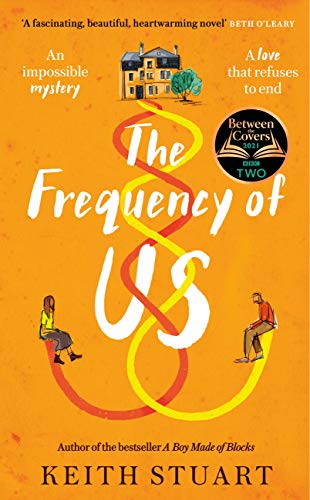
"The Frequency of Us" by Keith Stuart


Laura James has returned to Bath from London, and she’s living with her mother. Laura suffers from a variety of afflictions – anxiety, insecurity, and panic attacks are a few of them. Much of her life has been defined by her father, a man who would simultaneously give her what a child needs from a father and then belittle her and remind her of how worthless she was. Years before, her father had abandoned Laura and her mother, but he still shapes his daughter’s life. 

She begins a job as a carer, working for a social agency and assigned to check on elderly residents. She’s given the case of 87-year-old Will Emerson, who is something of a recluse living in Avon Lodge, the home of his family for 150 years. His neighbors think he’s eccentric; property developers would love to have his home, tear it down, and build something new and expensive. 


At first, Will wants nothing to do with his new carer. But he sees something in Laura that she at first doesn’t see herself. Before too long, however, she realizes that she has a purpose in being there, knowing Will, and learning his story. It’s important that she do for both Will and herself. And it’s something of a challenge: Will insists that he had a wife that no one else had ever heard of, that no record exists of, and who seems a figment of the old man’s imagination. He’s even filled journals of their life from the time he says they met, in 1938, to the time something happened, in 1942.


Keith Stuart

And the “something” was a German bombing raid on Bath in 1942. He tells Laure that he was showing a neighborhood boy all the wireless sets he had in his work shed (Will was a radio technician) when the raid occurred. The neighborhood was bombed; he doesn’t know what happened to the boy. All he remembers was seeing his beloved Elsa framed in the light of the kitchen door. He woke up in the hospital, and discovered that no one, including his neighbors, had ever heard of or seen Elsa.


The story of Will and Laura is told by British writer Keith Stuart is his new novel The Frequency of Us. And what a story it is! Like his previous novels (A Boy Made of Blocks remains a personal favorite), it is filled with unexpected twists and turns. You think you know what’s happening, until suddenly you’re wrong. And then you’re wrong again. And again. It’s a riveting book to read, and it’s Stuart’s skill in characterization that you come to care greatly about what happens to Will and to Laura. 


Stuart is the games editor for The Guardian newspaper, and has written extensively on video games, digital culture, and film. His second book, Days of Wonder, was published in 2018. He and his family live in Somerset, England. In his newest novel, he takes the reader on a trip to the early days of wireless communication and the role it played in World War II. 


The Frequency of Us is a wonderful story of healing brokenness, solving a personal mystery (and actually more than one personal mystery), and of two people reaching across decades to find what really matters in their lives.


Related:


A Boy Made of Blocks by Keith Stuart.

Sunday, October 3, 2021

Pilgrimage III


After Isaiah 9:6 and Psalm 121

The journey goes on,

often interminably,

as we toil upward

to the hills.

And as we walk

this road together,

we sing the sing

that’s always new.  


My help is from the Lord,

he who does not sleep,

he who holds us in his hand,

he who prevents our slips and falls,

he who protects against 

the dangers of night,

the dangers of day,

he who shields us from evil,

he who protects our lives,

and he did it then,

he does it now, and

he does it forever.


Photograph by Iva Rajović via Unsplash. Used with permission.

Saturday, October 2, 2021

Saturday Good Reads - Oct. 2, 2021


Last month marked the 700th anniversary of the death of Dante, and there have been all kinds of reading groups, programs, articles, and poems written in homage. Poet Paul Mariani blends Dante with a remembrance of an important teacher and talks at Church Life Journal about the art of translating the great poet. 

Joseph Pearce at The Imaginative Conservative was reading The Lord of the Rings, and discovered something most readers do not: he identified with Gollum.


What do you do when the news is so depressing, and you feel like you’re carrying the weight of the world on your shoulders? Isabel Chenot at Story Warren found herself often sobbing on her couch, until she realized there was something she could do – carry a candle.


More Good Reads


American Stuff


The Baleful Comet of Boston: Samuel Adams & the Puritan Republic – M.E. Bradford at The Imaginative Conservative. 


The Four-Legged Veteran of 58 Battles – Emerging Civil War.


Americans with a Shared Future Meet at the Stamp Act Congress – Tom Hand at Americana Corner.


In nine images: A visit to historic St. John's Episcopal Church – John Banks’ Civil War Blog.


Faith


The Intimacy of Language – Greg Doles at Chasing Light.


I Searched for the Key to Discipleship – Melissa Edgington at Your Mom Has a Blog.


The Tale of the Pig and the Sheep – Tim Challies.


Love the Real, Not the Ideal – Al Gooderham.


Art


An Afghan artist's life under the Taliban: burning art, deleting social media accounts and living in hiding – Sarvy Geranpayeh at The Art Newspaper.


Life and Culture


What Comes After the Failure of Technocracy? – Stephen Okey at Church Life Journal.


Canary in the cultural coal mine: Lionel Shriver on cancel culture – Robin Ashenden at The Critic Magazine. 


Poetry


‘My Lips Have Kissed Her’ and 'When Sorrow Comes' – David Irby at Society of Classical Poets.


The True Love – David Whyte via Maria Popova at Brain Pickings.


Writing


How to Add a Layer of Fear to Your Fiction – DiAnn Mills at CrimeReads.


How to Write Cinematically – Roy Peter Clark at Literary Hub.


Shadows in the Sky – Mike Oblinski 


Painting: Young Woman in White Reading (cicra 1873), oil on canvas by Pierre-Auguste Renoir (1841-1919).

Friday, October 1, 2021

Pilgrimage II


After Isaiah 9:6 and Psalm 121

A pilgrim’s question:

on my journey up

to the hills, my journey on

this dusty road with its twists

and turns, potholes,

roadblocks, obstructions,

eroding roadbed, cracks

and gaps,

I ask, I am asked,

by myself, 

by my fellow travelers,

what is the source,

the fount, the origin 

of my help? What is 

its birth, its start,

its creation?

My first response,

to myself,

to my fellow travelers,

is to look to the hills,

the hills where

the answer resides,

where the answer

always resides.


Photograph by Raimond Klavins via Unsplash. Used with permission.