Showing posts with label coming of age. Show all posts

Wednesday, February 14, 2024

"Across Five Aprils" by Irene Hunt


In 1964, author Irene Hunt (1907-2001) published the middle-grade novel Across Five Aprils. It’s the coming-of-age story of nine-year-old Jethro Creighton, the youngest of five brothers and a sister. They live and work with their parents Matt and Emma on a farm in southern Illinois. 

This coming-of-age story is set during the Civil War, beginning in 1861. It’s so well done, and such a good story, that it’s no wonder that it was runner-up to the Newberry Medal in 1965 (her second book, Up the Road Slowly, won the medal in 1966). In 212 pages, Hunt manages to tell both the story of the Creighton family and the story of the Civil War itself. 

To continue reading, please see my post today at Dancing Priest.

Some Wednesday Readings


Civil War Institutes and Conferences – Terry Rensel at Emerging Civil War. 

Who Won the Battle of Cold Harbor? – Owen Rust at The Collector.


"Your love will carry me safely through": War, Hope, and Reasons to Live - Sarah Kay Bierle at Emerging Civil War.


The Hidden Sorrow of Valentine's Day - David Bannon at Front Porch Republic.


On the Origin of Humanity's Superpower - Seth Lewis.


'February 14, 2024': An Ash Wednesday Valentine's Poem - Cynthia Erlandson at Society of Classical Poets.

Thursday, October 28, 2021

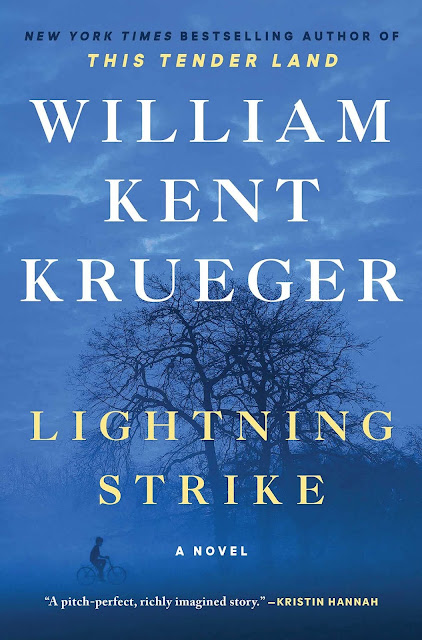
"Lightning Strike" by William Kent Krueger


William Kent Krueger is known for his wonderful coming of novels, stories like This Tender Land and Ordinary Grace. He’s also known for a considerable number of mystery stories featuring sheriff Cork O’Connor, Irish American on his father’s side and half Irish American and half Ojibwe Native American on his mother’s side.  

In his most recent novel, Lightning Strike, Kruger brings the coming-of-age story together with an O’Connor story, except the sheriff here is Liam O’Connor, Cork’s father. And the coming-of-age story is about 12-year-old Cork.


During a planned hike aimed at a Boy Scout merit badge, Cork and his best friend Jorge find a gruesome sight. In a well-known part of the Aurora, Minnesota, region where they live, a family friend and Ojibwe, Big John Manyworks, is hanging from a tree, an apparent suicide. Despite his troubled past, Big John didn’t seem the type to kill himself, but the evidence looks conclusive. Cork, however, is not convinced, and twice he sees a giant, menacing shadow that he believes is the spirit of Big John. 

 

William Kent Krueger

Cork’s father Liam undertakes an investigation. It still looks like suicide, but there are too many questions going unanswered. Gradually, Liam, with more than a little help from his son, discovers what wasn’t suicide at all but murder. And suspects abound: Big John’s half-brother Oscar; the richest man in town who owns the iron mine; and others. Cork takes counsel with an Ojibwe elder, who tells him to follow the crumbs. And it will lead Cork and friends right into deadly danger.


Krueger’s Cork O’Connor novels are all set in the North Woods of Minnesota. He’s also published three standalone novels: Ordinary GraceThe Devil’s Bed, and This Tender Land. He’s received a number of awards and recognitions, including the Minnesota Book Award, the Loft-McKnight Fiction Award, the Anthony Award, the Barry Award, the Dilys Award, the Friends of American Writers Prize, and the Edgar Award from the Mystery Writers of America. His last nine novels were all New York Times bestsellers. Krueger lives in St. Paul, Minnesota.


Lightning Strike deftly combines the conflict between white and Ojibwe cultures, the suspicions and mistrust of reservation people (including Liam’s own mother-in-law), a mystery of a staged suicide and a missing teenager, and the times of the early 1960s to create an intriguing, engrossing story. 


Related:


This Tender Land by William Kent Krueger.


Ordinary Grace by William Kent Krueger.


Tamarack County by William Kent Krueger.

Monday, March 30, 2020

“Beautiful Sky Beautiful Sky” by Stephen Parolini


David Tinker is something of a mess. Seventeen years old, and he and his father abandoned by his mother some years before, David exists in a perpetual haze of marijuana smoke, cigarette smoke, and alcohol. He’s a big guy, former school football player, and he’s completely into music and his notebook. He writes down his thoughts, and some are astonishing in their insight and clarity.

He’s dating, a more than dating, a girl named Wendy. She’s walked away from her church youth group and is clearly far more into David than he is into her. David’s school choir teacher, Mr. Halston, encourages him to sing and even try out for a significant part in an operetta, but David and his friends prefer to spend their time at the local quarry, drinking, smoking, and listening to music. David’s life is going nowhere fast. 

And then, almost inevitably, tragedy strikes. And the David Tinker who comes out on the other side has to learn how to take control of his life and essentially grow up.

Stephen Parolini
Beautiful Sky Beautiful Sky by Stephen Parolini can almost be seen as two novels bound together by common characters. There’s a pre-tragedy story and a post-tragedy. I’ll confess to an initial impatience with the pre-tragedy story, a long repetition of alcohol, marijuana, and generally dissolute behavior. But the post-tragedy clarifies that long pattern of misbehavior, and what happens could only have happened with the first David Tinker. It’s a coming-of-age story, aimed at teens, but it is also a story for adults, one that helps us understand what happens to young people who seem to have so much going for them.

It’s also a story about art, music, and writing, about what they mean and how we use them – to connect with each other and to connect with ourselves.

Parolini has been an editor for more than 28 years, working on a wide array of projects – curriculum, study guides, self-help books, fiction, and more. In addition to Beautiful Sky Beautiful Sky, he’s published two other novels – Duck (2014) and Stolen Things (2016). He blogs at Novel Doctor: Wisdom and Nonsense for Writers. Fiction, he says, is his first and primary love.

By the time I finished Beautiful Sky Beautiful Sky, I ended up doing what I didn’t expect at all at the outset – I fell in love with this book. To one degree or another, we all have something of David Tinker in us, something that’s worth being redeemed and set right.

Monday, December 19, 2016

“The Sense of an Ending” by Julian Barnes

When you reach a certain age, you tend to reflect more – upon your life, what influenced the directions you took, those phenomenally important and phenomenally impressionable teenage years, and how what seemed so vital and important doesn’t seem so much that from the perspective of time.

That’s what is happening in The Sense of an Ending by British author Julian Barnes. But like the fine author he is, he doesn’t allow the reader to see that until about halfway through the book. The first part appears to be the story – the very thoughtful and reflective story – of the young Anthony Webster and his friends. They meet at school, form a group, allow a new boy named Aidan into the group, and generally do what teenage boys of the upper middle class do in the early 1960s.

After school, they go to different universities (Aidan to Cambridge, Anthony to Bristol) but they all stay in touch. Anthony meets Veronica at university, they have what eventually becomes an intense relationship, he meets her family, and they eventually go their separate ways.

In the second part of the book, Anthony is in his 60s, remembering and reflecting. And then a death and being remembered in a will changes his life, and forces him to see his youth in a very different – radically different – way. And we are left with those eternal questions: can we really know other people? Can we truly know ourselves? What do we do when our understanding of our lives is turned upside down?

Julian Barnes
Barnes, born in 1946, is a novelist, essayist, short story writer, and translator. His most recent novel, The Noise of Time, was published in 2016. (I reviewed his novel Arthur and George here last year.) The Sense of an Ending won the Man Booker Prize in 2011.

To call The Sense of an Ending a coming-of-age novel is to do it an injustice. It is that, especially if you define “coming of age” as something that happens over a lifetime. But it is far more than that. It has the sense of an elegy, one sparingly and elegantly written. It is a compact, beautiful novel, one that left me gaping in surprise at the end. But it was the right end.

Related:


Top photograph by Kai Stachowiak via Public Domain Pictures. Used with permission.