Monday, February 14, 2022

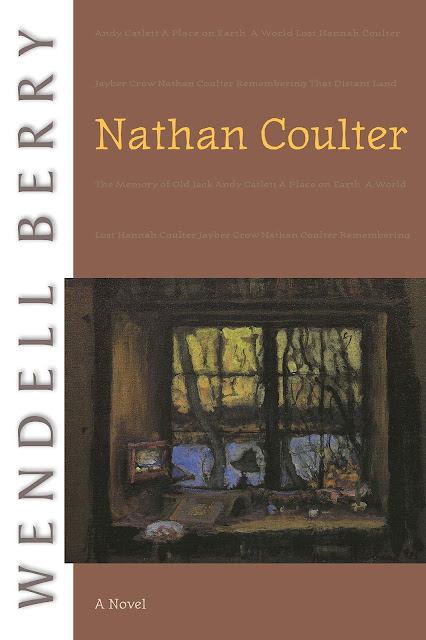
"Nathan Coulter" by Wendell Berry


Reading Nathan Coulter by Wendell Berry (born 1934) reminded me of reading A River Runs Through It by Norman Maclean (1902-1990). Two brothers, flyfishing, and a father are to Maclean what two brothers, farming, and a father are to Berry. I wondered which book might have influenced the other, until I saw the publication dates. Nathan Coulterwas published in 1960. A River Runs Through It was published in 1976. 

Nathan Coulter, Berry’s first novel, is a coming-of-age story of the title character. The story occurs in small-town and rural Kentucky from roughly 1929 to 1940. The Coulters are tobacco farmers, and Nathan’s family lives nearby his grandparents and Uncle Burley. The family is close-knit, until the death of Nathan’s mother sends the boys into the arms and the home of their grandparents. Their father is barely able to cope with his grief. 


Nathan and his older brother Thomas are inseparable, until Thomas discovers girls. And then they become more like boys living in the same house. As the brother being “left behind,” Nathan feels the loss most keenly. But it is a tobacco harvest that amplifies the loss and makes it irrevocable, a harvest that becomes a competition between Nathan’s father and his sons and then something far more between his father and his older brother. And in a brief moment, Nathan will see everything change irrevocably. 


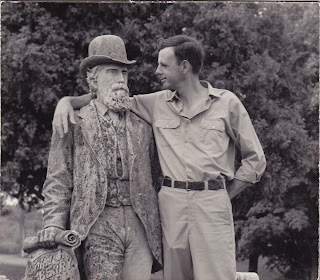
Wendell Berry about the time he wrote "Nathan Coulter"

Nathan Coulter
 is a story of family, of family farming, and especially of place. The family is rooted in place (a common theme in Berry’s stories, novels, and poems). The disruption of place will bring the disruption of family.
 

Berry is a poet, novelist, essayist, environmentalist, and social critic. His fiction, both novels and stories, are centered in the area he calls Port William, Kentucky, on the Ohio River. He’s won a rather astounding number of awards, prizes, fellowships, and recognitions. He lives on a farm in Kentucky.


With Nathan Coulter, Berry has written a beautiful novel. It tells it story, but it also tells a broader story. If you’ve grown up in the South or even the Midwest, the Coulter family is not recognizable; it’s like the family you grew up in.


Related:


My review of Berry’s That Distant Land.


Wendell Berry and the Land.


My review of Berry’s Jayber Crow.


Wendell Berry and This Day: Poems at Tweetspeak Poetry.


Wendell Berry and Terrapin: Poems at Tweetspeak Poetry.


Wendell Berry’s Our Only World.


The Art of the Commonplace by Wendell Berry.

Sunday, February 13, 2022

Just show us


After John 14:1-14
 

Just show us,

he says, just

show us and

it is sufficient,

it is enough,

sufficient

to answer

all questions,

enough to quell

all doubts, just

show us, that’s 

all you need 

to do.


I’ve already

shown you.

I am sufficient,

I am enough,

I taught you

this from the

beginning. No

surprises here;

you’ve already

seen, already

been shown.


Photograph by Marcus Paulo Prado via Unsplash. Used with permission.

Saturday, February 12, 2022

Saturday Good Reads - Feb. 12, 2022


Years ago, while on vacation in London, we met a friend at an Italian restaurant on Denmark Street, just off Charing Cross Road and about midway between Soho and Covent Garden. We had a great lunch, and then discovered there was a Roman ruin, part of a wall, visible in the basement where the bathrooms were. When a city has existed for more than 2,000 years, there’s no telling what you’ll find in the basement. Like when you go to the hairdresser. 

My grandmother died at age 94. She taught Sunday School and sang choir solos through age 90. Many a time I remember her scribbling her lesson notes in a little black leather notebook. And she loved to read mysteries, with Agatha Christie and especially Erle Stanley Gardner’s Perry Mason courtroom drams as her favorites (she also loved the Perry Mason television series with Raymond Burr). Both Christie and Gardner remain popular mystery and crime writers, long after their deaths. Rick Bleiweiss at CrimeReads lists them and 10 others as favorites.


It's easy to criticize companies like Coca-Cola because, well, they make it easy. Like when a company condemn a Georgia state election law that’s more liberal than New York’s and Delaware’s but becomes mute about a country where it does business (and sponsor sports games) that’s been undertaking systematic genocide. We can’t do much about Coca-Cola other than stop drinking their soft drinks. But we can pray. Randy Alcorn at Eternal Perspective Ministries explains how we can pray for the persecuted in China – in the context of the Olympic games.


More Good Reads


American Stuff


The Betrayal: How a small group saved some Afghan lives and American honor – George Packer at The Atlantic.


Life and Culture


Living Outside Our Bubbles – Micah Meadowcroft at The American Conservative.


Out of the Metaverse – Glenn Arbery at The Imaginative Conservative.


A crisis of truths – Charlotte Gauthier at The Critic Magazine.


Facebook Has a Superuser-Supremacy Problem – Matthew Hindman, Nathaniel Lubin, and Trevor Davis at The Atlantic. 


Faith


10 Things You Should Know about the Reliability of the New Testament Writers – Norman Geisler and Frank Turek at Crossway.


Marshall McLuhan’s Spiritual Vision for a Virtual Age – Nick Ripatrazone at Church Life Journal.


On Christians Reading Fiction: Stealing Past Watchful Dragons – Kelly Keller at Story Warren.


Poetry


‘Eenee, Meenee, Mainee, Mo’ by Rudyard Kipling Has Many Verses You May Not Know –  Beverly Stock at Society of Classical Poets.


Cancer Prayer – A.M. Juster at Kingdom Poets (D.S. Martin).


Leeds to Bournemouth – Sally Michaelson at The High Window (H/T: Paul Brookes). 


Writing and Literature


Crossing the Blood Meridian: Cormac McCarthy and American History – Bennett Parten at Los Angeles Review of Books.


On the terrifying hoax execution that haunted Dostoevsky’s writing – Walker Caplan at Literary Hub.


Let It Be (Beatles) – Gentri


Painting: Men Reading the Newspaper, watercolor (1890) by Arthur Burdett Frost (1851-1928).

Friday, February 11, 2022

The way to where


After John 14:1-14
 

You know the way

I’m going, and

yet you ask how,

and where. Yet

you know.

The house you

journey toward

is reached

by the way,

the path; it is

reached by the

truth, the word,

the map; it is

reached by the life,

the light that

illumines the way,

shines as the truth,

infusing life 

to those

who follow.


Photograph by Stephen Leonardi via Unsplash. Used with permission.

Thursday, February 10, 2022

"The Final Shot" by Simon Michael


Attorney Charles Holborne briefly has a case that even he knows is hopeless. A rather notorious criminal found religion in prison and became a Church of England minister upon release. He’s been working diligently in his chosen mission field in London, and he’d been trying to get a boy’s club set up to help steer teenagers in the right direction. But a man was killed, the minister charged on both evidence and a supposed confession and convicted. Charles looks at the case and agrees there’s no room for an appeal. 

But he buys a car from the minister’s son, who operates a dealership, and that sets in motion a train of events that will lead to violence, murder, and the doors to the Kray Twins, legendary crime czars in London in the 1950s and 1960s (the Krays happen to be historical figures). And in 1966, all of this is happening while England is heading to the final game of the World Cup.


His personal life is vastly improving. His former girlfriend sally is now his full-fledged girlfriend again; the two are living together and remodeling an old home not far from Charles’s chambers in the Temple. But his mother is increasingly in the grip of dementia, and his father is having trouble trying to care for her, even though he refuses to hear any talk of a care home. 


Simon Michael

What the reader of The Final Shot, the seventh Charles Holborne mystery by Simon Michael, knows is what Charles does not but only suspects: the murder victim for which the minister was sent to prison is very much alive. And the Kray Twins are behind it all, which may make it very problematic for Charles, who has his own problems, and entanglements, with the Krays.


Michael studied law at Kings College, London University and was called to the Bar in 1978. He worked primarily in the field of criminal law until the late 1990s, when he focused his practice on clinical negligence. He began writing in the 1980s and resumed it when he retired from legal practice.


The Final Shot is another solid entry in the Charles Holborne series, full of detail about the period when the Beatles were changing popular culture, Allen Ginsburg was reading his poetry, and LSD was a new entrant on the drug scene. 


Related:


My review of The Brief by Simon Michael.


My review of An Honest Man by Simon Michael. 


My review of The Lighterman by Simon Michael.


My review of Corrupted by Simon Michael.


My review of The Waxwork Corpse by Simon Michael.


My review of Force of Evil by Simon Michel.

Wednesday, February 9, 2022

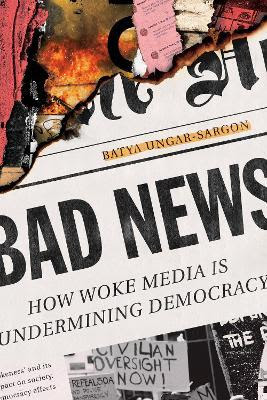
"Bad News" by Batya Ungar-Sargon


Batya Ungar-Sargon is the deputy opinion editor at Newsweek and co-hosts Newsweek’s podcast “The Debate.” Before joining Newsweek, she was the opinion editor of Forward, the largest Jewish media outlet in the United States. She’s written for The New York Times and Washington Post. She’s appeared on MSNBC, NPR, and NBC. She has a Ph.D. from the University of California, Berkeley. 

She is not the person you would expect to have written a book like Bad News: How Woke Media is Undermining Democracy. But she did. 


Bad News is not a book written from a conservative, right-wing, or alt-right perspective. It’s not a hastily compiled mishmash of everything that’s wrong with the news media. Instead, Ungar-Sargon has published a carefully researched, well-documented, and well-written story of where American news media has gone seriously wrong and how that is harming the United States.


To continue reading, please see my post today at Dancing Priest.

Tuesday, February 8, 2022

Poets and Poems: Kenneth Steven and "Iona"


Poet Kenneth Steven grew up in what he calls “the only truly land-locked part of Scotland,” otherwise known as the highlands of Perthshire. He recalls hills, lochs, forests, and rivers – but no sea. His favorite childhood memories involved summer holidays to the sea, and specifically the sea of the Atlantic Coast. Many of those holidays involved the island of Iona in the Hebrides. 

Iona wasn’t, and isn’t, only a beautiful island surrounded by the sea, filled with adventures for a young child. It was also the island where St. Columba (521-597) came when Irish monks were undertaking their famous missions. It was also the place where the Book of Kells was (most likely) created. And it is poems about the island that comprise the heart of Steven’s latest poetry collection, appropriately enough entitled Iona.

To continue reading, please see my post today at Tweetspeak Poetry.