Tuesday, December 7, 2021

Poets and Poems: Tina Barry and "Beautiful Raft"


In 2014, poet Tina Barry and her husband moved from Brooklyn to High Falls, New York. She began to research the area and learned that in 1946 and 1947, the artist Marc Chagall had lived there with his partner, Virginia Haggard, and Haggard’s young daughter Jean McNeil. Barry knew who Chagall was, but who was Haggard?  

The answer to that question ultimately led to Barry’s Beautiful Raft, a collection of 58 prose poems constructed as a work of fiction, including a cast of eight characters. When they moved to High Falls, Chagall was 59 and Haggard was 28. They both left spouses, and Haggard brought her daughter with her. Soon she was pregnant with Chagall’s baby, who was named David McNeil (Haggard was still married to her husband John McNeil when the baby was born).


To continue reading, please see my post today at Tweetspeak Poetry.

Monday, December 6, 2021

Books I’m Not Recommending for Christmas


My list of “Books I’m Not Recommending for Christmas” continues for 2021. In early December, I take stock of what I’ve read over the year. This isn’t a “best books of the year” activity as much as looking back and reflecting upon the novels, short stories, poetry, and non-fiction I’ve read that have made a particular impact. The “not recommending” description comes from my idiosyncratic view that no one should select books for another person, unless that person has requested it. 

Mt selections were tough in three categories, because they were what I read the most – fiction, poetry, and mysteries. I’ve divided fiction into two groups this year – those written in English and those translated into English. (Note: not all of these books were published in 2021, and all links are to my reviews.)


Children’s Stories


I read children’s stress because I’m always on the lookout for stories for the three grandsons. Two that I read were especially well done. Sara Barkat’s The Midnight Ball is a story about an invitation, telling time, and the oddest collection of partygoers you can imagine. Seth Lewis’s The Notorious Adventures of Nutt the Nefarious has just the right balance of fun (for kids) and satire (for adults). 


Mystery


I’ve been reading mystery stories since I was 9. I’ve probably read more mysteries than any other genre. And I take (some) solace in the fact that T.S. Eliot loved mysteries, too. 


This year, I discovered the William Benson legal thrillers by John Fairfax, aka Willian Brodrick. I had already been a fan of Brodrick’s Father Anselm mysteries, and then found this later series (and they’re not easy to find in print; I find used copies via Amazon and Alibris). Summary Justice is the first of the three published so far. I also enjoyed the Ryder and Loveday mysteries of Faith Martin, set in Oxford and of which A Fatal Obsession is the first (of seven so far). Damien Boyd published a new Nick Dixon mystery, Down Among the Dead, and I thoroughly enjoyed the first of Tim Sullivan’s mysteries, The Cyclist


These mysteries all have one major thing in common. They’re written by British authors.


Faith


Hands down, the book in this category I enjoyed the most this year was Seeing Jesus by Robert Hudson. Hudson takes a historical look at great visions of Jesus claimed throughout the centuries and the impact the people had on the culture, society, and their eras. 


Literary Criticism


My taste in literary criticism leans to (surprise) C.S. Lewis and J.R.R. Tolkien, and this year produced a bumper crop of fine works. On C.S. Lewis, there was C.S. Lewis: Pre-Evangelism for a Post-Christian World by Brian Williams and After Humanity,  Michael Ward’s guide to The Abolition of Man. Holley Ordway published Tolkien’s Modern Reading, tracing his influences to more than what the conventional wisdom holds. 


On the non-Lewis / non-Tolkien side, I really liked Jason Stacy’s Spoon River America and John Mullan’s The Artful Dickens. I also enjoyed the second volume of Aleksandr Solzhenitsyn’s literary memoir, Between Two Millstones


Non-fiction


My non-fiction reading tends to lean to the iconoclastic and anti-prevailing cultural. Jeffrey Bilbro takes a historical and theological journey into news media with Reading the Times. Rod Dreher looks at the lessons of the Soviet era and applies them to America in Live Not by Lies. In An Effort to Understand, David Murray seeks to find a way across the political divide. The Revolt of the Public by Martin Gurri focuses on the role of information today, and how it has seriously undercut the trust in and credibility of our traditional elites.


Poetry


Because of my work for Tweetspeak Poetry, and also because I enjoy it, I read a lot of poetry. And some really fine poetry was published this year. Just a few of the highlights: The Strangeness of the Good by James Matthew Wilson; My Father’s Face by Chandra Gurung; Love in the Time of Coronavirus by Angela Alaimo O’Donnell; Four Texas Quartets by Mark Johnson Cole (a nod to T.S. Eliot); Learning to Pray by Yahia Lababidi; The Courage It Takes by Kelly Chripczuk; and The Green Man by David Russell Mosley.


Fiction: In Translation


The Aviator by Eugene Vodolazhin was first published in English in 2018. It’s a fascinating tale of a man who awakens in a hospital bed who gradually learns he’s the sole survivor of freezing experiments conducted during the Soviet regime of Stalin. He’s as “old as the century,” and his story becomes Russia’s sory in the 20th century. This may get my nod as my favorite book in my 2021 reading.


Gerta by Katerina Tuckova is the story of a girl of German ethnicity living in Brno, Czechoslovakia, before, during and after World War II. It’s a story that often doesn’t get told: what happened to ethnic Germans living in the “wrong countries” after the war. At the End of the Matinee by Keeichiro Hirano, author of A Man (which I loved), tells the story of a classical guitarist and the reporter who falls in love with him. It’s a story of identity, honor, love, and duty. 


Fiction


This was the year Anthony Doerr published a novel after the wildly successful All the Light We Cannot See (2015). This one is entitled Cloud Cuckoo Land, and it is a very different book (and one his wife stopped him from throwing away at one point). It stretches across centuries – the time of the fall of Constantinople, contemporary Idaho, and sometime in the distant future. The book hasn’t had the sensational reception of his previous work, but it a rewarding story, with all the narrative threads brought together at the end.


Other novels I enjoyed include Iron Island by Gareth Griffin, a continuation of his early British history novels; Mildred’s Garden by Laura Boggess; The Sea by John Banville; The Frequency of Us by Keith Stuart; The Weight of Memory by Shawn Smucker; and Mr. Nicholas by Christopher de Vinck. Short story collections I liked include In the Wine Press by Joshua Hren; Scattered Lights by Steve Wiegenstein; and The Pieta in Ordinary Time by William Cook.


Top photograph by Gaelle Marcel via Unsplash. Used with permission.

Sunday, December 5, 2021

The stirring of different waters


After John 5:1-17
 

He sees the multitudes

edging the pool 

in their distress

and their hope,

and he asks one,

one chosen from

among them, if

he wants to be 

healed. The man

does, desperately, 

but cannot drag 

himself fast enough

to the stirred pool

before someone else

steps first. But still,

hope. And this day,

miraculous, different

waters stir, waters

moved by the words

‘get up and walk.’

And he who cannot

drag himself fast

enough is bathed

in the waters

of the words,

and he stands,

takes his bed,

and walks.


Photograph by Rostyslav Savchyn via Unsplash. Used with permission.

Saturday, December 4, 2021

Saturday Good Reads - Dec. 4, 2021


“America’s major institutions have gone woke the same way that someone goes bankrupt: slowly, then all at once.” Gabriel Rossman, a professor at UCLA (he must have tenure), offers a lesson at CityJournal on the sociology of organizations. 

T.S. Eliot is best known for his poetry, but he was also a prolific editor, critic, essayist, and letter writer. In his review of The Collected Prose of T.S. Eliot (eight – count them – eight volumes!) at the Wall Street Journal, Joseph Epstein says that Eliot was not only a poet, but that he defined what poetry of the era should be


When I was a young teen, spy movies and novels, led by Ian Fleming’s James Bond series, were all the rage, especially among boys. Underneath all the glitz and glamor, we probably knew that the spy business was nothing like it was being portrayed. Still, we ate up The AvengersMission ImpossibleI Spy, and The Man from UNCLE, not to mention ThunderballGoldfinger, and From Russia with Love on the big screen. In 1965, developed by Mel Brooks and Buck Henry, there emerged a parody of all this spy stuff on television that I wouldn’t miss for anything – Get SmartOlivia Rutigliano at CrimeReads has the story on Agent 86, the spy with a mobile phone in his shoe.


More Good Reads


Life and Culture


Secular Revolution & Religious Revival: A History Lesson – Joseph Pearce at The Imaginative Conservative. 


The talent and labor of Stephen Sondheim – Jay Nordlinger at New Criterion.


British Stuff


Queen Elizabeth II offers clear, personal sermon -- even while absent from public stage – Terry Mattingly at Get Religion.


The Thames of Old London and Sights of Wonderful London – Spitalfields Life.


Writing and Literature


Aleksandr Solzhenitsyn’s masterpiece is finally appearing: 'March 1917: The Red Wheel, Node III, Book 3' – Robert Kaplan at Spectator World.


Et tu, Harvard Business Review? – David Murray at Pro Rhetoric. 


What Accounts for the Lasting Appeal of Dune? – Michael Dirda at Literary Hub.


Poetry


These last days – Kathleen Everett at The Course of Our Seasons.


The Forgotten Poetry of John Martin Finlay – Micah Mattix at The Spectator.


Ruby’s House – Martin Rizley at Society of Classical Poets.


The Monastic and Intellectual Ethos of Gerard Manley Hopkins – Greg Peters at The Scriptorium.


Faith


Giving Thanks for Prosperity and Adversity – J.K. Wall at Gentle Reformation.


The Chosen and the Tradition of Apostolic Fan Fiction – Patrick Gray at Church Life Journal.


American Stuff


Death of a 'curly-headed, blue-eyed boy' at Hollow Tree Gap – John Banks Civil War Blog.


The Confederates may have lost the Civil War due to one inept officer – We Are the Mighty.


News Media


Notre Dame Cathedral's 'woke' rebuild plan: Why the glaring lack of mainstream news coverage? – Clemente Lisi at Get Religion.


Andrea Bocelli – Amo Soltanto Te ft. Ed Sheeran 


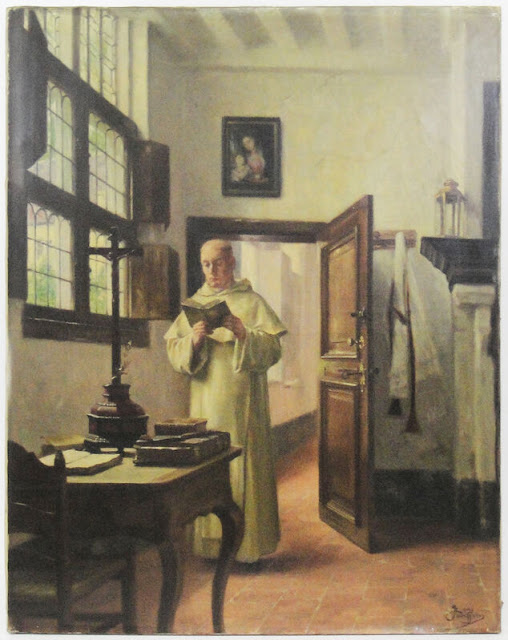
Painting: Man Reading, oil on canvas by 
Rene Janssens (1870-1936)

Friday, December 3, 2021

The stirring of the waters


After John 5:1-17
 

They wait in their dozens

and scores, clustered

among the colonnades,

blind, lame, paralyzed,

invalids for whom life

is confined, narrow,

dependent. They wait,

daily, for the stirring

of the waters: first in

is first (and only)

healed. It is the first

and only the first and

the reality must be

sufficient to keep

the multitudes coming

back to wait. The reality,

or the hope.


Photograph by USGS via Unsplash. Used with permission.

Thursday, December 2, 2021

"Error of Judgment" by Roy Lewis


The body of a young woman is found in the elevator of a polytechnical institute. Inspector John Crow is called in to investigate. The victim was the secretary for the institute’s principal. But no one can offer a motive. 

Ac Crow ad his team investigate, they learn that not everyone who might be a suspect has a solid alibi. And the investigation is complicated by ongoing student demonstrations against the administration (it’s the 1960s; student demonstrations were part of the university experience). In fact, Crow and his colleagues find their hands full of protesting students while they try to find the killer. 


Side stories begin to play into the investigation. A sociology instructor starts an affair with a student protester. A manager from the Ministry of Education begins to look into the murder himself. One suspect has suffered a heart attack. The stories and events are swirling, but Crow is finding almost every promising avenue a dead end. 


Roy Lewis

Error of Judgment
 by British author Roy Lewis is the second in the Inspector Crow mystery series. The policeman plays an expectedly large role in this story, unlike the first, A Lover Too Many, in which he seemed almost a minor character. Lewis is developing his chief protagonist, and we’re learning more about his background and his relationships with his team, and what it is that makes him successful (dogged determination).


Lewis is the author of some 60 other mysteries, novels, and short story collections. His Inspector Crow series includes A Lover Too ManyMurder in the MineThe Woods MurderError of Judgment, and Murder for Money, among others. The Eric Ward series, of which The Sedleigh Hall Murder is the first (and originally published as A Certain Blindness in 1981), includes 17 novels. The Arnold Landon series is comprised of 22 novels. Lewis lives in northern England.  


Error of Judgment is a tale of human frailty, misplaced passions, and being in the wrong place at the wrong time, all the while telling a story of student unrest in the 1960s.


Related:


A Lover Too Many by Roy Lewis.


A Cotswolds Murder by Roy Lewis
.


The Sedleigh Hall Murder by Roy Lewis.


The Farming Murder by Roy Lewis.


The Quayside Murder by Roy Lewis.


The Diamond Murder by Roy Lewis.


The Geordie Murder by Roy Lewis.


The Shipping Murder by Roy Lewis.


The City of London Murder by Roy Lewis.


The Apartment Murder by Roy Lewis.


The Spanish Villa Murder by Roy Lewis.


The Marriage Murder by Roy Lewis


The Wasteful Murder by Roy Lewis.


The Phantom Murder by Roy Lewis.


The Slaughterhouse Murder by Roy Lewis.


The Tattoo Murder by Roy Lewis.


The Football Murder by Roy Lewis.


The Tutankhamen Murder by Roy Lewis.


The Zodiac Murder by Roy Lewis.

Wednesday, December 1, 2021

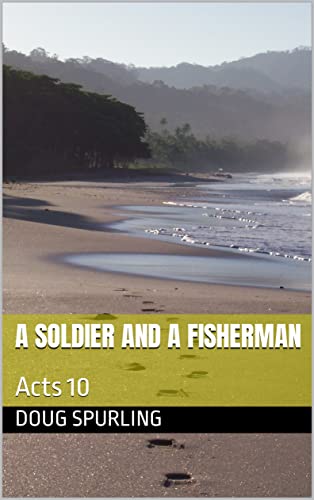
"A Soldier and a Fisherman" by Doug Spurling


In A Soldier and a Fisherman, Doug Spurling takes us into Acts 10, the story of Cornelius the Roman centurion and Peter the fisherman and disciple of Jesus. If there were an a more unlikely pair who would transform very early Christian understanding of the law and set Christianity on its revolutionary course in society, you might be hard put to find one. 

Cornelius was the Roman centurion charged with keeping the peace in Caesarea in Judea. He also happened to be the one commended by Jesus for his faith. And he had held fast to his faith. Cornelius hears a command – to send to Joppa for a man named Peter. Cornelius knows what to do with a command – and he sends three men.


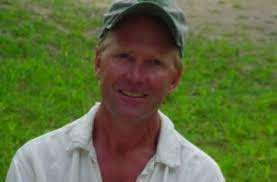
Doug Spurling

In Joppa, Peter is staying with Simon the tanner. He is praying on the roof when he has a vision – a sheet let down from heaven full of the things that were considered unclean under Jewish law. And he, too hears a voice, telling him to kill and eat. That came as a shock to Peter’s Jewish teaching, training, and thinking. But the voice wasn’t finished; Peter is told that three men are looking for him, and he is to go with them. And like Cornelius, Peter obeyed, fathering some friends to go with him. 


When they meet, a revolution starts – the understanding that Jesus didn’t die for only the Jews. He died for Gentiles as well.


Spurling retells this story in an expository fashion, citing the specific Bible verses as he expands upon the story. (He points out the significance of Simon the tanner to the narrative – a man practicing what the Jews considered an unclean trade.) We’re put into the minds of Cornelius and Peter. We initially see what they initially see. And we come to understand what they came to understand. The story comes alive in contemporary language.


Spurling is the author of the novel The Voice and lives with his family in Minnesota and Florida. A Soldier and a Fisherman is a short but impactful account of Cornelius and Peter is a gem of storytelling and insight.


Related:


Doug Spurling’s The Voice.